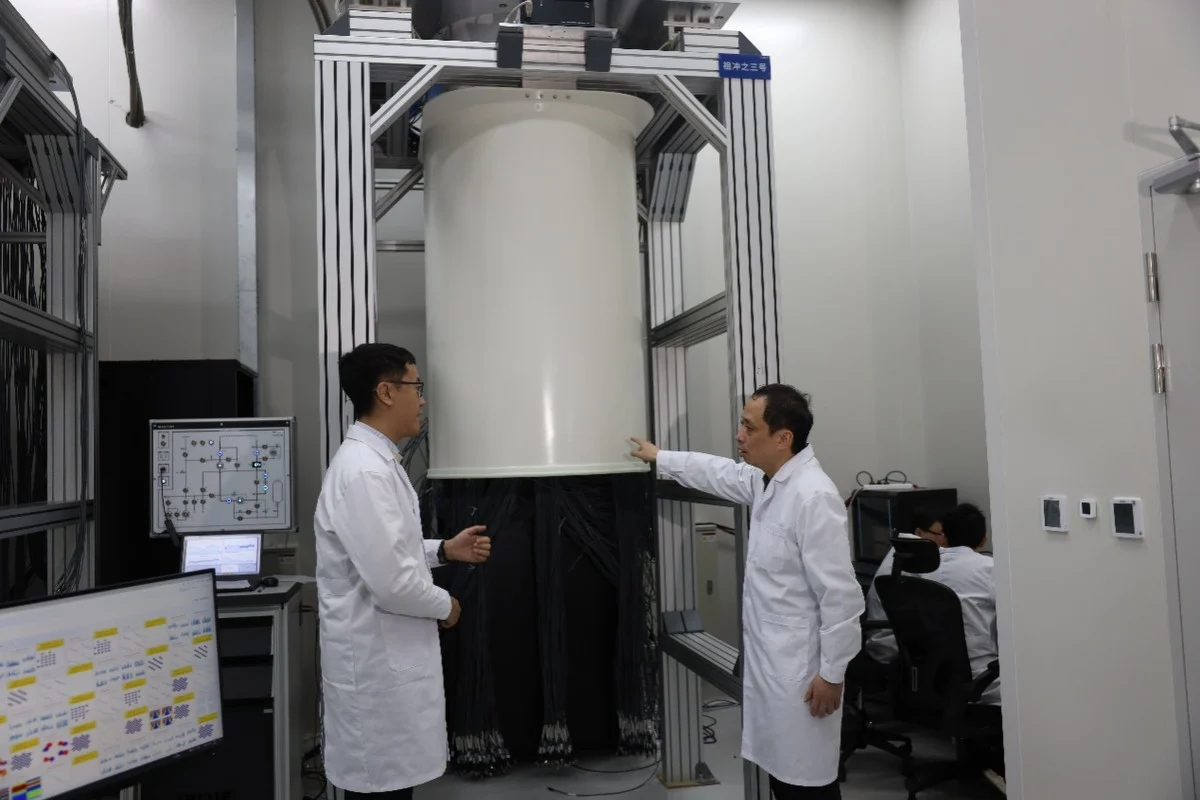
Chinese researchers led by Pan Jianwei demonstrated a breakthrough with their superconducting quantum computer, Zuchongzhi 3.2. The system achieved the fault-tolerant threshold, meaning error correction improved stability rather than causing further mistakes. This makes Zuchongzhi 3.2 the second in the world—after Google—to reach this critical milestone for scalable quantum computing.
Zuchongzhi 3.2 Reaches Fault-Tolerant Quantum Computing Threshold
Zuchongzhi 3.2 achieved a critical advance by demonstrating error correction that improves system stability. Unlike previous methods, the Chinese team utilized microwave-based control, presenting a potentially more efficient path toward scalable quantum computing compared to Google’s hardware-intensive approach. This breakthrough addresses the challenge of qubit instability and the quiet spread of errors within the system—a key obstacle in quantum computer development. This result marks China as the first team outside of the United States to reach the fault-tolerant threshold.
Successfully managing errors is essential because quantum computers rely on the principles of quantum physics, allowing them to potentially solve complex problems far beyond the reach of conventional computers. While still distant from practical applications, this experiment represents an “impressive feat” in tackling a fundamental quantum computing problem.
Microwave Control Surpasses Google’s Error-Suppression Methods
Researchers in China achieved a significant advancement in quantum computing by demonstrating superior error suppression compared to Google’s methods. Utilizing a superconducting quantum computer named Zuchongzhi 3.2, the team employed microwave-based control to stabilize the system, addressing the problem of qubit instability and error propagation. This approach potentially offers a more efficient pathway toward constructing large-scale, reliable quantum computers. The Chinese team’s success lies in reaching the fault-tolerant threshold, where error correction improves system stability. This milestone was accomplished without relying on the extensive hardware typically needed for error suppression, unlike Google’s approach. Though practical applications remain distant, this experiment signifies a key step in overcoming challenges inherent in quantum system design.
The transition to fault tolerance requires implementing Quantum Error Correction (QEC) codes, which encode logical qubits across multiple physical qubits. These codes allow the system to detect and correct errors—such as bit flips or phase flips—without measuring the encoded information directly, thereby maintaining the superposition principle. The process involves syndrome measurement, a complex series of ancillary qubit operations designed to isolate the location and type of error, which is fundamental to scaling the compute capacity beyond simple error detection.
At the heart of superconducting quantum computation are Transmon qubits, which operate by exploiting non-linear Josephson junctions in a superconducting loop. While these qubits offer high coupling strengths for fast gates, they are severely limited by decoherence. This decoherence manifests as the relaxation time ($T_1$) and the dephasing time ($T_2$), defining the operational lifespan of the quantum state. The architectural challenge is mitigating environmental noise and cross-talk, which cause correlated errors across adjacent qubits within the highly constrained cryogenic environment.
The efficiency derived from microwave-based control stems from the ability to address individual qubits or small groups of qubits with precise electromagnetic pulses. This high degree of spatial and temporal control minimizes spurious coupling and parasitic interactions, which are major sources of error in larger arrays. By fine-tuning these localized interactions, the system can selectively implement the complex logical operations required by QEC protocols with greater fidelity than bulk, system-wide control methods.