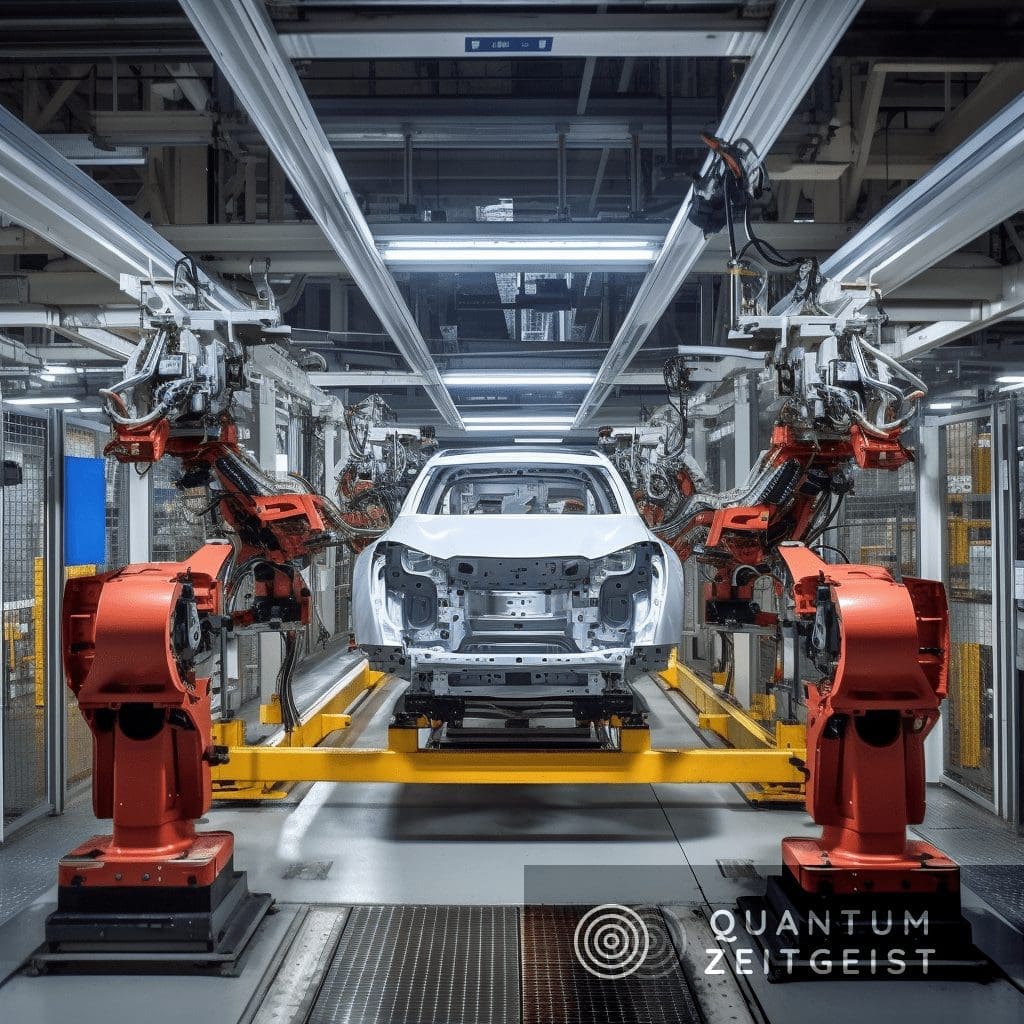
Zapata Computing and BMW have collaborated on a project to optimize vehicle production using quantum-inspired generative AI techniques. The joint paper, published as part of their membership in MIT’s Center for Quantum Engineering, details how Zapata’s Generator-Enhanced Optimization (GEO) technique can efficiently optimize BMW’s complex production schedule across multiple plants. In many cases, GEO outperformed state-of-the-art solvers in minimizing assembly line idle time while maintaining monthly vehicle production targets. The work was done on Zapata’s Orquestra software platform.
Zapata Computing and BMW Collaborate on Quantum-Inspired AI Techniques for Vehicle Production Optimization
Zapata Computing, a software company focused on solving complex computational problems, has partnered with BMW to develop new methods for optimizing vehicle production using quantum-inspired generative AI techniques. The collaboration is part of their membership in MIT’s Center for Quantum Engineering (CQE) Consortium, which aims to support the work of MIT students and researchers. The joint paper published by the two companies details the development and testing of simulations that demonstrate how Zapata’s Generator-Enhanced Optimization (GEO) technique can efficiently optimize BMW’s complex vehicle production schedule across multiple plants.
The GEO technique outperformed state-of-the-art solvers in minimizing assembly line idle time while maintaining monthly vehicle production targets. This work was carried out on Zapata’s Orquestra® software platform. The collaboration between Zapata, BMW, and CQE showcases the potential of quantum computing in addressing real-world challenges of commercial interest.
Quantum Computing Use Case for Complex Real-World Challenges
Dr William D. Oliver, Professor of Electrical Engineering and Computer Science and Physics at MIT and Director of The Center for Quantum Engineering highlighted that the problem presented by BMW is an excellent quantum computing use case. The Quantum Science and Engineering Consortium (QSEC) was created to connect the best and brightest from the academic landscape with industry partners to solve real-world problems. The collaboration between Zapata, BMW, and CQE demonstrates the potential of quantum computing in addressing complex, real-world challenges of commercial interest.
Optimizing Production Schedules with Quantum-Inspired Techniques
Marcin Ziolkowski, Emerging Technologies Manager at BMW Group, explained that optimizing production schedules is an incredibly complex and unique challenge. There are numerous possible configurations and constraints, such as varying production rates between shops, a discrete set of shift schedules, and the need to prevent overflows and shortages in the buffers between steps in the manufacturing process. The collaboration with Zapata and CQE allowed BMW to prove that the GEO technique outperforms other methods in production planning.
Yudong Cao, CTO and co-founder at Zapata Computing shared that they ran roughly a million optimization runs cycling through dozens of various algorithms, problem configurations, and optimizer solutions to benchmark their performance against each other. The GEO technique uses quantum or quantum-inspired generative machine learning models to learn from and improve upon the results generated by classical solvers. This approach aligns with MIT’s mission to advance knowledge and educate students in science, technology, and other areas of scholarship that will best serve the nation and the world in the 21st century.
“The problem that BMW presented to our team is an excellent quantum computing use case that addresses an incredibly complex, real-world challenge of commercial interest,”
Dr. William D. Oliver, Professor of Electrical Engineering and Computer Science and of Physics at MIT, and Director of The Center for Quantum Engineering.
Zapata Computing’s Technology
Zapata Computing, Inc. builds solutions to enterprises’ most computationally complex problems. The company has pioneered proprietary methods in generative AI, machine learning, and quantum techniques that run on classical hardware (CPUs, GPUs). Zapata’s Orquestra platform supports developing and deploying better, faster, more cost-effective models, such as Large Language Models, Monte Carlo simulations, and other computationally intense solutions. Founded in 2017, Zapata is headquartered in Boston, Massachusetts.
“We ran roughly a million optimization runs cycling through dozens of various algorithms, problem configurations and optimizer solutions to benchmark their performance against each other,” said Yudong Cao, CTO and co-founder at Zapata Computing.
“At BMW, we’re always looking for new, innovative ways to drive operational efficiency at our manufacturing plants,”
Marcin Ziolkowski, Emerging Technologies Manager at BMW Group.
Summary
Zapata Computing and BMW have collaborated on a project using quantum-inspired generative AI techniques to optimize vehicle production schedules across multiple plants. The Generator-Enhanced Optimization (GEO) technique outperformed other methods in minimizing assembly line idle time while maintaining monthly production targets.
- Zapata Computing and BMW have collaborated on a project as part of their membership in MIT’s Center for Quantum Engineering (CQE).
- The collaboration focused on optimizing vehicle production using quantum-inspired generative AI techniques.
- Zapata’s Generator-Enhanced Optimization (GEO) technique optimised BMW’s complex vehicle production schedule across multiple plants.
- In many cases, GEO outperformed state-of-the-art solvers in minimizing assembly line idle time while maintaining monthly vehicle production targets.
- The work was done on Zapata’s Orquestra® software platform.
- Dr. William D. Oliver, Professor at MIT and Director of The Center for Quantum Engineering highlighted the project’s real-world challenge and commercial interest.
- Marcin Ziolkowski, Emerging Technologies Manager at BMW Group, emphasized the complexity of optimizing production schedules and the success of GEO in outperforming other techniques.
- Yudong Cao, CTO and co-founder at Zapata Computing, mentioned that around a million optimization runs were conducted to benchmark various algorithms and optimizer solutions.
For more information, visit www.zapatacomputing.com.