

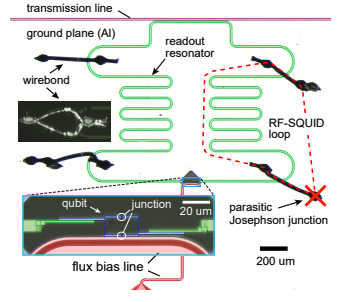
The pursuit of stable quantum computation necessitates minimising decoherence – the loss of quantum information – within superconducting qubit systems. Recent research highlights an unexpected source of this decoherence: parasitic radio-frequency Superconducting Quantum Interference Devices (RF-SQUIDs) formed unintentionally within the wiring connecting these delicate circuits. These unwanted SQUIDs, arising from Josephson junctions within wirebonds, couple to qubits and their associated readout resonators, introducing noise and instability. Berlitz et al. from the Physikalisches Institut, Lichttechnisches Institut and the Institute for Quantum Materials, all at the Karlsruhe Institute of Technology (KIT), detail this phenomenon in their paper, “Parasitic RF-SQUIDs in superconducting qubits due to wirebonds”, demonstrating a previously unrecognised pathway to decoherence in superconducting circuits.
Superconducting qubits represent a prominent architecture for realising practical quantum computers fabricated using integrated circuits. Maintaining qubit coherence – the ability to sustain quantum superposition – remains a significant challenge, largely due to energy dissipation from parasitic elements within the qubit and associated control circuitry. Recent research demonstrates that wirebond connections – essential for interfacing qubit chips – introduce parasitic Josephson junctions, contributing to decoherence and demanding a closer examination of interconnect design.
This study identifies these parasitic junctions as forming unintended Radio-Frequency Superconducting Quantum Interference Devices (RF-SQUIDs) within the circuit, impacting qubit fidelity and scalability. SQUIDs are extremely sensitive magnetometers exploiting quantum interference. These parasitic SQUIDs couple inductively to a nearby flux-tunable transmon qubit and exhibit strong AC-dispersive coupling to both the qubit and its readout resonator, revealing a complex interaction previously overlooked. Researchers observed periodic signatures in magnetic field sweeps, confirming this coupling mechanism and demonstrating a previously unrecognised source of decoherence.
The formation of these parasitic RF-SQUIDs arises from
The formation of these parasitic RF-SQUIDs arises from the wirebond connections enclosing superconducting loops, creating a pathway for unwanted noise and limiting coherence times. This configuration effectively creates a Josephson junction – a non-linear circuit element exhibiting quantum mechanical properties – altering the qubit’s behaviour and demanding a thorough understanding of its impact on quantum states. The observed AC-dispersive coupling, in addition to the expected DC-inductive coupling, indicates a more complex interaction than previously understood, prompting a reevaluation of existing models and control schemes.
Researchers meticulously characterised the parasitic RF-SQUIDs, determining their influence on qubit performance and identifying key parameters affecting their behaviour. They employed sensitive magnetic field measurements to detect the periodic signatures indicative of SQUID interference, confirming the presence of unwanted flux noise. Through careful analysis, they established a clear link between wirebond design and qubit performance, demonstrating that minimising the effective loop area reduces the detrimental effects of this noise source.
Researchers explored various wirebond configurations, systematically varying the loop area and observing the resulting changes in qubit coherence. They discovered a strong correlation between the loop area and the magnitude of the observed flux noise, confirming the detrimental effect of large loops. Optimised wirebond designs, featuring smaller loop areas, demonstrably reduced flux noise and improved qubit coherence times, validating the proposed mitigation strategy.
The study highlights the importance of carefully considering the design and implementation of wirebond connections in superconducting qubit circuits, demanding a shift in focus towards interconnect optimisation. By identifying this specific source of decoherence, the research provides a pathway towards improved qubit performance and increased system scalability. Future work will likely focus on mitigating the effects of these parasitic junctions through optimised wirebond designs, alternative connection methods, or circuit modifications.
Researchers are actively investigating alternative bonding techniques, such
Researchers are actively investigating alternative bonding techniques, such as flip-chip bonding and through-silicon vias, to address this issue.
The findings have significant implications for the development of practical quantum computers, paving the way for more robust and scalable quantum systems. Researchers are actively translating these findings into concrete design guidelines for qubit fabrication and interconnect optimisation.
Researchers are collaborating with industry partners to implement these findings in commercial quantum computing platforms, ensuring that the benefits of this research are widely available. This collaboration will accelerate the development of practical quantum computing applications.
Researchers are committed to sharing their findings with the broader scientific community, fostering collaboration and accelerating the progress towards fault-tolerant quantum computation. They are actively publishing their results in peer-reviewed journals and presenting their work at international conferences.
🗞 Parasitic RF-SQUIDs in superconducting qubits due to wirebonds
🧠 DOI: https://doi.org/10.48550/arXiv.2505.20458


