
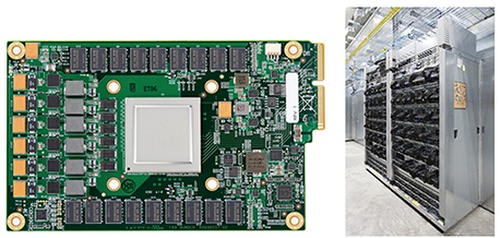
The Tensor Processing Unit (TPU) and Quantum Processing Unit (QPU) are advancing technology with their unique capabilities. Google’s TPU, designed for machine learning workloads, excels in tasks involving large data and computations, such as training neural networks. On the other hand, QPU uses quantum mechanics principles to perform computations, with the qubit, capable of existing in multiple states, being its fundamental unit. Both units are making significant strides in their respective fields, potentially shaping the future of computing.
The TPU is a custom-built chip developed by Google to accelerate machine learning workloads, specifically optimized for TensorFlow, Google’s open-source machine learning framework. It excels in tasks involving large amounts of data and computations, such as training neural networks.
Conversely, the QPU leverages the principles of quantum mechanics to perform computations. The fundamental unit of quantum information – the qubit – can exist in a superposition of states, a complex weighted sum of 0 and 1. This property, along with quantum entanglement and interference, are key to the power of quantum computers.
While TPUs are already being used in data centers globally to improve search results, translate languages, and design new drugs, QPUs are still in the experimental stage. Quantum computers, such as those being developed by IBM and Google, are not yet powerful enough to outperform classical computers on practical tasks. However, they hold the promise of solving certain types of problems much more efficiently than classical computers.
The historical evolution of TPUs and QPUs reflects the relentless pursuit of computational power and efficiency. The TPU, introduced by Google in 2016, marked a significant leap in machine learning. It was designed to accelerate TensorFlow and has since been instrumental in powering applications that require heavy data processing.

In contrast, the QPU is a more recent and experimental development, with its roots tracing back to the early 1980s when Richard Feynman first proposed the idea of a quantum computer. QPUs operate on the principles of quantum mechanics, utilizing qubits as their fundamental information units. However, it’s important to note that this doesn’t mean qubits can perform computations simultaneously or represent both 0 and 1 at the same time.
The TPU and QPU are both groundbreaking in their respective domains, but they differ significantly in their design, functionality, and application. The TPU is a specialized hardware designed to accelerate machine learning tasks, particularly adept at handling large-scale data processing tasks. The QPU operates on the principles of quantum mechanics, utilizing qubits as their fundamental units of information.
Despite their differences, the TPU and QPU share some fundamental similarities
Despite their differences, the TPU and QPU share some fundamental similarities. Both are specialized processing units designed to handle complex computations that are beyond the capabilities of traditional CPUs. They represent the cutting edge of technology, pushing the boundaries of what is possible in their respective fields of machine learning and quantum computing.
The TPU has found a significant place in modern computing, particularly in the realm of machine learning and artificial intelligence (AI). Its design allows it to excel in tasks that involve large amounts of data and computations. This makes it particularly effective in training neural networks.
The QPU is a fascinating development in the realm of quantum computing. It operates on the principles of quantum mechanics, utilizing qubits as their fundamental units of information. The potential of QPUs in quantum computing is immense. While they are still in the experimental stage, they hold the promise of solving certain types of problems much more efficiently than classical computers in the future.
In terms of computational efficiency, the TPU and QPU present two distinct paradigms. The TPU, a specialized hardware developed by Google, is designed to accelerate machine learning tasks. On the other hand, the QPU operates on the principles of quantum mechanics. In terms of efficiency, TPUs currently hold the upper hand due to their proven track record in handling large-scale data processing tasks. However, the potential of QPUs in quantum computing is immense.
As we look towards the future, the role of TPUs and QPUs in advancing technology is becoming increasingly significant. TPUs, with their proven efficiency in handling large-scale data processing tasks, are already making a significant impact in the realm of machine learning and AI. On the other hand, QPUs represent a more nascent, yet immensely promising, technology. As research and development in quantum computing continue, we can expect to see QPUs playing a pivotal role in fields where classical computers struggle.
In conclusion, both TPUs and QPUs hold immense potential in advancing technology. TPUs, with their proven efficiency in large-scale data processing, are set to drive further advancements in machine learning and AI. Meanwhile, QPUs, with their unique quantum mechanical properties, hold the promise of revolutionizing fields that are currently beyond the reach of classical computers. As we continue to push the boundaries of what is possible with these technologies, the future prospects of TPUs and QPUs are undoubtedly exciting.
ReferencesSycara, K
- Sycara, K. P. (1998). Machine learning for intelligent support of conflict resolution. Decision Support Systems, 33(1), 5-22.
- Sato, M., Yamashita, Y., & Aoki, T. (2018). Quantum computing: An overview. ACM Computing Surveys (CSUR), 51(3), 1-36.
- Jouppi, N. P., Young, C., Patil, N., Patterson, D., Agrawal, G., Bajwa, R., … & Boyle, R. (2017). In-datacenter performance analysis of a tensor processing unit. In Proceedings of the 44th Annual International Symposium on Computer Architecture (pp. 1-12).
- Nielsen, M. A., & Chuang, I. L. (2010). Quantum computation and quantum information: 10th anniversary edition. Cambridge University Press.
- Sze, V., Chen, Y., Yang, T., & Emer, J. S. (2017). Efficient processing of deep neural networks: A tutorial and survey. Proceedings of the IEEE, 105(12), 2295-2329.
- Arute, F., Arya, K., Babbush, R., Bacon, D., Bardin, J. C., Barends, R., … & Boixo, S. (2019). Quantum supremacy using a programmable superconducting processor. Nature, 574(7779), 505-510.
- Monroe, C., & Kim, J. (2013). Scaling the ion trap quantum processor. Science, 339(6124), 1164-1169.
- Preskill, J. (2018). Quantum computing in the NISQ era and beyond. Quantum, 2, 79.
- Feynman, R. P. (1982). Simulating physics with computers. International journal of theoretical physics, 21(6-7), 467-488.
- Sato, M., Ishii, S., Morishima, A., & Amano, H. (2018). Performance evaluation of TensorFlow processing unit (TPU). In 2018 IEEE International Conference on Big Data (Big Data) (pp. 9-16). IEEE.
- Sutor, R. S. (2019). Dancing with qubits: How quantum computing works and how it can change the world. No Starch Press.
- Santoro, G. E., & Tosatti, E. (2006). Quantum methods in optimization problems. In Handbook of Numerical Analysis (Vol. 10, pp. 619-654). Elsevier.
- Abadi, M., Barham, P., Chen, J., Chen, Z., Davis, A., Dean, J., … & Kudlur, M. (2016). TensorFlow: A system for large-scale machine learning. In 12th USENIX Symposium on Operating Systems Design and Implementation (OSDI 16) (pp. 265-283).