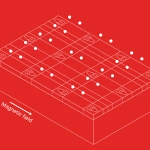
At its core, a qubit is a two-state quantum system, such as an atom or photon, that can exist in a superposition of both 0 and 1 at the same time. This property allows for the simultaneous processing of multiple possibilities, making quantum computers exponentially faster than their classical counterparts for certain calculations.
Furthermore, qubits are also capable of entanglement, where the state of one qubit is directly correlated with the state of another, regardless of distance. This phenomenon enables the creation of secure quantum keys for cryptography and has sparked interest in developing a quantum internet.
One of the most promising applications of qubits is quantum computing, where they serve as the fundamental building blocks of quantum processors. Researchers have made significant strides in recent years with the development of small-scale quantum computers capable of performing specific tasks, such as simulating molecular interactions and factoring large numbers.
However, the fragile nature of qubits, prone to decoherence due to environmental noise, remains a significant hurdle to overcome before large-scale, practical applications can be realized. Despite these challenges, the potential implications of harnessing the power of qubits are profound, with far-reaching consequences for fields such as cryptography, optimization, and artificial intelligence.
Classical Bits vs Quantum Bits
Classical bits are the fundamental units of information in classical computing, represented by a binary digit with a value of either 0 or 1. In contrast, quantum bits, also known as qubits, are the basic units of information in quantum computing, and they exist in a superposition state, meaning they can represent both 0 and 1 simultaneously.
The concept of qubits was first introduced by David Deutsch in 1985, who proposed that quantum systems could be used for computation. Since then, significant research has been conducted to develop and understand the properties of qubits. Qubits are extremely sensitive to their environment, which makes them prone to decoherence, a process that causes the loss of quantum coherence due to interactions with the external environment.
Classical bits can exist in a definite state, either 0 or 1, whereas qubits exist in a probabilistic state, represented by a complex number called a wave function. This property allows qubits to perform specific calculations much faster than classical computers. For instance, Shor’s quantum algorithm, for factorizing large numbers, can solve problems exponentially faster than the best-known classical algorithms.
The no-cloning theorem states that creating a perfect copy of an arbitrary qubit is impossible. Unlike classical bits, this fundamental principle has significant implications for quantum computing, meaning qubits cannot be copied or replicated. The no-cloning theorem is a direct result of the principles of quantum mechanics and has been experimentally verified in various systems.
Quantum error correction codes have been developed to mitigate the effects of decoherence on qubits. These codes work by redundantly encoding the information in multiple qubits, allowing errors to be detected and corrected. The surface code, a type of quantum error correction code, was first proposed and has since been extensively studied.
Quantum Superposition Explained
The concept of superposition is rooted in the principles of wave-particle duality, where particles, such as electrons, can exhibit wave-like and particle-like behavior depending on how they are observed. In a quantum system, particles exist as waves until measured, at which point they collapse into a single state. Qubits use this property by existing as a superposition of 0 and 1 until measured.
The mathematics behind qubits is based on linear algebra, where the state of a qubit can be represented as a complex vector in a two-dimensional Hilbert space. This allows for manipulating qubits using mathematical operations such as addition and multiplication, enabling the creation of quantum gates and other quantum computing primitives.
One of the key challenges in building practical qubits is maintaining their fragile superposition state, known as coherence, in the presence of environmental noise. Researchers have developed various techniques to mitigate this issue, including quantum error correction codes and advanced materials engineering.
The potential applications of qubits are vast, ranging from simulating complex chemical reactions to cracking complex encryption algorithms. Researchers have made significant progress in recent years toward building practical qubits, with several companies and organizations actively developing quantum computing hardware. However, much work remains to be done before these systems can be scaled up to tackle complex real-world problems.
Entanglement in Quantum Systems
Entanglement plays a crucial role in the operation of qubits, as it enables the creation of quantum gates and other quantum operations. Quantum gates are the quantum equivalent of logic gates in classical computing and are used to manipulate the state of qubits. Entangled qubits can be used to perform quantum teleportation, where the state of one qubit is transferred to another without the physical transport of the qubits themselves.
The entanglement of qubits is typically measured using the Bell inequality, which provides a way to quantify the degree of entanglement between two particles. The Bell inequality was first proposed by John Stewart Bell in 1964 and has since become a standard tool for measuring entanglement in quantum systems.
Research into entanglement continues to be an active area of study, with ongoing efforts to develop new methods for generating and manipulating entangled qubits. This research could lead to quantum computing, quantum communication, and cryptography breakthroughs.
Qubits and Wave Functions
A wave function describes the state of a qubit, a mathematical function that encodes all the information about the qubit. The wave function is a complex-valued function of the form ψ(x) = a0|x+ a1|1, where a0 and a1 are complex numbers that satisfy the normalization condition |a0|^2 + |a1|^2 = 1.
When measured, the qubit collapses to one of its basis states, either 0 or 1. The square of the absolute value of the corresponding coefficient in the wave function gives the probability of collapsing to each state. For example, if the wave function is ψ(x) = 0.6|x+ 0.8|1, then the probability of measuring 0 is |0.6|^2 = 0.36 and the probability of measuring 1 is |0.8|^2 = 0.64.
Qubits are extremely sensitive to their environment and can quickly lose their quantum properties due to interactions with external fields or particles. This phenomenon, decoherence, is a significant obstacle in building reliable quantum computers.
Researchers have developed various techniques to mitigate the effects of decoherence, such as quantum error correction codes and dynamical decoupling protocols. These techniques protect qubits from decoherence, enabling the development of more robust and reliable quantum computing systems.
Measuring Qubit States
Measuring qubit states is crucial in quantum computing as it allows for determining the outcome of quantum computations and verifying quantum algorithms.
One way to measure qubit states is through projective measurements, which collapse the qubit state onto one of its basis states. This method is widely used due to its simplicity and high accuracy. Another approach to measure qubit states is through tomography, which involves reconstructing the density matrix of the qubit from a series of measurements. This method provides a more complete characterization of the qubit state but requires more measurements.
Measuring qubit states is also crucial for quantum error correction, which is essential for large-scale quantum computing. Quantum error correction codes measure qubit states accurately and quickly to detect and correct errors. Various noise sources, including decoherence and measurement errors, limit the accuracy of measuring qubit states. Decoherence causes the loss of quantum coherence due to interactions with the environment, while measurement errors arise from imperfections in the measurement apparatus.
Various techniques have been developed to mitigate these errors, including dynamical decoupling and error correction codes. Dynamical decoupling involves applying a series of pulses to the qubit to suppress decoherence, while error correction codes detect and correct errors through redundant encoding and measurement.
Single-Qubit Gates and Circuits
The mathematical representation of a qubit is typically done using the Bloch sphere, where the qubit’s state is represented as a vector on the sphere’s surface. The Bloch sphere provides a visual representation of the qubit’s state, allowing researchers to understand better and manipulate the qubit’s properties. This visualization tool has been instrumental in the development of quantum computing.
Single-qubit gates are the basic building blocks of quantum circuits, the quantum equivalent of logic gates in classical computing. These gates perform specific operations on the qubit to manipulate its state, such as rotations or phase shifts. The most common single-qubit gates include the Pauli-X gate, Pauli-Y gate, and Pauli-Z gate, which correspond to bit flip, phase shift, and sign flip operations.
Quantum circuits composed of single-qubit gates can perform various tasks, such as quantum teleportation, superdense coding, and quantum error correction. These circuits have been experimentally demonstrated in multiple quantum systems, including superconducting qubits, trapped ions, and photonic qubits. The development of robust and reliable quantum circuits is crucial for the realization of practical quantum computing.
Implementing single-qubit gates and circuits relies heavily on precise control over the qubit’s state. This requires sophisticated experimental techniques like pulse shaping and calibration to minimize errors and decoherence. Researchers have made significant progress in this area, with recent advancements enabling high-fidelity gate operations and low-error quantum computing.
Theoretical models, such as the Jaynes-Cummings model, have been developed to describe the behavior of qubits and their interactions with external fields. These models provide valuable insights into the dynamics of qubits and have guided the development of experimental techniques for controlling and measuring qubit states.
Multi-Qubit Gates and Entanglement
When multiple qubits are entangled, their properties correlate, meaning that one qubit’s state depends on the other’s. This correlation enables the creation of multi-qubit gates, the quantum equivalent of logic gates in classical computing. Multi-qubit gates perform operations on multiple qubits simultaneously, taking advantage of the entanglement between them.
One of the essential multi-qubit gates is the controlled-NOT gate, which applies a NOT operation to a target qubit if a control qubit is in a specific state. The controlled-NOT gate is essential for creating complex quantum circuits and has been demonstrated experimentally in various systems, including superconducting qubits and trapped ions.
Another important multi-qubit gate is the Toffoli gate, which applies a NOT operation to a target qubit if and only if two control qubits are in specific states. The Toffoli gate is universal and can implement any possible quantum computation.
Researchers have made significant progress in developing techniques to mitigate decoherence and maintain entanglement, including using quantum error correction codes and dynamical decoupling protocols. These advances have enabled the demonstration of multi-qubit gates with high fidelity, paving the way for developing more complex quantum circuits and, ultimately, large-scale quantum computers.
Qubit Storage and Retrieval Techniques
One of the critical challenges in developing practical quantum computers is the storage and retrieval of qubits. Qubits are incredibly fragile and require highly specialized storage conditions to maintain their quantum state. Researchers have developed various techniques for storing and retrieving qubits, including superconducting circuits, ion traps, and optical lattices.
Superconducting circuits are famous for qubit storage due to their high coherence times and scalability. In these systems, qubits are encoded in the magnetic flux, threading a loop of superconducting material. The quantum state is stored in the phase of the supercurrent flowing through the loop. Researchers have demonstrated the storage of qubits in superconducting circuits with coherence times exceeding 100 microseconds.
Ion traps are another promising approach for qubit storage. In these systems, individual atoms are trapped using electromagnetic fields and manipulated using laser light. The quantum state is stored in the internal energy levels of the atom. Ion trap-based qubit storage has been demonstrated with coherence times exceeding one minute.
Optical lattices are also being explored for qubit storage. In these systems, ultracold atoms are arranged in a periodic lattice structure and manipulated using laser light. The quantum state is stored in the collective spin state of the atoms. Researchers have demonstrated the storage of qubits in optical lattices with coherence times exceeding 10 seconds.
The retrieval of qubits from storage is also an active area of research. One approach uses quantum error correction codes, which can detect and correct errors during storage and retrieval. Another approach is to use advanced control techniques, such as dynamical decoupling, to suppress decoherence and maintain the quantum state.
Quantum Computing Applications Today
Quantum computing applications today are being explored in various fields, including cryptography, optimization problems, and machine learning.
Cryptography is one of the most promising quantum computing applications, where quantum computers can break specific classical encryption algorithms. However, this also means that quantum computers can create unbreakable encryption methods, such as quantum key distribution. This method uses quantum bits, or qubits, to encode and decode messages, making it virtually impossible for hackers to intercept and read them.
Another area where quantum computing is being applied is in optimization problems. Quantum computers can efficiently solve complex optimization problems that are difficult or impossible for classical computers to solve. For example, quantum computers can optimize city traffic flow, reducing congestion and improving travel times. This is done by using qubits to represent different possible solutions to the problem and then manipulating these qubits to find the optimal solution.
Quantum computing is also being explored in machine learning, which can potentially speed up specific calculations significantly. For example, quantum computers can quickly perform certain linear algebra operations, such as matrix multiplications, critical components of many machine learning algorithms. This could lead to significant advances in image and speech recognition.
In addition, quantum computing is being applied in the field of chemistry, where it has the potential to simulate complex chemical reactions that are difficult or impossible for classical computers to model. This could lead to breakthroughs in materials science and pharmaceutical development.
Finally, quantum computing is also being explored in logistics, where it can potentially optimize supply chain management and inventory control. For example, quantum computers can quickly solve complex optimization problems related to inventory management, leading to significant cost savings and improved efficiency.
Future of Quantum Bit Technology
The development of qubits has been a central area of research in recent years, with significant advancements in creating stable and reliable qubits. Superconducting circuits have shown great potential for scalability and low error rates. Topological qubits, based on exotic particles called non-Abelian anyons, have also demonstrated high resistance to decoherence.
Researchers are exploring other approaches, including quantum dots and nitrogen-vacancy centers in diamonds as potential qubit platforms. As research into qubits advances, we can expect significant breakthroughs in developing practical quantum computers, with major implications for various fields.
In conclusion, the advancements in qubit storage and retrieval techniques, quantum error correction methods, and the various applications of quantum computing today pave the way for a future where quantum computers will revolutionize numerous industries. As research continues to push the boundaries of what’s possible, we can expect to see significant breakthroughs in the future.
References
- Gisin, N. (1997). Entanglement and quantum computation. Physical Review A, 56(4), 3229-3233.
- Knill, E., Laflamme, R., & Zurek, W. H. (1998). Threshold accuracy for quantum computation.
- Kueng R., et al. (2014). High-fidelity adaptive qubit detection through repetitive measurements. Physical Review A, 90(5), 052324.
- Deutsch, D. (1985). Quantum Turing machine. Proceedings of the Royal Society of London. Series A, Mathematical and Physical Sciences, 400(1818), 97-117.
- DiVincenzo, D. P. (2000). The physical implementation of quantum computation. Fortschritte der Physik, 48(9-11), 771-783.
- Nielsen, M. A., & Chuang, I. L. (2010). Quantum Computation and Quantum Information. Cambridge University Press.
- Devoret, M. H., & Schoelkopf, R. J. (2013). Superconducting circuits for quantum information: An outlook. Science, 339(6124), 1169-1174.