

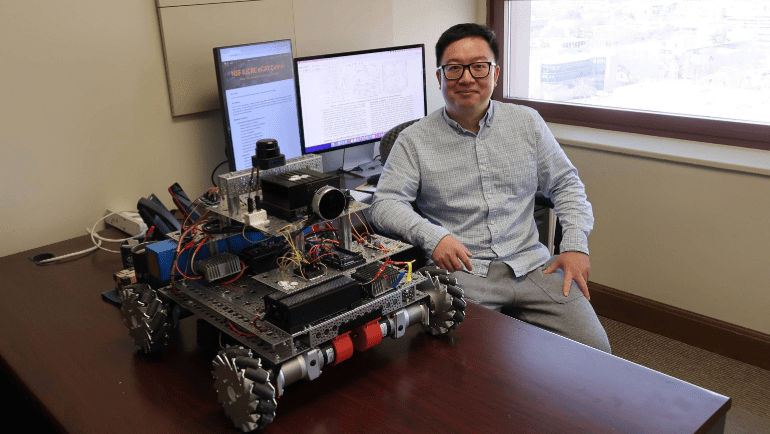
Wayne State University has received a $595,611 National Science Foundation (NSF) grant over five years to advance research in autonomous vehicle and machine systems. The project, led by Zheng Dong, Ph.D., an assistant professor of computer science at Wayne State’s School of Engineering, aims to enhance safety and reliability through hardware-software co-design that addresses timing challenges in deep neural network-driven systems.
Wayne State University has received a significant grant from the National Science Foundation (NSF) to advance research in autonomous vehicle safety. The five-year, $595,611 award supports Zheng Dong, Ph.D., assistant professor of computer science at Wayne State’s School of Engineering, whose project focuses on ensuring timing correctness in deep neural network (DNN)-driven autonomous vehicles. Titled “CAREER: ChronosDrive,” the initiative aims to develop an integrated architecture leveraging hardware-software co-design to enhance safety and reliability in autonomous systems.
The research addresses critical technical challenges in integrating advanced analytical methods, such as worst-case execution time analysis, with system-on-chip (SoC) design for real-time performance. By focusing on these areas, the project seeks to provide robust solutions for safe and effective autonomous operation while maintaining a focus on safety and reliability.
Through this work, students are trained in developing next-generation autonomous systems, ensuring a skilled workforce capable of addressing complex technical challenges. The initiative underscores the importance of integrating education with research to advance the field of autonomous technologies.
Wayne State University’s commitment to advancing research and innovation
The research at Wayne State University addresses critical technical challenges in ensuring timing correctness for deep neural network (DNN)-driven systems, particularly in autonomous vehicles. These systems must meet strict timing requirements to ensure operational safety and reliability, necessitating rigorous real-time safety certifications.
Zheng Dong’s project aims to develop an integrated architecture leveraging hardware-software co-design to address these complex issues. By combining advanced analytical methods with accelerator-enhanced SoC integration, the initiative seeks to provide robust solutions for safe and effective autonomous operation while maintaining a focus on safety and reliability.
Through this work, students are trained in developing next-generation autonomous systems, ensuring a skilled workforce capable of addressing complex technical challenges. The initiative underscores the importance of integrating education with research to advance the field of autonomous technologies while maintaining a focus on safety and reliability.
More information
External Link: Click Here For More


