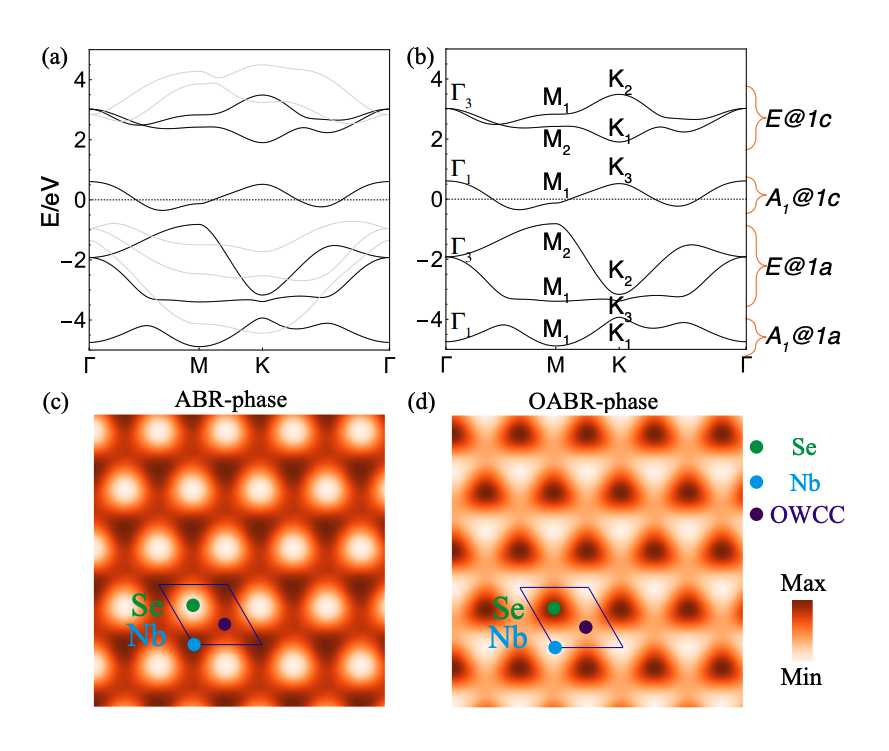
The electronic behaviour of transition metal dichalcogenides, materials exhibiting properties ranging from superconductivity to charge density waves, remains a complex area of condensed matter physics. Understanding the interplay between band topology and material properties is crucial for designing novel electronic devices. Jiabin Yu, Yi Jiang, and colleagues report on a detailed investigation into the electronic structure of monolayer 1H-NbSe₂ and related compounds, including 1H-MoS₂, NbS₂, TaS₂, TaSe₂ and WS₂. Their work, entitled ‘Quantum Geometry in the NbSe Family I: Obstructed Compact Wannier Function and New Perturbation Theory’, constructs simplified models of these materials using a technique called Wannierization, which projects the complex electronic bands onto a set of localised atomic orbitals, revealing obstructed atomic bands near the Fermi energy and enabling a new perturbation theory.
Recent research details the electronic structure and band topology of monolayer 1H-NbSe₂, alongside related compounds including 1H-MoS₂, NbS₂, TaS₂, and WS₂. The team constructed a series of models—a six-band, a three-band, and a single-band model—directly from ab initio calculations using a Wannierization procedure, aiming to simplify complex electronic behaviour and reveal underlying physical mechanisms. These materials consistently exhibit obstructed atomic isolated bands near the Fermi energy, a characteristic that significantly influences their electronic properties and potential applications in novel devices.
Wannierization transforms the calculated electronic band structures into a more localised basis set, facilitating a clearer understanding of electron behaviour within the material and simplifying subsequent calculations. This approach allows researchers to accurately capture the essential physics of the electronic structure, focusing on key features governing material properties. The resulting models reveal the presence of obstructed bands, characterised by a unique dispersion and localisation pattern, which critically determine electronic transport, optical properties, and the potential for hosting exotic quantum states.
The three-band model accurately approximates the obstructed atomic
The three-band model accurately approximates the obstructed atomic Wannier function using optimally compact Wannier functions, achieving over 90% accuracy, peaking at 94% for NbSe₂. This high level of accuracy validates the modelling approach and confirms the reliability of the results. Researchers carefully optimised the model’s parameters to accurately reproduce key features of the electronic structure, including energy levels, band widths, and orbital character.
Interestingly, the simplest single-band model exhibits a surprising characteristic: next-nearest-neighbour hopping is significantly larger than nearest-neighbour hopping—by nearly an order of magnitude for MoS₂, NbSe₂, TaS₂, and WS₂. This unexpected result challenges conventional understanding of electron transport in these materials and suggests that long-range interactions play a crucial role in determining their electronic properties. Researchers attribute this phenomenon to the unique electronic structure of the materials, featuring a complex interplay between different orbitals and bonding configurations.
The origin of this enhanced next-nearest-neighbour hopping lies in the cancellation of atomic onsite terms and nearest-neighbour hopping after projecting onto the obstructed atomic Wannier functions. This cancellation effectively suppresses the contribution of nearest-neighbour hopping, allowing the next-nearest-neighbour hopping to dominate electronic transport. Researchers analysed the orbital character of the Wannier functions to understand this cancellation, revealing that the obstructed bands are primarily localised on specific atomic orbitals weakly coupled to their nearest neighbours.
Specifically for NbSe₂, researchers developed a novel approximation scheme to derive an effective Hamiltonian capturing the three bands primarily originating from the niobium atom. This effective Hamiltonian provides a simplified description of the electronic structure, focusing on key features governing material properties. Researchers validated the accuracy of the effective Hamiltonian by comparing its predictions to more detailed calculations.
Furthermore, the team employed conventional perturbation theory to
Furthermore, the team employed conventional perturbation theory to obtain the ab initio obstructed Wannier function with 95% accuracy, confirming the reliability of their calculations and providing a benchmark for future studies.
These results lay the groundwork for future investigations into the influence of geometry on correlated phases within this family of materials, opening new avenues for research and potentially leading to the discovery of novel quantum phenomena. The understanding of obstructed bands and their influence on electronic properties is crucial for designing new materials with tailored functionalities.
The investigation provides a comprehensive understanding of the electronic structure and band topology of 2D materials, revealing the importance of obstructed bands and long-range interactions in determining their properties. The team’s findings have significant implications for the design of new electronic devices and the development of novel quantum materials. The detailed analysis of the electronic structure and band topology provides valuable insights into the fundamental physics of these materials and paves the way for the development of new and innovative technologies.
🗞 Quantum Geometry in the NbSe Family I: Obstructed Compact Wannier Function and New Perturbation Theory
🧠 DOI: https://doi.org/10.48550/arXiv.2507.02047