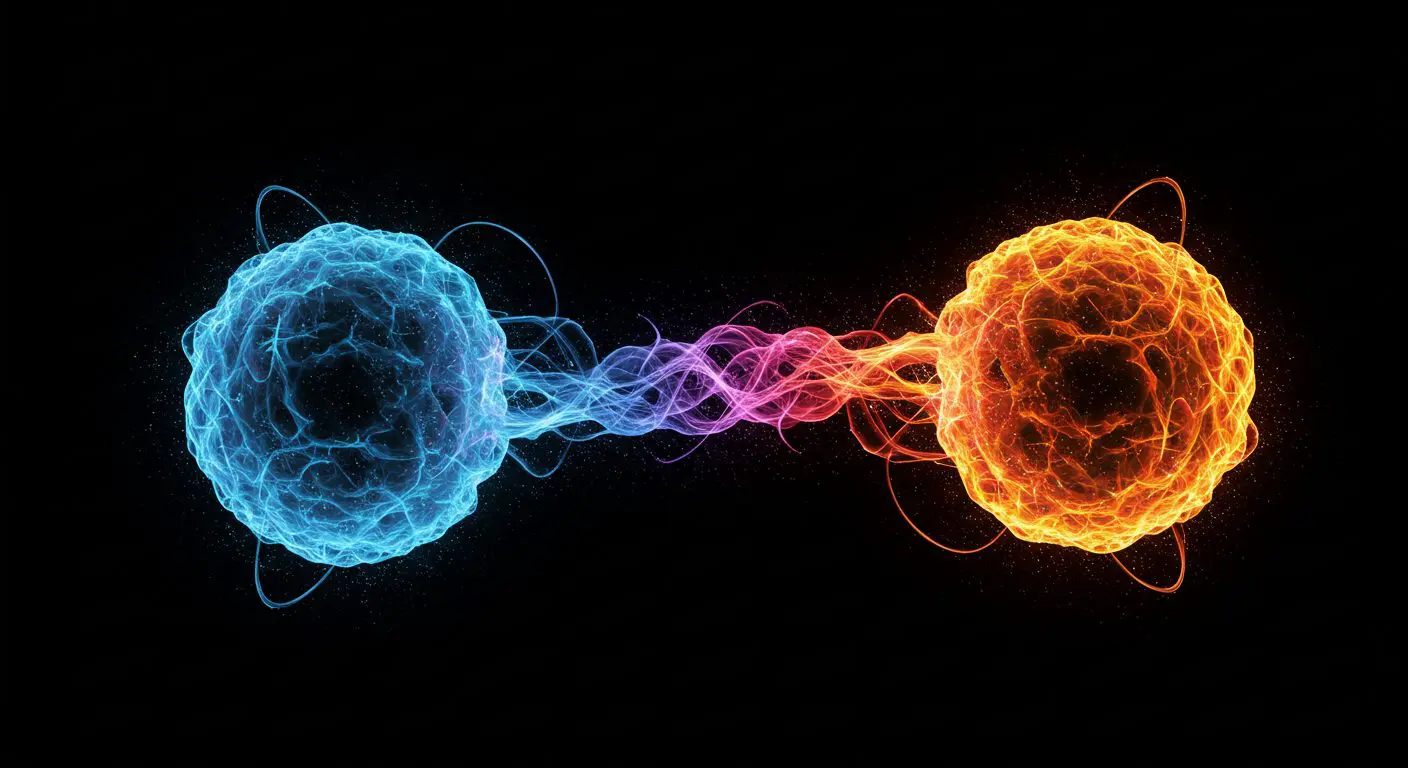
The manipulation of quantum entanglement, a phenomenon where two or more particles become linked and share the same fate, irrespective of the distance separating them, continues to drive innovation in quantum technologies. Recent research focuses on harnessing the properties of vortex light, light beams that twist around their propagation axis, to enhance entanglement protocols. Fan Meng, Hao Zhu, and colleagues from the School of Physics at Beihang University detail a theoretical approach to generating continuous variable entanglement using vortex light within coherently prepared media, published as ‘Continuous variable entanglement with orbital angular momentum multiplexing in coherently prepared media’. Their work explores Raman scattering, an alternative to conventional methods like spontaneous parametric down-conversion, to induce entanglement through atomic coherence and identifies parameters for optimising entanglement levels, potentially advancing applications in quantum teleportation, secure communication, and high-dimensional data encoding.
Quantum entanglement, a fundamental principle within quantum information science, serves as a crucial resource for emerging quantum technologies. Researchers currently investigate diverse physical platforms for realising and manipulating entanglement, including photons, atoms, and ions, each presenting unique advantages for specific applications. Photons, due to their capacity to travel long distances with minimal interaction, are particularly well-suited for quantum communication and information processing, prompting exploration into utilising additional properties, such as their orbital angular momentum (OAM), to enhance quantum networks. OAM introduces an additional degree of freedom for encoding quantum information, enabling the creation of high-dimensional quantum states that increase both the capacity and security of quantum communication.
Recent research concentrates on leveraging atomic coherence and Raman scattering as a means of generating vortex optical entanglement, offering a potentially more versatile and controllable method compared to spontaneous parametric down-conversion (SPDC). SPDC is a nonlinear optical process used to create entangled photon pairs, but alternative methods utilising atomic interactions offer greater control over the generated states. Through precise control of system parameters, researchers aim to optimise the degree of entanglement and unlock the full potential of vortex light for advanced quantum applications, including quantum teleportation and secure key distribution.
The core principle involves inducing correlations between two light fields via atomic coherence, effectively ‘linking’ their quantum states and establishing a viable pathway for generating entangled photons. Central to this approach is the manipulation of atomic ensembles, utilising the phenomenon of electromagnetically induced transparency (EIT), which creates a narrow window of transparency within an otherwise opaque medium, allowing light to propagate with minimal absorption. Employing a specific four-level atomic system, configured in a lambda shape, and illuminating it with two laser fields – a ‘probe’ and a ‘control’ beam – establishes a coherent superposition of atomic states crucial for mediating the entanglement process.
Researchers leverage stimulated Raman adiabatic passage (STIRAP), a
Researchers leverage stimulated Raman adiabatic passage (STIRAP), a technique that coherently transfers population between atomic states, to precisely control the interaction between light and matter, optimising the entanglement generated. To verify the entanglement generated, the authors utilise established mathematical criteria, including those developed by Peres-Horodecki, Simon, and Duan, which provide quantifiable measures of the correlations between the two light fields. These criteria assess the degree of non-classical correlation present in the system, confirming the presence of entanglement.
Numerical simulations play a critical role in this work, allowing researchers to thoroughly explore the impact of various system parameters on the degree of entanglement, revealing that entanglement quality is highly sensitive to the precise tuning of these parameters. By systematically varying these parameters, researchers identify optimal conditions for maximising the entanglement, providing a valuable reference framework for future experimental investigations. The potential applications of this research are broad, spanning quantum teleportation, secure key distribution, high-dimensional quantum information processing, and the development of quantum memories.
This work presents a theoretical framework for generating entanglement in vortex light using a novel approach that diverges from traditional methods relying on SPDC, instead employing Raman scattering within a coherently prepared medium. The study meticulously investigates the influence of various system parameters on the degree of entanglement achieved, utilising numerical simulations to actively model the behaviour of the system, allowing for precise control and optimisation of the process.
A key aspect of this research lies in its adoption of continuous variable (CV) analysis, contrasting with the more common discrete variable (DV) approaches, utilising continuous properties of light, such as amplitude and phase, offering potential advantages in terms of compatibility with existing optical technologies and increased information capacity. Researchers demonstrate that by carefully controlling the continuous variables, they can establish and maintain a high degree of entanglement between the vortex light fields, offering a complementary pathway to DV entanglement, potentially broadening the scope of quantum information processing.
This work establishes a reference framework for vortex light entanglement, extending beyond theoretical modelling to provide actionable insights for experimental implementation, paving the way for scalable quantum technologies. The use of Raman scattering offers a potentially more efficient and practical method for generating entangled photons compared to traditional SPDC, actively contributing to the development of continuous variable quantum information processing, offering advantages in compatibility with classical optics and ease of manipulation. The generated entangled states hold considerable promise for a range of quantum applications, with quantum key distribution benefiting from the enhanced security offered by high-dimensional entanglement.
Quantum teleportation leverages the correlated nature of entangled
Quantum teleportation leverages the correlated nature of entangled photons for state transfer, while the capacity for high-dimensional information encoding expands the potential for quantum computation and advanced quantum imaging techniques. Future work will focus on experimentally validating the theoretical predictions and exploring the scalability of the proposed scheme, investigating the impact of decoherence mechanisms and developing strategies for mitigating their effects. Extending the scheme to generate even more complex entangled states with a larger number of photons represents a significant avenue for future research, potentially unlocking new capabilities in quantum information processing.
System parameters, including atomic density and laser intensities, demonstrably affect entanglement quality, allowing for precise control and optimisation, specifically identifying optimal conditions for achieving maximal entanglement, offering a practical guide for experimental realisation. This level of control represents a significant advancement in the field, enabling the tailoring of entangled states for specific applications.
🗞 Continuous variable entanglement with orbital angular momentum multiplexing in coherently prepared media
🧠 DOI: https://doi.org/10.48550/arXiv.2507.03944