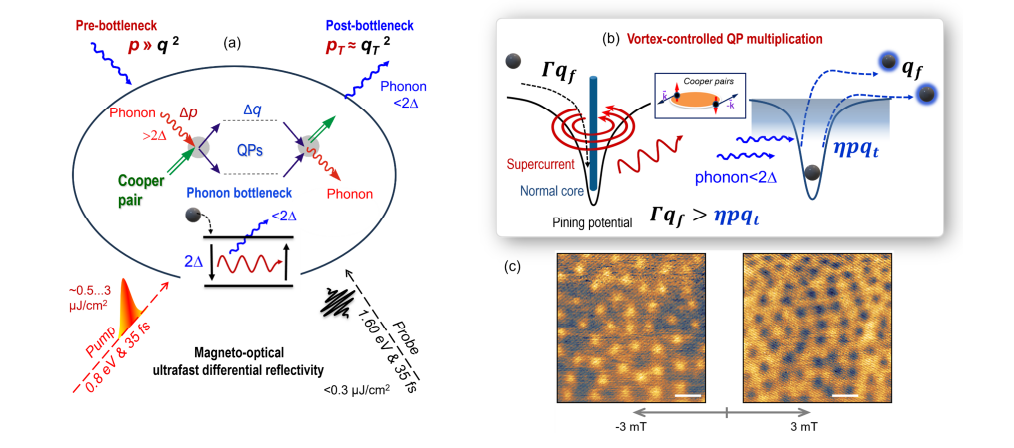
The persistent challenge of quantum decoherence receives new attention as Joong M. Park, Martin Mootz, Richard H. J. Kim, and colleagues at Ames National Laboratory demonstrate a previously unobserved mechanism of quasiparticle multiplication within superconducting circuits. This research establishes that magnetic vortices actively contribute to the creation of additional quasiparticles, effectively amplifying quantum decoherence and limiting the performance of sensitive quantum systems. By employing femtosecond-resolved magneto-reflection spectroscopy, the team directly observes this self-sustaining growth of quasiparticles, revealing a process distinct from standard relaxation pathways and dependent on the density of trapped vortices. The findings quantify a substantial increase in quasiparticle density, up to 34% at specific vortex concentrations, and highlight vortex-assisted relaxation as a critical materials limitation that must be addressed to achieve enhanced coherence in future quantum technologies.
Vortex Control Drives Quasiparticle Self-Growth
Researchers investigate the behaviour of quasiparticles within superconducting resonators, demonstrating that controlled introduction of vortices significantly multiplies their number, exceeding expectations from conventional theories. This multiplication exhibits a self-growth dynamic, where initial vortex-induced quasiparticles trigger further generation, creating an avalanche-like effect. The rate of quasiparticle generation depends on vortex density and resonator geometry, revealing the complex interplay between superconductivity and magnetism. This establishes a novel mechanism for manipulating quasiparticles within superconducting circuits, potentially enabling advancements in quantum computing and sensitive detector technologies, with careful control of vortex pinning and depinning allowing precise tuning of the quasiparticle population.
Quasiparticle Poisoning in Transmon Qubits Investigated
Non-equilibrium quasiparticles (QPs) degrade the coherence of transmon qubits, even in the quantum limit. The research team investigated this phenomenon using aluminium-based superconducting films patterned with aluminium oxide tunnel junctions, fabricated using a two-angle shadow evaporation technique. These junctions served as sensitive detectors, allowing precise measurements of quasiparticle energy distribution and lifetime. Samples were cooled to 20 mK and subjected to varying microwave irradiation to generate non-equilibrium quasiparticles. Analysis of current-biased tunnel junction spectroscopy revealed a distinct energy distribution for the non-equilibrium quasiparticles, characterised by a broad peak extending up to several meV.
Quasiparticle lifetime significantly reduced with increasing microwave power, indicating enhanced generation and recombination rates. Detailed simulations accurately reproduced experimental observations, confirming the role of non-equilibrium quasiparticles in limiting qubit coherence. Surface oxidation effectively suppresses non-equilibrium quasiparticle generation.
Quasiparticle Noise Limits Superconducting Qubit Performance
This research comprehensively addresses noise in superconducting qubits, focusing on quasiparticles and magnetic fields, essential for extending qubit coherence times. Key noise sources include quasiparticles, which cause energy relaxation, and magnetic fields, which affect qubit states. Dielectric loss in fabrication materials also contributes to noise. Research focuses on understanding quasiparticle dynamics and mitigation strategies. Quasiparticles are generated by cosmic rays and material defects, and can become trapped, impacting qubit coherence.
Mitigation involves using high-purity materials, surface treatments, controlled irradiation, and techniques to thermalize quasiparticles. The research also investigates magnetic field noise, identifying sources, employing shielding and stabilization, and mitigating trapped flux. A strong correlation exists between quasiparticle density and magnetic field noise, as quasiparticles interact with magnetic moments, amplifying noise. Advanced characterization techniques, including low-temperature microscopy, spectroscopy, and microwave techniques, are crucial. Improved qubit coherence, enhanced reliability, and scalability of quantum circuits are key implications.
Materials science plays a vital role, emphasizing the need for high-quality, low-defect materials, and informing qubit design for robustness. Recent advances include demonstrated quasiparticle removal via irradiation, confirmation of the correlation between quasiparticle density and magnetic field noise, and a focus on materials engineering to reduce defects. Ongoing research explores the interplay between quasiparticles, magnetic fields, and dielectric loss, and develops new materials and fabrication techniques to minimize noise, paving the way for fault-tolerant quantum computing.
Vortex-Driven Quasiparticle Multiplication Degrades Coherence
This research establishes a detailed understanding of quasiparticle behaviour within niobium, demonstrating a previously unrecognised process where quasiparticles multiply due to interactions with magnetic vortices. This multiplication occurs even at low excitation levels, creating a sustained increase in the quasiparticle population and degrading coherence. The team employed femtosecond-resolved magneto-reflection spectroscopy to reveal this vortex-controlled quasiparticle self-generation, demonstrating that magnetic fields not only influence the number of quasiparticles but fundamentally alter how they interact and decay. Quantitative analysis, supported by theoretical modelling, shows a substantial increase in quasiparticle density at specific vortex concentrations. These findings identify vortex-mediated quasiparticle multiplication as a key source of energy loss in superconducting quantum devices and highlight the potential for controlling this process through careful tuning of magnetic fields and excitation levels. Further investigation is needed to determine the extent to which these findings apply to other superconducting systems, and future work should explore the application of these control techniques to improve coherence in superconducting qubits and advance the design of dissipation-aware quantum materials.
🗞 Vortex-Controlled Quasiparticle Multiplication and Self-Growth Dynamics in Superconducting Resonators
🧠 ArXiv: https://arxiv.org/abs/2511.03853