Researchers from the University of California, San Diego (UCSD) have proposed a novel method for observing electron motion on attosecond timescales – ultrafast vortex electron diffraction. This experimental concept, detailed in a study published in Physical Review Letters, could potentially revolutionize our understanding of quantum processes and advanced materials.
The technique’s unique sensitivity to electronic coherence offers unprecedented opportunities for visualizing ultrafast quantum phenomena in molecules, bringing us one step closer to controlling chemical reactions at their most fundamental level. The study was led by Haowei Wu and Haiwang Yong from UCSD, with support from the W. M. Keck Foundation through computing resources at the W. M. Keck Laboratory for Integrated Biology at UC San Diego.
Unveiling the Invisible: A New Lens to Observe Electrons in Motion
In atomic physics, electrons dance around nuclei at breathtaking speeds, completing a cycle in mere femtoseconds (one femtosecond is a millionth of a billionth of a second). The challenge lies not in their swiftness but in observing these elusive particles in motion within molecules. A team of researchers from the University of California, San Diego’s Department of Chemistry and Biochemistry has proposed an innovative solution: ultrafast vortex electron diffraction.
Ultrafast Vortex Electron Diffraction: A Revolutionary Approach
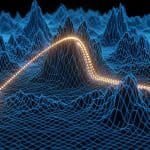
The concept revolves around a specialized electron beam that spirals as it travels, enabling precise tracking of electron motion in both space and time. This method is particularly sensitive to electronic coherence, a phenomenon where electrons move in a synchronized, harmonious manner. By effectively isolating such coherent electron dynamics from other competing processes, this technique opens up new avenues for studying quantum processes, such as energy transfer and electron behavior in advanced materials.
Unlocking the Secrets of Quantum Processes
The study, published on February 19, 2025, in Physical Review Letters, was led by Haowei Wu and Haiwang Yong from UC San Diego. Their research was supported in part by the W. M. Keck Foundation through computing resources at the W. M. Keck Laboratory for Integrated Biology at UC San Diego. The study titled “Diffractive imaging of transient electronic coherences in molecules with electron vortices” can be read in Physical Review Letters.
A Step Closer to Controlling Chemical Reactions
As Haiwang Yong, one of the researchers, stated, “This technique’s exceptional sensitivity to electronic coherences unlocks new possibilities for visualizing ultrafast quantum phenomena in molecules, bringing us closer to the ultimate goal of controlling chemical reactions at the most fundamental level.”
Implications and Future Directions
This breakthrough could pave the way for a deeper understanding of molecular and material behavior at the quantum level. By visualizing electron motion on attosecond timescales, researchers can gain insights into energy transfer mechanisms, electron dynamics in advanced materials, and the fundamental behavior of molecules and materials. The potential applications extend to fields such as photovoltaics, catalysis, and drug design, where controlling chemical reactions could lead to significant advancements.
External Link: Click Here For More