The pursuit of low-dimensional magnetic materials continues to drive innovation in spintronics, with van der Waals compounds attracting considerable attention due to their potential for creating novel devices. Understanding the interplay between electronic structure and magnetic order within these materials remains a significant challenge. Now, A. De Vita, S. Stavrić, and colleagues report detailed spectroscopic and theoretical investigations into chromium triiodide (CrI₃), a prototypical two-dimensional ferromagnet. Their work, entitled ‘Orbital mixing as key ingredient for magnetic order in a van der Waals ferromagnet’, reveals a crucial link between the mixing of iodine p and chromium eg orbitals and the emergence of ferromagnetism, offering fundamental insights applicable to a broader range of low-dimensional magnetic systems. The research, conducted by an international collaboration spanning institutions including the Technische Universität Berlin, the Vinča Institute of Nuclear Sciences, and the European Synchrotron Radiation Facility, clarifies the microscopic origins of magnetic behaviour in this material.
Recent advances in van der Waals materials research demonstrate significant potential for next-generation spintronic technologies. Investigations frequently focus on compounds incorporating light 3d-transition metals combined with chalcogenides or halogens. Researchers address a knowledge gap through a comprehensive study of chromium triiodide (CrI₃), employing complementary absorption and photoemission spectroscopies alongside density functional theory (DFT) calculations.
The study reveals the electronic structure and orbital character of CrI₃ in both paramagnetic and ferromagnetic phases, and results demonstrate couplings that underpin the material’s energy diagram, establishing that orbital mixing between iodine p and chromium eg states stabilises ferromagnetism. X-ray Absorption Spectroscopy (XAS) data, collected at both 30K and 90K, show minimal change in the overall electronic structure across the Curie temperature, indicating the magnetic transition does not dramatically alter the fundamental electronic properties. Importantly, XAS and X-ray Magnetic Circular Dichroism (XMCD) measurements confirm the presence of magnetic moments associated with iodine atoms, demonstrating their contribution to the overall magnetic ordering.
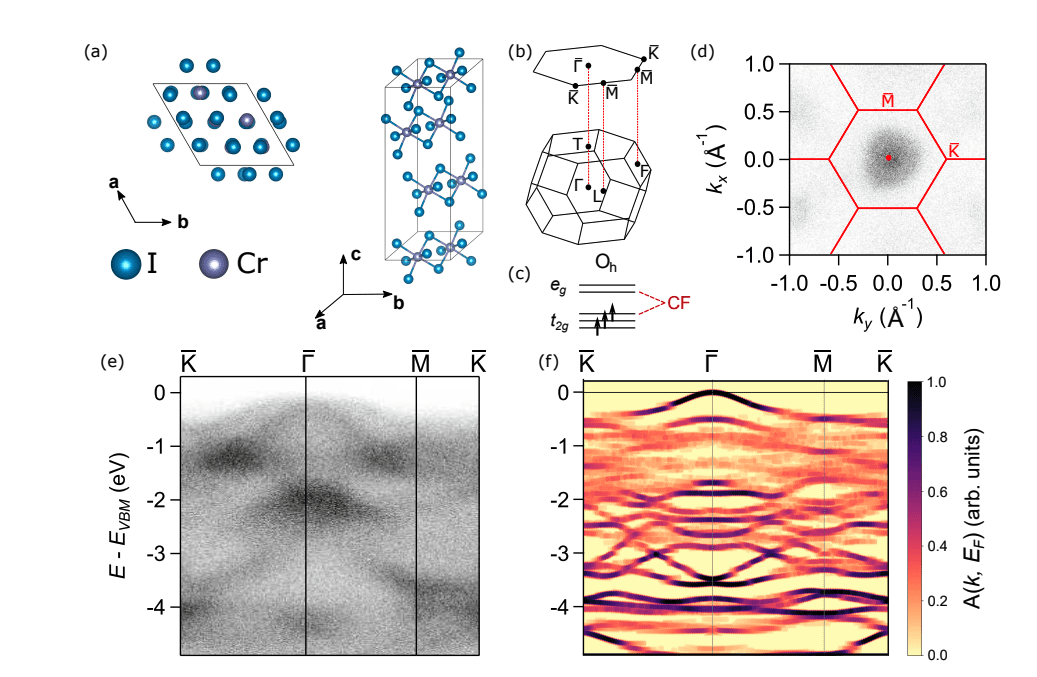
Theoretical cluster calculations corroborate these experimental findings, and these calculations demonstrate that incorporating hybridization parameters into the model generates a high-energy feature in the XAS spectra and modifies the XMCD signal, while the absence of hybridization results in a shoulder on the L₃ peak. This provides strong evidence that orbital mixing is essential for accurately describing the electronic structure and magnetism of CrI₃. Angle-Resolved Photoemission Spectroscopy (ARPES) data further supports this conclusion, revealing sharper and more defined energy distribution curves at lower temperatures, indicative of increased electronic coherence.
Finally, calculations utilising the DFT+U method, which accounts for strong electron-electron interactions, illustrate how the electronic structure evolves with varying Hubbard U parameters, and projection of the spectral function onto chromium d states demonstrates that increasing U merges two distinct peaks into a single peak, highlighting the significant impact of electron correlations on the material’s electronic behaviour. Collectively, these findings establish a microscopic connection between orbital and spin degrees of freedom, offering fundamental insights applicable to a broader range of low-dimensional magnetic materials.
The detailed spectroscopic analysis confirms that orbital mixing plays a crucial role in determining the magnetic properties of CrI₃, and the observation of a clear correlation between orbital hybridization and magnetic ordering provides strong evidence for this mechanism. The experimental data, combined with theoretical calculations, provides a comprehensive understanding of the electronic structure and magnetic properties of CrI₃, and this understanding is essential for designing and developing new spintronic devices based on this material.
The observation of magnetic moments associated with iodine atoms, confirmed by XMCD measurements, highlights the importance of considering the contributions of all elements in the material to the overall magnetic ordering, and the consistency between experimental and theoretical results strengthens the validity of the proposed mechanism. The detailed analysis of the electronic structure, combined with the investigation of the impact of external stimuli, provides a roadmap for future research in this field, and the potential for controlling and manipulating the magnetic order through external stimuli opens up exciting possibilities for developing novel spintronic devices.
Future work should focus on extending these investigations to other van der Waals magnetic materials, exploring the generality of this orbital mixing mechanism. Investigating the impact of strain and dimensionality on the orbital mixing and magnetic properties would also be valuable, and furthermore, exploring the potential for controlling and manipulating the magnetic order through external stimuli, such as electric fields or light, could pave the way for novel spintronic devices.
👉 More information
🗞 Orbital mixing as key ingredient for magnetic order in a van der Waals ferromagnet
🧠 DOI: https://doi.org/10.48550/arXiv.2507.04144