Yishu Wang, a joint assistant professor at the University of Tennessee, has been awarded a $719,000 research grant from the United States Department of Energy to study the dynamic behavior of magnets with quantum mechanical properties. These correlated magnets exhibit unconventional superconductivity and quantum entanglement, making them promising for energy-efficient devices capable of high-speed computation.
Conventional neutron scattering methods are limited in capturing the properties of these novel magnets, which lack a static ordering. Wang’s research aims to develop a new capability of neutron scattering that can fully capture the spin dynamics in correlated magnets over time. Collaborating with colleagues at Oak Ridge National Laboratory, Wang will synthesize correlated magnetic materials and develop instrumentation to perform experiments. The instruments and methods developed will remain available at ORNL’s Spallation Neutron Source for future studies, benefiting a range of scientific communities and securing its position as the world’s premier innovation center for neutron science.
Unveiling the Dynamics of Correlated Magnets: A Quantum Leap in Materials Science
The study of magnetism has long been a cornerstone of materials science, with researchers seeking to understand the intricate dance of electrons that gives rise to magnetic properties. However, traditional magnets, such as those found in metals like iron, can be viewed as static orderings of electrons, analogous to a painting. In contrast, correlated magnets exhibit vivid, coherent, and entangled dynamics of their electrons’ spins, making them more akin to movies than paintings. This distinction is crucial, as correlated magnets hold strong potential for energy-efficient devices capable of high-speed computation.
Correlated magnets are defined by the quantum mechanical interactions between their electrons, leading to unconventional superconductivity, quantum entanglement, and other novel features. To fully capture the spin dynamics in these systems, researchers require a more nuanced approach than traditional neutron scattering methods, which provide limited snapshots of the electrons’ spin-spin correlations.
Adding Time Resolution to Neutron Scattering: A New Capability for Investigating Correlated Magnets
Yishu Wang, a joint assistant professor in the Department of Materials Science and Engineering and the Department of Physics and Astronomy, has been awarded a $719,000 research grant from the United States Department of Energy (DOE) to develop a new capability of neutron scattering that will fully capture the spin dynamics in correlated magnets over time. This novel approach will provide researchers with a refreshed perspective on the dynamic behaviors of correlated magnetic systems, gaining deeper insights into their underlying quantum mechanical interactions.
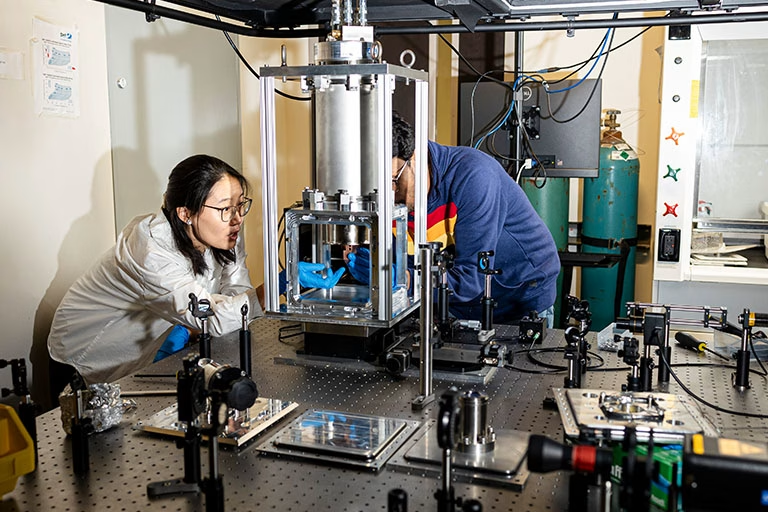
The development of this new capability is made possible through collaboration between Wang and colleagues at both UT and the Neutron Science Division at Oak Ridge National Laboratory (ORNL). The team will synthesize correlated magnetic materials to investigate, develop and implement instrumentation to perform experiments, and interpret the experimental data. The instruments and methods developed during this grant will remain available in ORNL’s Spallation Neutron Source (SNS) for future studies.
The Significance of Correlated Magnets in Energy-Efficient Devices
The study of correlated magnets holds significant potential for the development of energy-efficient devices capable of high-speed computation. By harnessing the unconventional superconductivity and quantum entanglement exhibited by these systems, researchers may unlock new avenues for device design and optimization. The implications of this research extend beyond the realm of materials science, with potential applications in fields such as computing, energy storage, and medical imaging.
Furthermore, the development of neutron scattering with time resolution will benefit a range of scientific communities, securing ORNL’s SNS as the world’s premier innovation center for neutron science. This research is particularly valuable to the quantum science community, as it provides a new tool for investigating the intricate dynamics of correlated magnets.
The Role of Interdisciplinary Collaboration in Advancing Materials Science
The success of this research grant is, in part, due to the collaboration between Wang and undergraduate computer science students at UT. This interdisciplinary approach highlights the importance of diverse academic backgrounds in advancing materials science. By combining expertise from physics, materials science, and computer science, researchers can develop novel methods and instrumentation that push the boundaries of what is possible.
As Wang notes, “Working with undergraduate students from diverse academic backgrounds has been one of my greatest joys since becoming a faculty member at UT.” This collaboration not only fosters innovation but also provides opportunities for students to engage in cutting-edge research, gaining valuable experience and insights into the intricacies of materials science.
External Link: Click Here For More