The search for novel states of matter continues to drive advances in condensed matter physics, and recent work explores a fascinating new class of materials called unconventional hybrid-order topological insulators. Wei Jia from the Lanzhou Center for Theoretical Physics, Yuping Tian and Wei-Jiang Gong from Northeastern University, and colleagues demonstrate the existence of these materials, which uniquely host multiple higher-order topological states within a single one-dimensional system. This research is significant because it expands the understanding of topological phases beyond conventional classifications, revealing a novel form of bulk-edge-corner correspondence not seen before. The team not only develops a comprehensive theoretical framework to describe these hybrid states, but also identifies a potential pathway for realising them in materials like bismuth, paving the way for both fundamental research and potential technological applications.
Simulating Hybrid Topological Insulator Corner States
This supplemental material provides extensive supporting evidence for a new class of hybrid-order topological insulators. Researchers demonstrate the realization of materials that exhibit both helical edge/surface states and localized corner states simultaneously, a more complex topology than standard topological insulators. The document details how these properties are modeled and simulated, offering insights into their behavior. A key component of this work involves demonstrating a physical implementation of the theoretical model using an electrical circuit, allowing for experimental verification of the predicted topological properties.
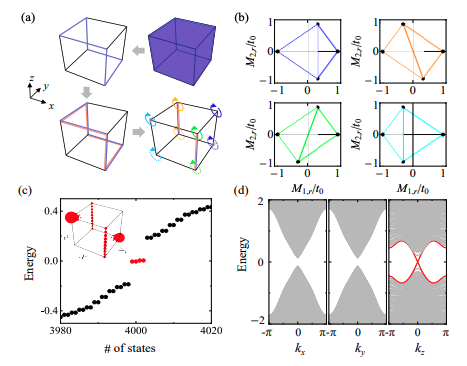
The team utilizes a circuit Laplacian, a mathematical representation of the circuit’s connectivity, to model the system’s behavior, carefully selecting component values to achieve the desired electronic characteristics. The most substantial part of this material presents detailed calculations and simulations using a tight-binding model, a simplified quantum mechanical approach that describes the electronic structure of a solid by considering interactions between neighboring atoms. Researchers apply this model to a three-dimensional hexagonal lattice, a crystal structure commonly found in materials like bismuth, which is known to exhibit topological properties. Through these simulations, they demonstrate the coexistence of helical edge states and localized corner states within the same material, protected by time-reversal symmetry and the specific crystal structure.
By carefully analyzing the energy spectrum and visualizing the wave functions of the electrons, the team confirms the presence of these topological features. Overall, this supplemental material provides a comprehensive and detailed analysis of the HyOTI, supporting the claims made in the main paper. It demonstrates the theoretical and numerical evidence for the existence of this unconventional topological phase and provides a pathway for its experimental realization. The combination of circuit-based implementation and tight-binding simulations makes this work particularly compelling.
Unconventional Hybrid Topological Insulator States Discovered
Researchers have discovered a new class of materials exhibiting unconventional hybrid-order topological insulator (HyOTI) properties, significantly expanding the understanding of topological phases. Unlike previously known materials that typically display only one type of topological order, these HyOTIs simultaneously host multiple distinct higher-order topological states within a single system. This breakthrough challenges the conventional understanding of how topological states coexist and opens new avenues for classifying these materials. The research team developed a theoretical framework to describe these unconventional HyOTIs, focusing on how different topological states manifest on the material’s boundaries.
Applying this theory, they discovered a three-dimensional HyOTI that exhibits both second-order (helical) and third-order (corner) topological states within the same energy gap, demonstrating a novel “bulk-edge-corner correspondence” not seen in conventional materials. Notably, the researchers observed that by adjusting the material’s parameters, it can transition into other known topological phases, such as conventional HyOTIs, second-order topological insulators, and Weyl semimetals. To aid in experimental verification, the team proposed a circuit-based method for detecting these unique properties and identified a modified tight-binding model of bismuth that could potentially support this new type of HyOTI, offering a pathway towards realizing these materials in the laboratory.
Hybrid Topological Insulators and Bulk-Edge Correspondence
This research introduces a new class of materials, unconventional hybrid-order topological insulators, which exhibit multiple types of topological states within a single system. These materials uniquely combine different higher-order topological properties, differing from previously known topological insulators and offering a novel relationship between their bulk and surface characteristics. The team developed a theoretical framework to describe these unconventional insulators, successfully identifying a specific material configuration that simultaneously supports both second and third-order topological states. By manipulating the properties of the system, researchers observed transitions between this hybrid state and more conventional topological phases, and proposed a circuit-based method for experimental verification of these findings. Importantly, the study suggests a pathway to realizing these materials through doping bismuth with magnetic elements or interfacing it with magnetic substrates. This work expands the understanding of hybrid topological states and provides insights for exploring similar phenomena in a wider range of materials.
🗞 Unconventional hybrid-order topological insulators
🧠 ArXiv: https://arxiv.org/abs/2507.22666