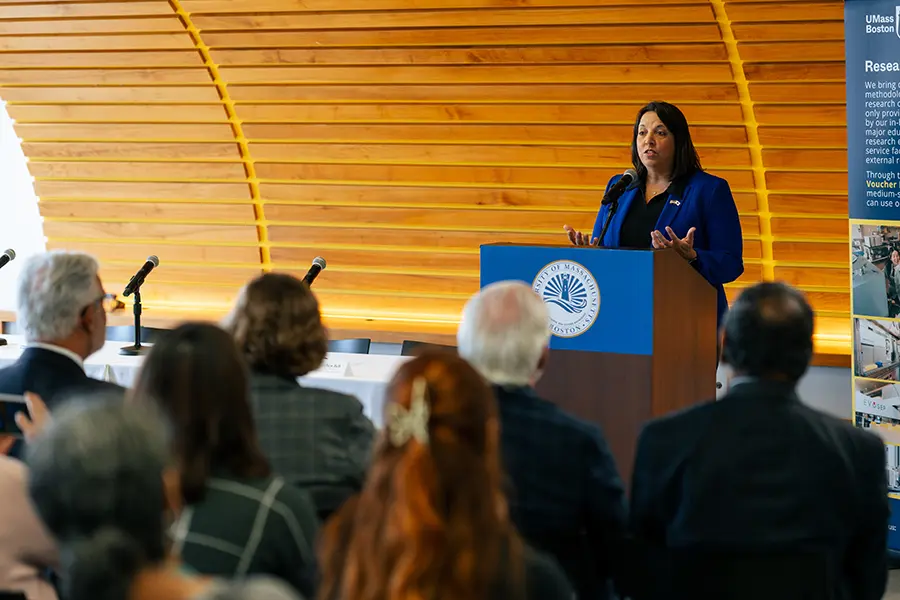
Massachusetts Technology Collaborative (MassTech), together with the state’s Executive Office of Economic Development, announced on Tuesday a $3.8 million grant to the University of Massachusetts Boston (UMass Boston) to broaden the Commonwealth’s leadership in the “Second Quantum Revolution.” The funding, which follows an initial $1 million investment in 2022, will bankroll a range of quantum‑enabled technologies, computing, sensing, communication and cryptography, whose potential to reshape cybersecurity, finance, pharmaceuticals and materials science is now beginning to move from theory to market. The announcement was made at UMass Boston’s Venture Development Center, where academics, industry leaders and state officials convened to chart a path from laboratory breakthroughs to commercial products.
How UMass Boston Plans to Spend $3.8 Million
The new grant will be funneled into a multi‑faceted infrastructure upgrade that begins with the expansion of the university’s quantum core measurement facility. This hub, already equipped with state‑of‑the‑art dilution refrigerators, will receive additional cryogenic testbeds and specialised measurement hardware that enable the testing of quantum processors at temperatures near absolute zero. The funding will also finance a new quantum hardware packaging and assembly facility in Hatfield, Massachusetts, designed to translate laboratory prototypes into fabrication‑ready components. “This next phase will deliver cutting‑edge testing and measurement infrastructure at UMass Boston and Western New England University, developed in close collaboration with industry partners,” said Professor Matthew Bell, chair of the Engineering Department at UMass Boston. The investment will support the Data and Quantum Science (DataQS) Center, a joint venture that already secured $5 million in federal funding, and will launch the Quantum Jumpstart seed grant programme, which provides early‑stage capital to accelerate product validation. By combining core facilities with seed funding, UMass Boston aims to shorten the time between discovery and market entry for quantum technologies.
The Statewide Quantum Research Network Expanding
The grant builds on a partnership that began in 2022 between UMass Boston and Western New England University (WNEU) in Springfield, which established a statewide network of quantum research centres. The network now serves as a collaborative platform for small businesses and start‑ups to access high‑end cryogenic testbeds and measurement equipment that would otherwise be prohibitively expensive. “The initial funding demonstrated that a collaborative model works,” said Lt. Governor Kim Driscoll. The network’s reach extends beyond academia, incorporating industry stakeholders who bring practical requirements to the table. As part of the expansion, the quantum core measurement facility will become the first public quantum lab in the Commonwealth to host external partners, enabling a seamless transition from research to commercial development. The network’s growth also dovetails with a broader workforce initiative that will pair local industry with university researchers and students, creating upskilling pathways for engineers and technicians and addressing the skills gap that currently hampers hardware scaling.
Why Massachusetts is Leading the Second Quantum Revolution
Massachusetts’ advantage lies in its deep reservoir of talent and a history of driving technological change. The state’s universities have long supplied the talent that powered the digital age, and now that talent is being redirected toward quantum science. Governor Maura Healey highlighted the state’s commitment: “Innovation and research are foundational to the Massachusetts economy.” While federal support for research and development has waned, state investment has stepped in to keep the Commonwealth at the cutting edge. The quantum computing market, valued at $866 million in 2023, is projected to reach $4 billion by 2028, with hardware accounting for 82 % of the current market. Major players such as IBM, Google, Amazon, Honeywell, Microsoft and Intel are pouring capital into hardware, yet scaling remains a bottleneck. Massachusetts’ initiative tackles this by building the physical infrastructure, dilution refrigerators, packaging facilities, and measurement labs, while also nurturing a talent pipeline. “MassTech has continued to support innovative projects to expand quantum computing in Massachusetts because we anticipate enormous growth potential in this sector,” said MassTech CEO Carolyn Kirk. By aligning academic research, industry needs and state policy, Massachusetts is positioning itself as a global hub for quantum innovation.
From $1 Million to $3.8 Million: The Evolution of Quantum Funding
The journey from a modest $1 million seed in 2022 to the current $3.8 million grant illustrates a deliberate scaling strategy. The initial investment enabled the creation of the quantum core measurement facility and secured a $5 million federal grant for the DataQS Center, laying the groundwork for a robust quantum ecosystem. The new funding will double the capacity of the core facility, add a packaging plant, and fund seed grants that accelerate product development. UMass President Marty Meehan underscored the impact: “We have worked tirelessly at the University of Massachusetts to build our research enterprise into something that strengthens the university and drives the state’s economy.” The expansion also reflects a broader trend of state‑led investment in high‑tech sectors that can drive economic resilience in the face of shifting federal priorities. As the Commonwealth continues to pour resources into quantum research, it signals a long‑term commitment to maintaining a competitive edge in an industry poised to transform global technology landscapes.
The $3.8 million injection marks a pivotal moment for Massachusetts, turning a nascent quantum research network into a full‑blown industrial base. By marrying cutting‑edge infrastructure with a talent pipeline and a clear commercial pathway, the state is not merely following the quantum race, it is setting the pace. The next few years will see whether these investments translate into quantum processors that outperform classical machines, secure cryptographic systems that outlast current threats, and sensing technologies that open new frontiers in medicine and materials science. For Massachusetts, the quantum revolution is no longer a distant horizon; it is a tangible, funded trajectory toward a future where the state’s universities, businesses and policymakers work in concert to harness the power of quantum mechanics for the public good.