A research team led by Prof. LIANG Changhao from the Institute of Solid State Physics at the Hefei Institutes of Physical Science, Chinese Academy of Sciences, has developed a novel method using Laser Ultrafast Confined Alloying (LUCA) to synthesize sub-5 nm RuM alloys supported on carbon nanotubes for efficient hydrogen evolution.
This advancement addresses the challenge of thermodynamic immiscibility in creating such alloys, enabling the production of highly effective catalysts for water splitting. The resulting Ru95Cu5/CNTs catalyst demonstrated superior performance with a low overpotential and Tafel slope, significantly outperforming other catalysts, including Pt/C benchmarks and those synthesized through alternative methods.
Ultrafast Laser Alloying Methodology for Ru-Based Catalysts
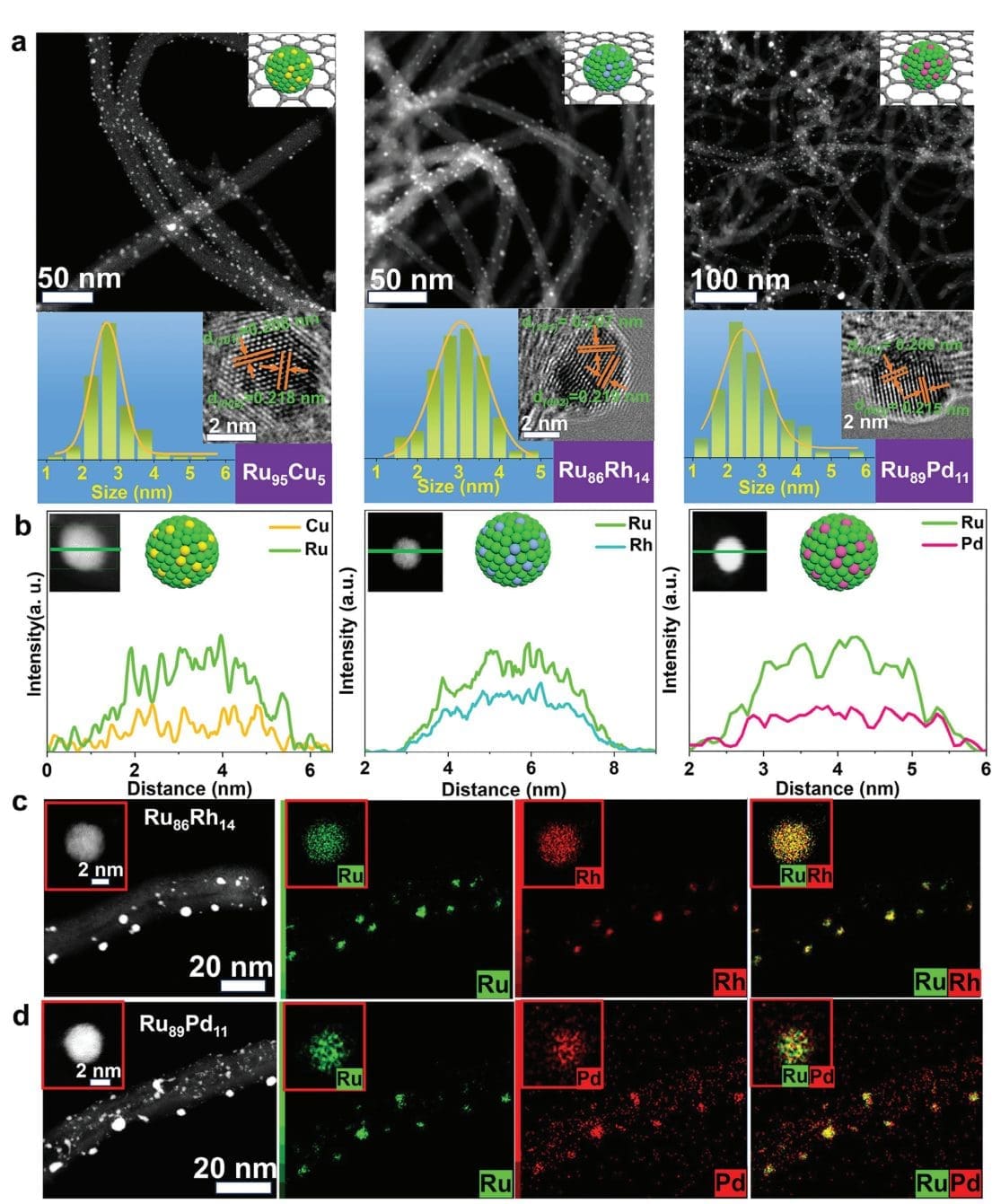
The research team led by Prof. LIANG Changhao has developed an innovative methodology using ultrafast laser alloying (LUCA) to synthesize sub-5 nm Ru-based catalysts supported on carbon nanotubes (CNTs). This technique addresses the challenge of thermodynamic immiscibility, enabling the creation of intermetallic RuM alloys with varying compositions. The LUCA process allows for precise control over the size and composition of nanoparticles, which is crucial for optimizing catalytic performance.
The resulting RuM/CNTs catalysts, where M represents metals such as Cu, Rh, or Pd, exhibit exceptional efficiency in hydrogen evolution reactions (HER). These catalysts achieve low overpotentials and favorable Tafel slopes, significantly outperforming commercial benchmarks like 20% Pt/C and other Ru-based alternatives. For instance, the Ru95Cu5/CNTs catalyst demonstrates an overpotential of 17 mV and a Tafel slope of 28.4 mV dec⁻¹ at 10 mA cm⁻², showcasing its superior activity.
Another notable feature of these catalysts is their durability, with high robustness observed over 5000 cyclic voltammetry cycles. This performance highlights the potential of LUCA-synthesized RuM/CNTs as advanced hydrogen evolution catalysts, offering a cost-effective and scalable solution for large-scale applications in renewable energy systems.
In summary, the ultrafast laser alloying methodology advances the synthesis of efficient HER catalysts and opens new avenues for exploring novel catalytic materials. This research underscores the importance of innovative techniques in addressing the challenges of sustainable hydrogen production.
Synthesis of Sub-5 nm RuM/CNTs Alloys
The research team utilized ultrafast laser alloying (LUCA) to synthesize sub-5 nm Ru-based alloys supported on carbon nanotubes (CNTs). This method overcomes the typical thermodynamic immiscibility challenge in creating intermetallic RuM alloys. By incorporating non-noble metals such as Cu, Rh, or Pd into Ru-based alloys, the team achieved cost-effective synthesis while maintaining high catalytic activity.
The scalability of the LUCA synthesis method was also emphasized, making it a promising approach for the large-scale production of high-performance hydrogen evolution catalysts. This advancement addresses critical challenges in renewable energy systems by providing an efficient, cost-effective solution for sustainable hydrogen production.
Electrochemical Performance and Robustness of Ru-Based HER Catalysts
The electrochemical performance of the synthesized RuM/CNTs catalysts was evaluated through hydrogen evolution reaction (HER) testing under alkaline conditions. The Ru95Cu5/CNTs catalyst exhibited an overpotential of 17 mV and a Tafel slope of 28.4 mV dec⁻¹ at 10 mA cm⁻², showcasing its efficiency in facilitating HER. The stability demonstrated over extended operation periods further validates their suitability for renewable energy systems focused on sustainable hydrogen production.
The electrochemical performance of the RuM/CNTs catalysts highlights their potential as advanced materials for hydrogen evolution reactions under alkaline conditions. Their robustness and efficiency make them promising candidates for integration into renewable energy technologies aimed at sustainable hydrogen production.
More information
External Link: Click Here For More