Led by Laura Gagliardi, Richard and Kathy Leventhal Professor in the Department of Chemistry and the Pritzker School of Molecular Engineering at the University of Chicago, a new computational approach unites traditionally separate perspectives in chemistry and physics to unlock the secrets of advanced materials. The method builds upon the Localized Active Space (LAS) framework, extending it to periodic solids and merging local quantum chemistry with global band theory. This hybrid approach accurately describes electron behavior within complex materials—like organic semiconductors and strongly correlated oxides—by modeling both localized fragments and the movement of charges across the material, offering a new toolkit for material design and understanding.
New Quantum Chemistry Method Unites Chemistry and Physics
A new computational method developed at the University of Chicago unites traditionally separate perspectives from chemistry and physics to better understand materials. Researchers led by Laura Gagliardi created a rigorous approach merging local quantum chemistry with global band theory, building on the Localized Active Space (LAS) framework. This hybrid method aims to explain the behavior of materials—like those used in solar cells and superconductors—where electrons move by “hopping” between repeating fragments, a phenomenon difficult to model with existing techniques.
The team demonstrated the power of their method by accurately modeling hydrogen chains, correctly classifying them as insulators, while standard density-function theory incorrectly predicted metallic behavior. They also successfully simulated a p–n junction—a core component of solar cells and computer chips—revealing how charges separate and move when exposed to light. This success, published in Nature Communications on December 2, 2025 (DOI: 10.1038/s41467-025-65846-1), proves the method captures crucial physics at a high level of accuracy.
The researchers envision this approach as a tool for both understanding existing materials and designing new ones with extraordinary properties. The open-source LAS method, supported by the Q-NEXT research center and the U.S. Department of Energy, is designed to be accessible to other researchers investigating quantum transport. Ultimately, the goal is to bridge the gap between molecular and materials science, recognizing that “all materials are quantum mechanical at heart.”
The Localized Active Space (LAS) Approach Explained
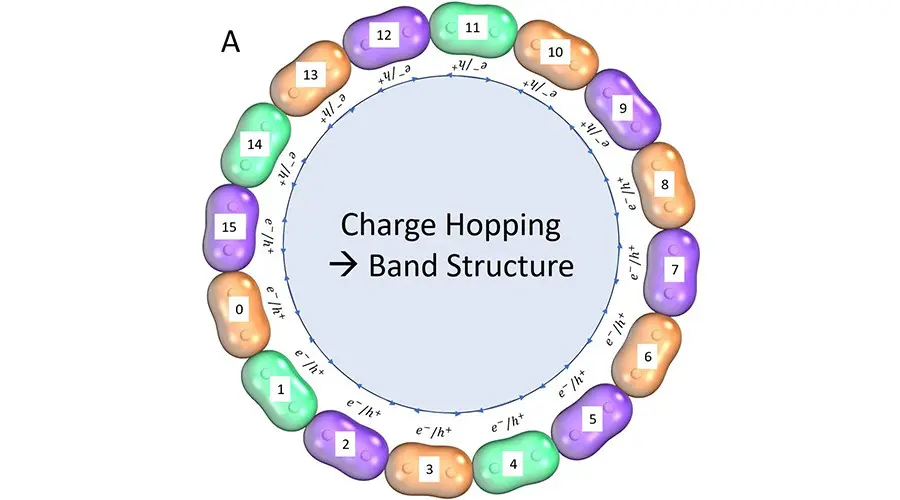
The research team at the University of Chicago developed a new computational method called the Localized Active Space (LAS) approach to bridge the gap between how chemists and physicists view materials. Traditionally, physicists focus on broad band structures while chemists examine local electron behavior. LAS merges these perspectives by modeling local fragments and capturing how electrons hop between them, addressing a key challenge in understanding complex materials like organic semiconductors and metal-organic frameworks.
The LAS approach builds upon work originally developed by Research Assistant Professor Matthew Hermes, extending it to periodic solids to create a hybrid method. To demonstrate its power, researchers applied LAS to hydrogen chains, correctly predicting their insulator properties – a feat previously missed by standard density-function theory methods which incorrectly classified them as metals. This accurate modeling showcases LAS’s ability to describe electron behavior in challenging systems.
Researchers also successfully used the LAS approach to simulate a p–n junction – a fundamental component of solar cells and computer chips – revealing how charges separate and move when exposed to light. Published in Nature Communications on December 2, 2025 (DOI: 10.1038/s41467-025-65846-1), this work demonstrates the method’s potential for both understanding existing materials and designing new ones with extraordinary properties. The LAS method is available open-source.
For decades, chemists and physicists have used very different lenses to look at materials. What we’ve done now is create a rigorous way to bring those perspectives together.
Laura Gagliardi
Method Validated Through Modeling of Hydrogen Chains and p–n Junctions
A new computational method developed at the University of Chicago unites traditionally separate approaches from chemistry and physics to better understand material properties. This method builds upon the Localized Active Space (LAS) framework, extending it to periodic solids and merging local quantum chemistry with global band theory. Researchers validated the method by successfully modeling hydrogen chains, correctly predicting their insulator properties—a feat that classic density-function theory methods previously failed to achieve.
The team also applied the LAS method to simulate a p–n junction, a crucial component of solar cells and computer chips. This simulation revealed how charges separate and move across the junction when exposed to light, a process difficult to capture with earlier computational techniques. This successful modeling of both hydrogen chains and p–n junctions demonstrates the method’s ability to accurately capture key physics at high accuracy, serving as a proof of principle.
Published in Nature Communications on December 2, 2025, this work is supported by the U.S. Department of Energy and available open-source. Researchers envision the LAS method as a tool for both understanding existing materials and eventually designing new ones, bridging the gap between molecular and material-level quantum behavior and offering insights into how quantum mechanics drives everyday material properties.