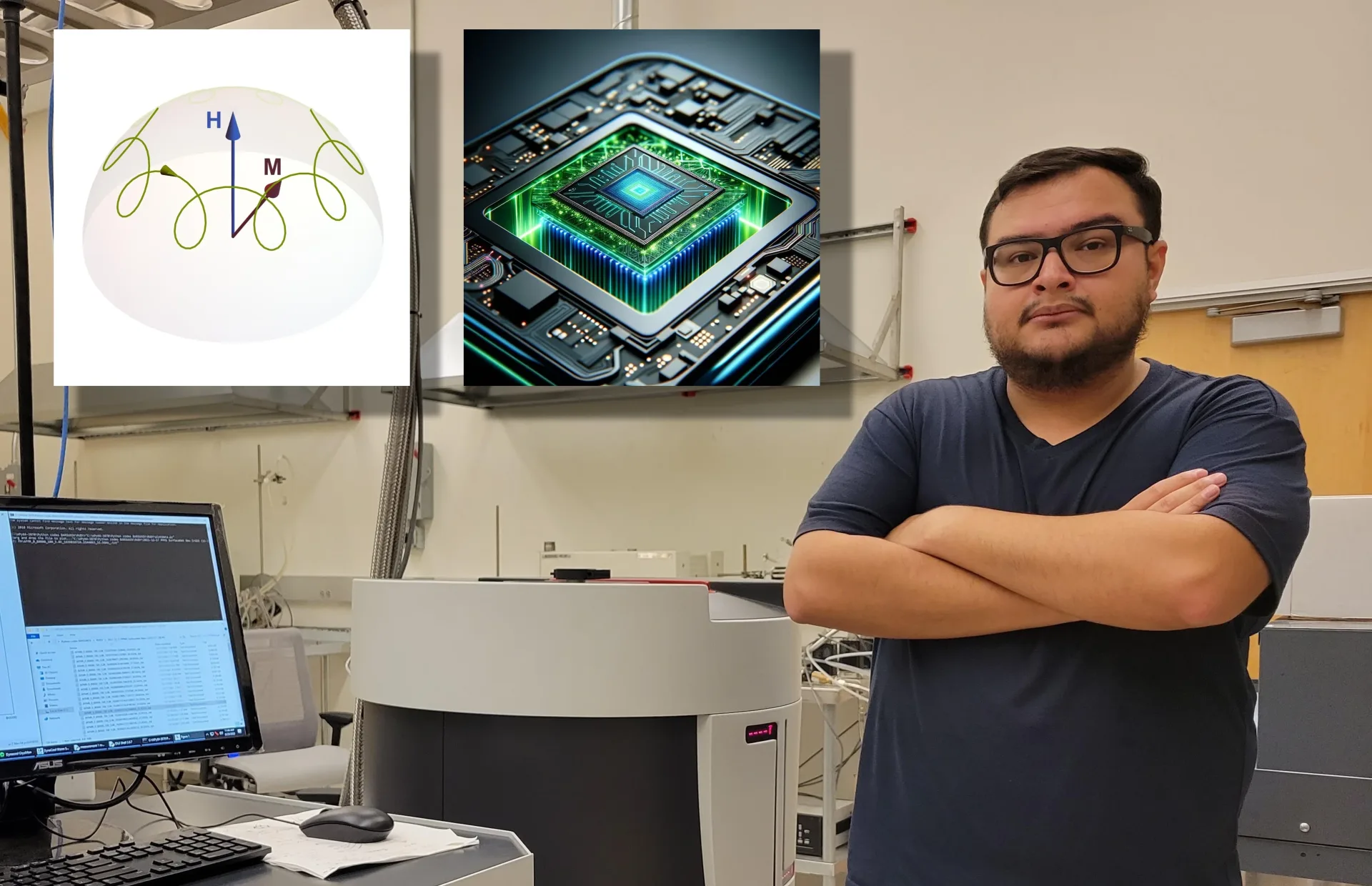
Researchers at the University of California, Riverside, led by associate professor of physics and astronomy Igor Barsukov, have made a significant breakthrough in enabling ultra-fast spin behavior in ferromagnets. This could unlock terahertz processing power, potentially making next-generation communication and computation technologies operate a thousand times faster than current gigahertz frequencies. The team discovered that injecting a spin current with the “wrong” sign can excite nutational auto-oscillations, which hold great promise for future technologies. The research was supported by the National Science Foundation.
Unlocking Terahertz Processing Power in Ferromagnets
A significant breakthrough in the field of ferromagnets has been achieved by an international team of researchers led by the University of California, Riverside. The research, published in Physical Review Letters and highlighted as an editors’ suggestion, has discovered a method to exploit ultra-fast spin behavior in ferromagnets. This development could potentially unlock terahertz processing power, paving the way for ultra-high frequency applications.
Current smartphones and computers operate at gigahertz frequencies, a measure of their operational speed. Scientists are continually striving to increase these speeds. The new research has found a way to achieve terahertz frequencies using conventional ferromagnets, which could lead to next-generation communication and computation technologies that operate a thousand times faster.
Understanding Spin Waves in Ferromagnets
Ferromagnets are materials where electron spins align in the same direction. However, these spins also oscillate around this direction, creating what are known as “spin waves.” These spin waves are crucial for emerging computer technologies, playing a key role in processing information and signals.
“When spins oscillate, they experience friction due to interactions with electrons and the crystal lattice of the ferromagnet,” said Igor Barsukov, an associate professor of physics and astronomy, who led the study. “Interestingly, these interactions also cause spins to acquire inertia, leading to an additional type of spin oscillation called nutation.”
Nutation: The Key to Ultra-High Frequencies
Nutation occurs at ultra-high frequencies, making it highly desirable for future computer and communication technologies. Recently, physicists’ experimental confirmation of nutational oscillations excited the magnetism research community.
“Modern spintronic applications manipulate spins using spin currents injected into the magnet,” said Rodolfo Rodriguez, the first author of the paper, a former graduate student in the Barsukov Group, and now a scientist at HRL Labs, LLC.
Barsukov and his team discovered that injecting a spin current with the “wrong” sign can excite nutational auto-oscillations. “These self-sustained oscillations hold great promise for next-generation computation and communication technologies,” said coauthor Allison Tossounian, until recently an undergraduate student in the Barsukov Group.
The Role of Spin Inertia and the Potential of Ferrimagnets
According to Barsukov, spin inertia introduces a second time-derivative in the equation of motion, making some phenomena counterintuitive. “We managed to harmonize spin-current-driven dynamics and spin inertia,” he said. “We also found an isomorphism, a parallel, between the spin dynamics in ferromagnets and ferrimagnets, which could accelerate technological innovation by exploiting synergies between these fields.”
In ferrimagnets, usually two antiparallel spin lattices have an unequal amount of spin. Materials with antiparallel spin lattices recently received increased interest as candidates for ultrafast applications, Barsukov said.
Overcoming Technological Challenges for Ultra-High Frequency Applications
“Many technological challenges remain,” Barsukov said. “Our understanding of spin currents and materials engineering for ferromagnets has significantly advanced over the past few decades. Coupled with the recent confirmation of nutation, we saw an opportunity for ferromagnets to become excellent candidates for ultra-high frequency applications. Our study prepares the stage for concerted efforts to explore optimal materials and design efficient architectures to enable terahertz devices.”
The study was supported by the National Science Foundation. The title of the paper is “Spin inertia and auto-oscillations in ferromagnets.”
External Link: Click Here For More