

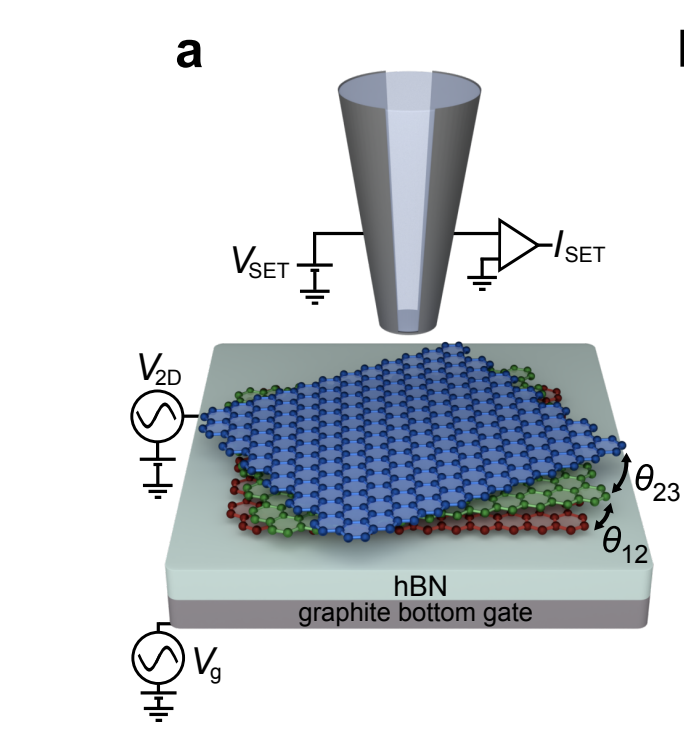
The pursuit of superconductivity in twisted multilayer materials continues to drive innovation in condensed matter physics, and new research sheds light on the complex relationship between electronic correlations and this remarkable phenomenon. Jesse C. Hoke, Yifan Li, and Yuwen Hu, along with colleagues at institutions including those of Kenji Watanabe and Takashi Taniguchi, investigate these connections in twisted trilayer graphene. Their work demonstrates that superconductivity does not simply arise from the formation of correlated insulating states, but instead correlates strongly with features in the material’s electronic compressibility, suggesting a shared underlying mechanism. By combining precise local measurements of electronic behaviour with broader transport studies, the team reveals a nuanced interplay between these properties, establishing a clear dependence on the subtle angles between the graphene layers and offering a powerful new approach to understanding and potentially enhancing superconductivity in these materials.
Twist Angle Drives Correlated Insulating States
This research presents a comprehensive investigation of twisted bilayer graphene, exploring the relationship between the twist angle of the graphene layers and the emergence of correlated insulating states and superconductivity. The team employed a combination of scanning tunneling spectroscopy and transport measurements to understand how these exotic electronic properties arise. By correlating data from both techniques, scientists aim to understand how the material’s electronic structure drives these correlated states. The study reveals that the emergence of correlated insulating states and superconductivity is strongly dependent on the twist angle between the graphene layers.
Researchers observed that features in the electronic compressibility directly correspond to the emergence of these correlated states and superconductivity. Spatial mapping of the electronic structure reveals that it is not uniform across the sample, and that correlated states may be localized to specific regions. In essence, this research builds a microscopic understanding of how the twist angle in bilayer graphene affects the electronic structure and drives the emergence of exotic correlated states, like superconductivity and correlated insulating behavior. The combination of scanning tunneling spectroscopy and transport measurements connects the microscopic electronic structure to the macroscopic properties of the material, providing valuable insights into this fascinating area of condensed matter physics.
Mapping Correlations via Local Twist Angle Variation
Scientists have developed a novel approach to investigate strong electronic correlations in twisted trilayer graphene by combining local thermodynamic measurements with transport measurements on the same sample. This avoids limitations of previous studies that relied on comparing data from different devices. The team pioneered the use of a scanning single-electron transistor microscope to map the impact of electron-electron interactions across a region of the sample where the local twist angle changes gradually, allowing for precise correlation of observed phenomena with the underlying structural properties. The team meticulously characterized the electronic structure of their trilayer graphene device, beginning with calculations to understand how graphene layers hybridize at specific twist angles.
These calculations revealed that flat bands, crucial for strong correlation effects, predominantly originate from strong hybridization between the first two layers. To experimentally probe these electronic characteristics, scientists measured the local inverse electronic compressibility using the high-resolution scanning single-electron transistor, providing a detailed map of the material’s electronic landscape. By analyzing the density-dependent compressibility, the team identified the local twist angle and estimated the second interlayer twist angle by measuring the renormalized Fermi velocity in a magnetic field. They observed a correlated insulator and sawtooth-like oscillations indicative of strong interactions. Mapping the compressibility as a function of position revealed that strong interactions persist over a range of twist angles, consistent with theoretical predictions. This detailed mapping, combined with transport measurements, allows scientists to directly compare thermodynamic and transport signatures, clarifying the relationship between superconductivity and other correlation effects in twisted graphene multilayers.
Twist Angle Controls Superconductivity and Correlation
Scientists have uncovered a strong connection between superconductivity and correlated electron behavior in twisted trilayer graphene. Experiments reveal that manipulating the twist angle between graphene layers allows precise control over these correlated states, leading to the observation of both gapped correlated insulators and robust superconductivity. The team meticulously mapped the impact of electron interactions across a region of the sample where the twist angle varies smoothly, providing unprecedented insight into these phenomena. Results demonstrate a pronounced asymmetry between electron and hole conduction, with distinct “magic angles” governing conduction and valence bands.
Notably, superconductivity emerges at a higher twist angle than the onset of the gapped insulating state, creating a window where superconductivity exists without a corresponding insulating phase, particularly for hole-doped superconductivity. The critical temperature for superconductivity correlates closely with the strength of a “sawtooth” pattern observed in electronic compressibility, suggesting a shared origin or underlying mechanism linking the two. The data confirms a strong relationship between compressibility and superconductivity, with the relative strength of each signature scaling with the twist angle in a nearly identical manner. Researchers propose that this correlation may stem from the redistribution of light and heavy charge carriers as the material is doped, potentially involving heavy carriers analogous to those found in heavy fermion superconductors. Furthermore, the team identified regions where both electron and hole-doped superconductors coexist without proximate correlated insulators, suggesting these phases are either independent or competing. This research establishes that the twist angle is a key parameter governing strongly correlated behavior in trilayer graphene, linking distinct thermodynamic and transport signatures.
Compressibility Links Superconductivity and Insulation
This research establishes connections between several electronic properties in twisted trilayer graphene, a material exhibiting strong electron interactions. The team demonstrates that regions within the material display both superconductivity and correlated insulating behaviour, but these are not necessarily linked; superconductivity can exist independently of the insulators. Importantly, the strength of superconductivity closely correlates with the degree of ‘sawtooth’ variation observed in electronic compressibility, suggesting a shared underlying mechanism driving both phenomena. The study highlights the importance of interlayer twist angles in shaping these electronic properties.
By combining local scanning single-electron transistor microscopy with broader transport measurements, researchers were able to map variations in twist angle and correlate them with the observed electronic behaviour. While the research reveals a strong link between compressibility and superconductivity, the authors acknowledge that the precise role of a coexisting dispersive band within the trilayer structure requires further investigation. Future work should focus on understanding how the filling of this band and its interaction with the flat bands influence superconductivity and the observed correlations, as well as exploring the fragility of the correlated insulating states and their sensitivity to external factors like strain and disorder.
🗞 Linking thermodynamic correlation signatures and superconductivity in twisted trilayer graphene
🧠 ArXiv: https://arxiv.org/abs/2509.07977


