The pursuit of materials with near-zero friction, known as superlubricity, receives a significant boost from new research into twisted bilayer graphene. Irina V. Lebedeva, Andrey M. Popov, Yulia G. Polynskaya, and colleagues demonstrate that specific twisting angles can create remarkably smooth surfaces, potentially overcoming limitations seen in previous studies of layered materials. Their work, based on detailed computational modelling, reveals that the energy landscape governing the relative motion of these twisted layers exhibits unexpectedly shallow corrugations, minimising frictional resistance. Importantly, the team predicts the existence of stable boundaries, or domain walls, between different aligned regions within the material, further enhancing the robustness of this superlubricity and suggesting avenues for creating macroscopic surfaces with exceptionally low friction. This research not only explains the underlying mechanisms of friction in twisted graphene but also provides a pathway towards designing materials with tailored frictional properties and opens exciting possibilities for applications in nanotechnology and beyond.
Layered Materials and Phase Transition Simulations
Scientists conduct computational research focused on the structural properties and phase transitions of layered materials, particularly graphene and related two-dimensional materials. This work emphasizes density functional theory and related computational methods to understand interlayer interactions, stacking configurations, and material behavior under various conditions. A significant focus lies in understanding the transition between commensurate and incommensurate stacking arrangements, driven by van der Waals (vdV) interactions. Accurate modeling of vdW forces requires using appropriate vdW-corrected functionals within density functional theory calculations.
Researchers investigate different stacking arrangements, including perfectly aligned commensurate stacking, misaligned incommensurate stacking, and turbostratic stacking, where layers are randomly rotated, leading to a loss of long-range order. The research explores transitions between these configurations, and how strain and defects influence stacking and properties. The primary computational method employed is density functional theory, utilizing specific vdW-corrected functionals such as Langreth-Lundqvist, optPBE-vdW, and D3(BJ) to accurately model vdW interactions. Norm-conserving pseudopotentials represent the core electrons of atoms, and researchers utilize data from the PseudoDojo database.
K-point sampling, using the Monkhorst-Pack scheme, generates meshes for Brillouin zone integration. Molecular dynamics simulations, employing the Brenner potential, also contribute to the understanding of material behavior. Scientists study graphene extensively, alongside hexagonal boron nitride, and structures composed of graphene and/or hexagonal boron nitride. The research emphasizes the importance of accurate vdW modeling for predicting correct stacking configurations and material properties, and aims to provide insights into the structural properties and behavior of these materials.
Twisted Graphene Layer Potential Energy Surfaces Calculated
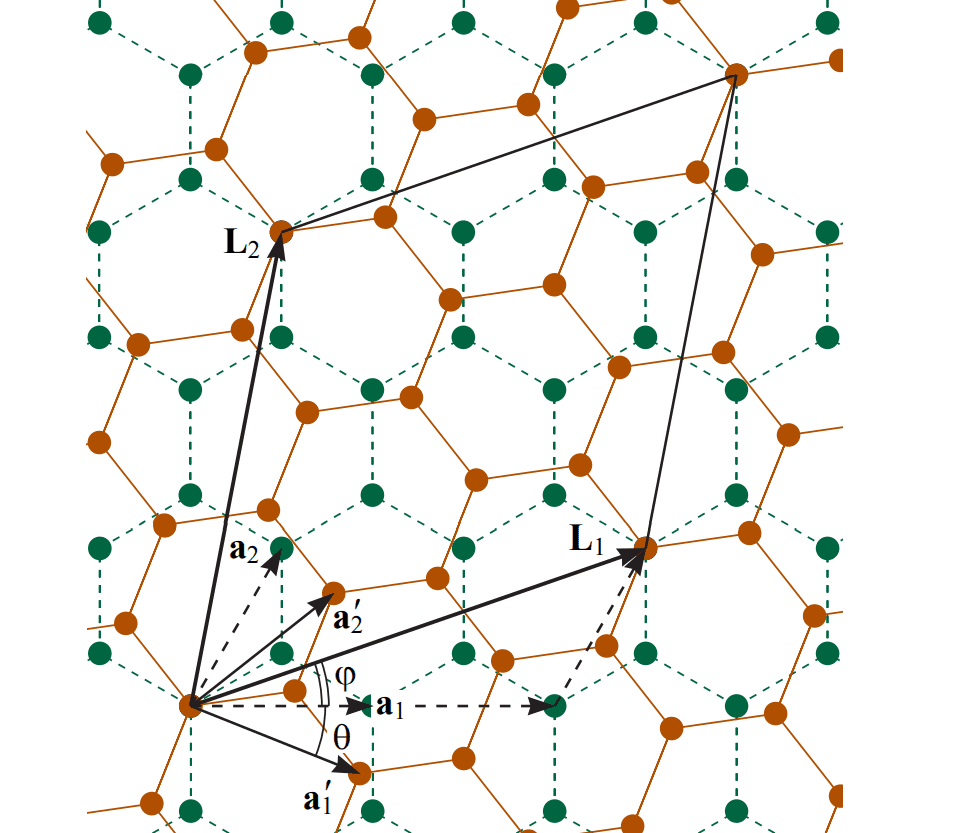
Scientists investigated interlayer interactions in twisted bilayer graphene using density functional theory calculations, focusing on the potential energy surface for relative layer displacement. The study centered on moiré patterns created by twisting graphene layers with (2,1) and (3,1) commensuration, employing the vdW-DF3 functional to accurately model van der Waals interactions. Researchers constructed atomic models of twisted bilayers, defining the twist angle and moiré pattern lattice vectors to establish the geometry for calculations. The team computed the potential energy surface, revealing corrugations of 0.
4 and 0. 03 electron volts per atom for the (2,1) and (3,1) patterns, respectively. Structural relaxation doubled the corrugation for the (2,1) pattern while minimally affecting the (3,1) pattern. This work pioneered a detailed analysis of how potential energy minima and maxima shift with interlayer distance in moiré patterns, a phenomenon not observed in aligned layers. Researchers approximated the potential energy surface using only the first spatial Fourier harmonics, confirming this approach accurately describes the PES shape both with and without structural relaxation.
To estimate a barrier to rotation towards an incommensurate state, the team leveraged this approximated PES, aiming to understand the robustness of superlubricity in these systems. Furthermore, the study derived measurable physical properties, including shear mode frequency, shear modulus, and static friction force, directly related to interlayer interactions, providing avenues for experimental verification of the computational results. Researchers predicted the existence of domain walls separating commensurate domains within the moiré pattern, estimating their characteristics based on the computed potential energy surface. The team established a framework for relating the potential energy surface to measurable physical properties, enabling direct comparison between theoretical predictions and experimental observations.
Twisted Graphene Reveals Remarkably Low Friction Potential
This work presents a detailed investigation of interlayer interactions in twisted bilayer graphene, revealing the potential for extremely low friction and robust superlubricity. Scientists performed accurate density functional theory calculations to map the potential energy surface (PES) for relative displacement of graphene layers forming specific moiré patterns, namely (2,1) and (3,1). The calculations demonstrate that the PES exhibits corrugations with amplitudes of 0. 4 and 0. 03 electron volts per atom for the (2,1) and (3,1) patterns, respectively.
Importantly, accounting for structural relaxation doubles the PES amplitude for the (2,1) pattern, while minimally affecting the (3,1) pattern. Researchers discovered a unique behavior in moiré patterns where the positions of PES minima and maxima switch upon changes in interlayer distance, a phenomenon not observed in aligned layers. The shape of the PES is accurately described using the first spatial Fourier harmonics, both with and without structural relaxation, confirming previous findings for commensurate layered systems. Based on the approximated PES, the team estimated a barrier for relative rotation of the layers into an incommensurate state, suggesting a mechanism for robust superlubricity.
Furthermore, the study derives a set of measurable physical properties related to interlayer interaction, including shear mode frequency, shear modulus, and static friction force. These predictions provide a pathway for experimental verification of the computational results and refinement of theoretical models. The team also predicts the existence of domain walls separating commensurate domains within the moiré patterns, estimating their characteristics and providing further avenues for experimental observation. Through accurate density functional theory calculations, the team mapped the potential energy surface for relative displacement of graphene layers forming specific moiré patterns, namely (2,1) and (3,1). These calculations demonstrate that the energy landscape, or potential energy surface, exhibits corrugations with amplitudes of 0. 4 and 0. 03 electron volts per atom for the (2,1) and (3,1) patterns, respectively.
👉 More information
🗞 Robust structural superlubricity of twisted graphene bilayer and domain walls between commensurate moiré pattern domains from first-principles calculations
🧠 ArXiv: https://arxiv.org/abs/2511.01338