The evolution of geometric shapes within a simplified model of quantum gravity exhibits behaviour strikingly similar to the expansion of the universe, according to research published by Iñaki Garay, Sergio Rodríguez-González, and Raúl Vera. Their work centres on the ‘two-vertex model’, a truncation of a more complex framework known as loop quantum gravity, which attempts to reconcile quantum mechanics with general relativity. The researchers demonstrate that polyhedra, representing the geometry of spacetime within this model, undergo a consistent homothetic expansion – a uniform scaling in size – mirroring the observed expansion of the universe as described by the Friedmann–Lemaître–Robertson–Walker (FLRW) metric. This correspondence suggests a potential link between the fundamental geometry of quantum spacetime and the large-scale cosmological behaviour of the universe.
Loop quantum gravity (LQG) explores the quantization of spacetime, and this research investigates the cosmological implications of a truncated model—the two-vertex model—and its connection to classical cosmology. Through the application of a spinorial formalism and the construction of frame bases, the authors demonstrate that the polyhedra defining the discrete geometry within this model undergo homothetic expansion. This expansion, coupled with prior findings establishing a correspondence between the model’s dynamics and the Friedmann equation, strengthens the argument for an emergent Friedmann-Lemaître-Robertson-Walker (FLRW) cosmological model within this LQG framework.
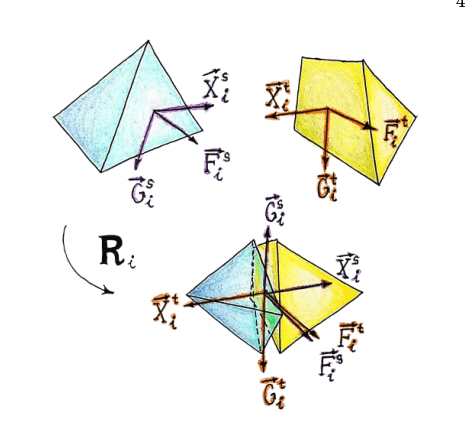
The study leverages the spinorial formalism to represent the holonomy-flux phase space, employing complex spinors to parameterize the geometry. This formalism describes the geometry associated with each node of the graph using pairs of complex numbers, representing holonomy and flux variables. These variables define the geometry at each link and node, and are subject to matching constraints ensuring consistency. A key development is the construction of frame bases that fully encode the twisted geometries associated with the graph structure of the two-vertex model, providing a complete description of the dynamics within the model. By analysing the evolution of these frame bases within the U(N)-reduced sector of the model—a sector exhibiting symmetry—the authors rigorously demonstrate the homothetic expansion of the constituent polyhedra. This expansion signifies a scaling of the geometry while preserving its shape, a characteristic feature of isotropic cosmological models.
The observed homothetic expansion, in conjunction with the reproduction of the Friedmann equation, establishes a compelling link between the discrete geometry of the U(N)-reduced sector and the continuous spacetime described by the FLRW metric. This suggests that the U(N)-reduced sector of the model provides a viable framework for understanding the emergence of classical cosmology from a quantum gravity theory. Future work could focus on extending these results to more complex graph structures, investigating the implications of quantum corrections, and exploring the potential for observational signatures of this emergent cosmology.
Note: Holonomy and flux are fundamental quantities in loop quantum gravity, representing geometric properties of spacetime. The Friedmann equation describes the expansion of the universe in standard cosmology, and the FLRW metric is a solution to Einstein’s field equations commonly used to model the universe. A U(N)-reduced sector simplifies calculations by imposing symmetry constraints.
More information
Homothetic expansion of polyhedra in the two-vertex model: emergence of FLRW
DOI: https://doi.org/10.48550/arXiv.2507.06951