

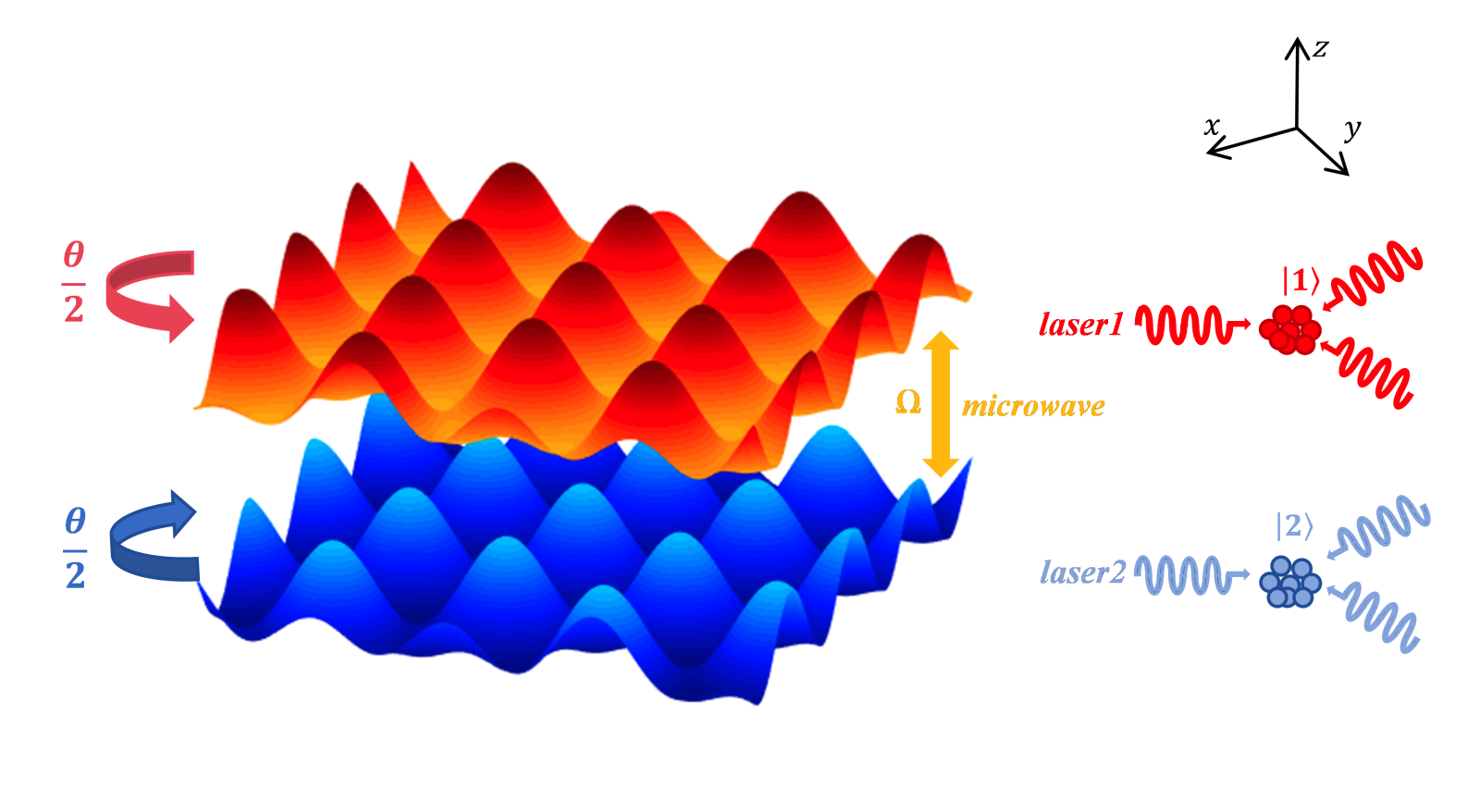
The creation of exotic states of matter receives a boost from new research into moiré quasicrystals, patterned structures exhibiting order without traditional repeating symmetry. Zhenze Fan, Meiling Wang, and Juan Wang, all from East China Normal University, alongside Yan Li, demonstrate a method for generating these patterns using ultracold atoms trapped in twisted layers of light. Their work reveals how carefully controlling the interactions between atoms allows the creation of a twelve-fold symmetric quasicrystal, mirroring structures found in other materials, and importantly, establishes a new approach to investigating these complex systems using tunable atomic lattices. This level of control over quasicrystal formation opens possibilities for exploring fundamental physics and potentially developing new technologies, including highly sensitive quantum measurement devices.
Researchers generate these patterns by manipulating intralayer atomic interactions within twisted bilayer hexagonal optical lattices of ultracold atoms, providing precise control over atomic arrangement and the formation of quasicrystals, structures exhibiting long-range order without translational symmetry. By tracking the density wave amplitude, the team partitions the dynamical system, enabling a detailed analysis of quasicrystal formation and properties, and exploring the fundamental physics of quasicrystals, potentially harnessing their unique properties for advanced materials and quantum technologies.
The system evolves through four distinct stages, and the team verifies pattern changes in both real and momentum space. Spatial symmetry is intimately tied to modulation amplitudes and frequencies; appropriately reducing the modulation frequency and increasing the amplitude facilitates lattice symmetry breaking and the subsequent emergence of rotational symmetry. Most notably, a twelve-fold (D12) moiré quasicrystal pattern emerges, closely resembling that observed in twisted bilayer graphene, with momentum-space patterns likewise exhibiting pronounced rotational symmetry and good agreement with real-space observations at specific parameters.
Twisted Lattices Host Exotic Bose-Einstein Condensates
This research focuses on creating and exploring novel quantum systems using twisted-bilayer optical lattices with Bose-Einstein Condensates (BECs), aiming to create artificial materials with unique properties by twisting two layers of optical lattices, similar to twisted bilayer graphene. Researchers create a twisted-bilayer optical lattice using lasers to trap and cool atoms, forming a BEC that mimics the structural and electronic properties of twisted bilayer materials. The work demonstrates the feasibility of creating these twisted lattices with BECs and explores the resulting quantum behavior, including modifications to the band structure, the emergence of novel quantum phases, and the effects of disorder.
The research builds upon and connects to several active areas, inspired by the discovery of unconventional superconductivity and correlated insulating behavior in twisted bilayer graphene, which the optical lattice setup aims to replicate in a more controllable and tunable system. Optical lattices are a powerful tool for simulating condensed matter physics, allowing researchers to create and control quantum systems with high precision, while Bose-Einstein Condensates provide a clean and well-defined system for studying quantum phenomena. The twisting creates a quasiperiodic structure, similar to quasicrystals, opening the possibility of exploring topological states and unique electronic properties, and the interplay between twisting and disorder is crucial, with the research investigating how disorder affects quantum behavior and whether Anderson localization occurs. The potential for observing a superfluid-insulator transition, a fundamental phenomenon in disordered bosonic systems, is also explored, alongside the dynamics of the BEC in the twisted lattice, potentially leading to the formation of complex patterns and excitations.
The research utilizes several important concepts and techniques, including band structure engineering, manipulating the energy bands of the system to achieve desired properties, and flat bands, energy bands with zero dispersion, leading to strong correlations and localized states. Topology, characterizing the topological properties of the band structure, can lead to robust and protected states, while quench dynamics, studying the response of the system to sudden changes in parameters, is also employed, alongside numerical simulations and advanced experimental techniques to create, control, and characterize the BEC in the twisted lattice.
This research has several potential implications, as the creation of twisted-bilayer optical lattices with BECs could lead to the discovery of new quantum materials with tailored properties and provide insights into fundamental questions about condensed matter physics, such as the nature of superconductivity and the behavior of disordered systems. The unique properties of these systems could be exploited for developing new quantum technologies, such as quantum sensors and quantum simulators, and future research directions likely include exploring different twisting angles and lattice geometries, investigating the effects of interactions between atoms, studying the dynamics of the system in more detail, developing new theoretical models to understand the observed phenomena, and extending the research to higher-dimensional systems. This work represents a promising avenue for exploring novel quantum phenomena and developing new quantum technologies by combining the principles of twisted bilayer materials, optical lattices, and Bose-Einstein condensates.
Floquet Engineering Creates Twelvefold Quasicrystal Patterns
This research demonstrates the creation of moiré quasicrystal patterns within ultracold atomic systems using Floquet-engineering, manipulating interactions within a twisted bilayer hexagonal optical lattice. By carefully controlling the modulation of these interactions, the team successfully generated a twelve-fold quasicrystal pattern closely resembling those observed in twisted bilayer materials, verified through analysis of both spatial arrangement and momentum-space characteristics, confirming the emergence of rotational symmetry. The findings introduce a novel approach to investigating quasicrystals and their symmetries, offering a new platform for their study using ultracold atoms, and the observed patterns exhibit a strong sensitivity to modulation frequency, suggesting potential applications in quantum precision measurement where this frequency dependence could be exploited. Further research is needed to explore the full range of achievable patterns and their properties, and future work could investigate the robustness of these patterns to imperfections and explore their potential for creating novel quantum states of matter.
🗞 Floquet-engineered moire quasicrystal patterns of ultracold atoms in twisted bilayer optical lattices
🧠 ArXiv: https://arxiv.org/abs/2508.21093


