

Quantum simulation represents a crucial pathway to harnessing the power of quantum computers, but limited access to quantum hardware demands increasingly sophisticated simulation techniques. Siddharth Dangwal, Tina Oberoi, and Ajay Sailopal, all from the University of Chicago, along with their colleagues, address this challenge with a new approach called TUSQ, Tracking, Uncomputation, and Sampling for Noisy Quantum Simulation. Their method significantly accelerates simulations of noisy quantum circuits by intelligently reducing redundant calculations and reusing computational resources, a process facilitated by representing circuits as a tree and employing a rollback-recovery technique. The team demonstrates substantial speedups, averaging 23x over existing methods and 17x over CUDA-Q for a comprehensive set of benchmarks, with even greater improvements observed for larger, more complex quantum circuits, bringing scalable quantum simulation closer to reality.
The research addresses the computational expense of simulating quantum circuits, particularly those with many qubits and complex operations, which hinders the development and validation of quantum algorithms. The paper introduces Tqsim, a novel simulator that tackles this challenge by intelligently reusing computations. Tqsim’s core idea involves decomposing large quantum circuits into smaller, reusable subcircuits organized into a tree structure.
This allows the simulator to efficiently identify and reuse common computational patterns, significantly reducing redundant calculations and accelerating the simulation process. Importantly, Tqsim also supports realistic noise modeling, enabling the simulation of noisy quantum computations crucial for reflecting the behaviour of real quantum hardware. The results demonstrate substantial performance improvements compared to state-of-the-art simulators like SV-Sim and Qiskit Aer, especially for noisy simulations. The tree-based reuse approach allows Tqsim to scale to larger qubit counts and circuit depths than many existing simulators, confirming that a significant portion of the computation in quantum circuits can be avoided through reuse. Quantum computers hold the promise of revolutionizing fields like medicine and materials science, but limited access to actual quantum hardware necessitates powerful simulation tools. TUSQ addresses this challenge by mimicking the behaviour of noisy quantum hardware with greater efficiency than existing methods. TUSQ incorporates a module that identifies and eliminates redundant calculations, ensuring that each computation contributes unique information.
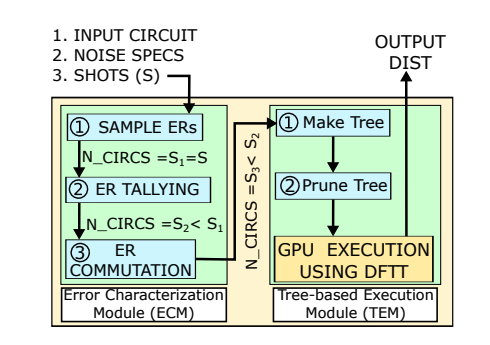
This “Error Characterization Module” intelligently tracks circuit executions, reducing the overall computational load without sacrificing accuracy. Building on this, TUSQ employs a “Tree-based Execution Module” that further optimizes the process by reusing previously computed results, representing calculations as a tree structure to “roll back” and adapt prior results to new scenarios. The results demonstrate a substantial performance improvement, with TUSQ achieving an average speedup of 52. 5 times and 12. 53 times compared to leading simulators like Qiskit and CUDA-Q across a suite of 186 benchmark tests.
For larger circuits exceeding 15 qubits, the speedup increased to 55. 42 times and 23. 03 times respectively, with some cases exceeding 7800 times. This leap in performance allows researchers to simulate circuits with greater complexity and scale, pushing the boundaries of quantum algorithm development. The team successfully simulated a 30-qubit Adder circuit on a single Nvidia A100 GPU in just over 13 minutes, a task that would take more than 10 hours on comparable simulators. The open-source release of the code promises to further accelerate innovation in the field.
TUSQ Simulator Dramatically Speeds Noisy Circuit Modelling
The research presents TUSQ, a new simulator designed to efficiently model the behaviour of noisy quantum circuits, which is crucial as quantum computers grow in complexity. TUSQ addresses the challenge of accurately representing noise while maintaining computational speed. The simulator achieves this through two key modules: the Error Characterization Module, which reduces redundant calculations, and the Tree-based Execution Module, which reuses computations across multiple circuits represented as a tree structure. Evaluations demonstrate that TUSQ significantly outperforms existing simulators, achieving an average speedup of 52. TUSQ demonstrates substantial gains over the recently proposed Tqsim simulator, achieving an average speedup of 68. 6 times. This work was supported by multiple grants focused on advancing quantum computing research and infrastructure.
🗞 Noisy Quantum Simulation Using Tracking, Uncomputation and Sampling
🧠 ArXiv: https://arxiv.org/abs/2508.04880


