
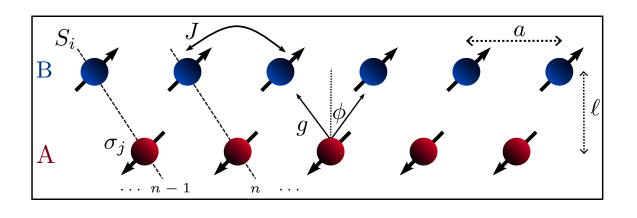
The behaviour of interacting magnetic systems presents a long-standing challenge in condensed matter physics, and recent research explores how to precisely control magnetic order within complex materials. Rafael D. Soares of the Max Planck Institute for the Physics of Complex Systems, alongside J. M. Viana Parente Lopes from the Universidade do Porto and Hugo Terças of the Instituto Politécnico de Lisboa, investigated the magnetic properties of coupled spin chains subject to a chiral interaction. Their work demonstrates the ability to tune magnetic order, revealing how the strength and orientation of this interaction dictates the formation of distinct antiferromagnetic phases. This control over magnetic arrangements represents a significant step towards designing materials with tailored magnetic properties for potential applications in data storage and spintronics.
Topological Superconductivity and Majorana Fermion Hosting
This research details a theoretical model of a topological superconductor, a material capable of hosting exotic quasiparticles called Majorana fermions. The model investigates a one-dimensional system comprising two interconnected sublattices, designed to exhibit the properties necessary for supporting these unusual particles. The core of the model is a mathematical description that accounts for electron movement, Cooper pairing, essential for superconductivity, and interactions between the sublattices, all controlled by specific parameters. The central goal of this work is to demonstrate the emergence of Majorana fermions as zero-energy modes at the edges of the system.
These particles are unique because they are their own antiparticles, a property with significant implications for quantum computing. Scientists characterized the system using a topological invariant, revealing that a specific value indicates the presence of Majorana edge modes. The model predicts a phase diagram mapping the conditions under which the system transitions between a normal state and a topological phase supporting Majorana fermions. Calculations confirm that these Majorana modes are localized at the edges of the system, as evidenced by the distribution of electronic states. This model shares similarities with the well-known Kitaev chain, but the inclusion of the sublattice structure introduces new features and complexities.
Chiral Spin Chains and Fermion Mapping
Scientists investigated the magnetic behavior of two interconnected spin chains, each composed of two-level systems arranged in a triangular geometry. The chains interact through a chiral connection, meaning the interaction depends on the relative orientation of the spins. Researchers characterized this interaction by its strength and a geometric angle, representing the phase of the complex coupling between neighboring spins. To analyze this complex system, the team mapped the spin model to a description involving fermions, allowing for both analytical calculations and numerical simulations. This approach enabled scientists to determine how the coupling strength and geometric angle influence the critical lines separating distinct magnetically ordered phases.
Numerical analysis, combined with analytical approximations, revealed that the geometric angle can shift the position of these critical lines and even suppress transitions between phases. The study established that the critical behavior consistently falls within the Ising universality class, regardless of the geometric phase. Scientists inspected the spin-spin correlation function to characterize the resulting magnetic order, demonstrating the formation of two types of antiferromagnetic stripes. The orientation of these stripes is tunable through the interaction angle, while the system also exhibits non-collinear orders characterized by a finite vector spin chirality on each chain. This research highlights the crucial role of the chiral interaction in shaping the underlying magnetic order and controlling the system’s quantum phase transitions.
Chiral Interactions Drive Magnetic Phase Transitions
This work details a study of two interconnected spin chains, designed to reveal novel magnetically ordered phases and the influence of their arrangement on their behavior. Scientists investigated how the chains interact through a chiral connection, parameterized by both its strength and a geometric angle defining the relative spin orientations. Through a combination of analytical mapping and numerical simulations, the team constructed a detailed ground-state phase diagram, identifying critical lines that separate distinct magnetic phases. Experiments revealed that the geometric angle can significantly shift or even suppress transitions between these phases.
By increasing the coupling strength between the chains, the system undergoes a phase transition, resulting in the formation of two distinct types of in-plane antiferromagnetic stripes, with the stripe orientation dictated by the geometric angle. Notably, the chiral interaction induces a non-trivial vector spin chirality, exhibiting opposite orientations on each chain. This chirality emerges smoothly from a decoupled state, occurring for angles differing from zero and π, where collinear order is favored instead. To explore this complex system, scientists mapped the spin Hamiltonian to a fermionic representation, simplifying the analysis and allowing for analytical approximations. Further investigation utilized advanced numerical calculations, ensuring accurate results. These calculations allowed the team to compute spin-spin correlation functions, low-lying energy levels, and entanglement properties, providing a comprehensive understanding of the system’s ground state.
Chiral Interaction Controls Magnetic Stripe Order
This research establishes a comprehensive ground-state phase diagram for two spin chains connected by a chiral interaction, demonstrating control over magnetic order through both the interaction’s strength and a geometric angle between the chains. The team identified critical lines separating distinct magnetically ordered phases, revealing that the geometric angle can both shift and completely suppress the transitions between these phases. Increasing the coupling strength drives a phase transition, resulting in the formation of two types of in-plane antiferromagnetic stripes, with the stripe orientation dictated by the geometric angle. Notably, the chiral interaction induces a finite vector spin chirality with opposite orientations on the two chains, emerging smoothly from the decoupled limit and vanishing at specific angles where collinear order is favored.
Within the symmetric phase, this chirality grows with interaction strength, but is limited by the approach to the phase transition, while in the symmetry-broken phase, it is strongly suppressed by the development of collinear in-plane order. The critical exponents associated with the transition were found to align with the Ising universality class, regardless of whether the interaction strength or geometric angle is used to tune the system. This research provides a detailed understanding of how to manipulate magnetic order in coupled spin chains, offering potential insights for the design of novel magnetic materials.
👉 More information
🗞 Tunable Magnetic Order in Chiral Coupled Spin Chains
🧠 ArXiv: https://arxiv.org/abs/2509.10286