Researchers at Tsinghua University in China, led by Zihan Geng, have developed a 3D tracking method that is over 200 times faster than traditional methods. The technology, based on single-pixel imaging, can track fast-moving objects in real-time, potentially improving autonomous driving, industrial inspection, and security surveillance systems. The method requires minimal computational resources and storage space, making it more cost-effective and efficient. However, the technology currently can only track a single object. The research was published in the Optica Publishing Group journal Optics Letters.
Revolutionary 3D Tracking Method Achieves Unprecedented Speeds
Researchers have developed a novel 3D tracking method that can monitor fast-moving objects at speeds over 200 times faster than traditional methods. This innovative approach, based on single-pixel imaging, has the potential to significantly enhance autonomous driving, industrial inspection, and security surveillance systems.
The team, led by Zihan Geng from Tsinghua University in China, has designed a system that does not necessitate the reconstruction of the object’s image to calculate its position. This feature significantly reduces data storage and computational costs. Specifically, acquiring a 3D coordinate requires only 6 bytes of storage space and 2.4 µs of computation time. This efficiency could lower the cost of equipment needed for high-speed tracking, making the technology more accessible and enabling new applications.
Single-Pixel Imaging: The Core of the New Tracking Method
The new tracking method is based on single-pixel imaging, a computational method that acquires measurements using a single detector, rather than the traditional array of pixels. This method typically involves illuminating a scene with a sequence of patterns and then measuring the corresponding intensity values with a single-pixel detector.
To make this system more practical for object tracking, the researchers implemented a non-orthogonal projection approach, which is more efficient than the orthogonal method typically used. This involves projecting geometric light patterns onto two non-orthogonal planes, which creates 3D coordinates used to calculate the object’s position. Non-orthogonal projection also reduces the overall system size, making it easier to assemble and implement.
High-Speed Tracking: Testing and Validation
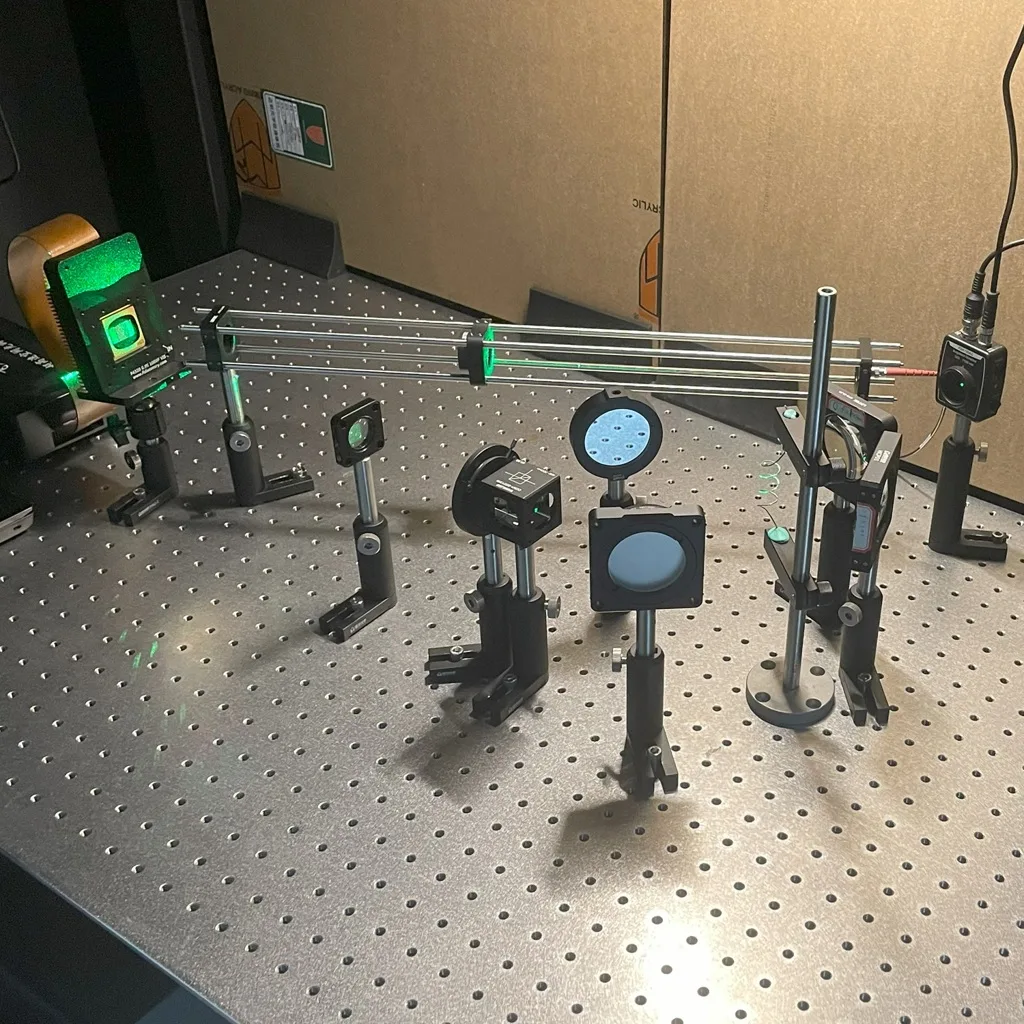
After validating their method using simulations, the researchers conducted experiments using a single-pixel imaging setup that included a 532 nm laser for active illumination, a digital micromirror device (DMD) with a 20kHz modulation rate to create the light patterns, and two single-pixel detectors to collect the light signals.
To test the tracking ability, they allowed a metal sphere with a central hole to move down a curved spiral wire under gravity while being illuminated with light patterns. They used the detectors’ signals to calculate the object’s 3D position and then used coordinate system rotation to obtain the calculated motion trajectory of the object. With this approach, they achieved a tracking rate of 6667 Hz with the DMD at a modulation rate of 20kHz.
The primary challenge with this technology is that it can currently only be used to track a single object. The researchers are now developing methods that will allow multiple objects to be tracked with single-pixel imaging. This advancement could further enhance the perception abilities of technologies like self-driving cars, improve security surveillance systems, and offer more efficient monitoring and quality control for industrial inspection.
External Link: Click Here For More