

The quest for practical quantum computation relies on generating complex quantum states, known as magic states, but creating these states typically demands significant resources. Varun Menon, J. Pablo Bonilla Ataides, and Rohan Mehta, all from Harvard University, along with their colleagues, present a new approach to magic state generation using a specially designed class of quantum codes called tricycle codes. These codes, building on previous work with bicycle codes, offer a potentially transformative improvement by enabling the creation of multiple magic states within a single processing step, bypassing the need for repeated and costly distillation procedures. The team demonstrates, through both theoretical analysis and numerical simulations, that tricycle codes support efficient, low-overhead magic state distillation with a remarkably high tolerance for errors in quantum circuits, paving the way for more scalable and robust quantum computers.
Quantum low-density parity check (LDPC) codes, when equipped with specific quantum operations, offer a promising route to reducing the resources needed for fault-tolerant quantum computation. Researchers are exploring these codes to simplify the creation of ‘magic states’, essential building blocks for universal quantum computers, and to bypass the need for complex, multi-step refinement processes. This work introduces a new class of quantum codes, termed ‘tricycle codes’, which generalize earlier ‘bicycle codes’ and enable efficient magic state generation.
Topological Codes from Group Cohomology
Researchers are employing advanced mathematical tools from algebraic topology and group theory to construct quantum error-correcting codes in a more systematic and principled way. This approach moves beyond traditional, ad-hoc code design by leveraging concepts like cochain complexes and cohomology to create codes with desirable properties. These mathematical structures provide a framework for encoding the rules of a code, allowing researchers to build codes with improved performance and efficiency. Cochain complexes and cohomology are used to represent classical codes and define the logical qubits protected by the code.
The use of balanced products and group algebras allows for the incorporation of symmetries into the code’s structure, leading to more compact and efficient designs. These techniques provide a mathematically rigorous way to analyze code properties, such as its ability to correct errors and protect quantum information. By systematically constructing codes using these tools, researchers aim to create a foundation for more advanced and powerful quantum error correction schemes. Essentially, this approach provides a set of rules for building quantum codes, ensuring a strong and stable structure capable of protecting quantum information. The symmetries incorporated into the design are akin to using identical building blocks in a repeating pattern, simplifying construction and improving efficiency.
Tricycle Codes Simplify High-Fidelity State Generation
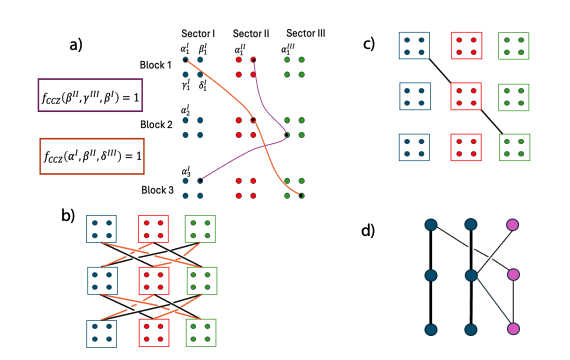
Researchers have developed a new approach to generating high-fidelity quantum states, essential resources for universal quantum computation, with significantly reduced overhead compared to existing methods. Current techniques for preparing these states, known as magic state distillation, often require multiple stages of refinement and substantial qubit resources, creating a bottleneck in building practical quantum computers. This new method utilizes a specially designed class of quantum codes, termed ‘tricycle codes’, which streamline the distillation process. These tricycle codes build upon earlier ‘bicycle codes’ and are uniquely capable of supporting complex quantum operations, specifically a three-qubit gate, directly within the code itself.
This allows for the creation of multiple high-quality magic states in a single step, circumventing the need for repeated distillation cycles. The key innovation lies in the codes’ structure, enabling a ‘single-shot’ preparation of magic states, meaning a high-fidelity state is produced directly without iterative refinement. This represents a substantial improvement over protocols that require multiple stages to achieve comparable fidelity. Importantly, the researchers demonstrate that these codes can function effectively even in the presence of realistic circuit noise. Simulations reveal a high circuit-noise threshold exceeding 0.
4%, indicating a robust performance and potential for practical implementation. The team has also designed efficient circuits for extracting information about errors within the code, crucial for correcting them and maintaining the integrity of the quantum computation. The researchers have outlined a specific implementation of these codes using a reconfigurable neutral atom array, a promising platform for building quantum computers, demonstrating the practical feasibility of the approach and paving the way for low-overhead magic state distillation in a real-world quantum device.
Tricycle Codes Distill High-Fidelity Magic States
This research introduces tricycle codes, a new class of quantum error correcting codes designed to improve the efficiency of preparing high-fidelity ‘magic states’ essential for universal quantum computation. The team demonstrates that these codes support transversal circuits capable of implementing complex logical operations, specifically a CCZ gate, between multiple code blocks. Importantly, the codes enable a single-shot distillation process, meaning they can refine noisy input states into high-fidelity outputs without the need for multiple rounds of distillation typically required by existing methods. Numerical simulations confirm the robustness of tricycle codes under realistic circuit noise, achieving a circuit-noise threshold exceeding 0.
4% when using a specific decoding method. The researchers also designed optimal circuits for extracting syndrome information from the codes and propose a protocol for implementing these on a reconfigurable neutral atom array platform, suggesting a pathway towards practical implementation. While further research is needed to explore the full potential of these codes, the findings represent a significant step towards reducing the overhead associated with magic state distillation and advancing fault-tolerant quantum computation. The authors note that exploring alternative designs and optimisations could further enhance performance and that investigating the scalability of these codes to larger systems and exploring their compatibility with different quantum computing architectures may prove beneficial.
🗞 Magic tricycles: efficient magic state generation with finite block-length quantum LDPC codes
🧠 ArXiv: https://arxiv.org/abs/2508.10714


