The pursuit of understanding topological order in condensed matter physics continues to reveal unexpected phases of matter exhibiting exotic properties. Recent research demonstrates that even well-established models of topological order, such as the chiral toric code, can harbour further emergent phases when subjected to specific perturbations. Robin Schäfer, Claudio Chamon, and Chris R. Laumann, alongside their colleagues, detail these findings in their article, “Hall-on-Toric: Descendant Laughlin state in the chiral toric code”. Their work identifies novel “Hall-on-Toric” states, hierarchical phases featuring fractionalized charges and increased topological ground-state degeneracy, which appear within the chiral toric code under particular conditions and are confirmed through extensive numerical simulations utilising infinite density matrix renormalisation group techniques. These states, characterised by analysis of topological entanglement entropy, entanglement spectra, and a generalized Hall conductance, demonstrate robustness even without the need for symmetry protection, offering a deeper understanding of emergent excitations within topologically ordered systems.
Recent investigations have detailed the discovery of novel emergent topological phases, termed Hall-on-Toric, within the framework of the chiral toric code —a model system in condensed matter physics. These phases exhibit a more complex topological structure than previously understood, characterised by fractionalised charges and an increased degeneracy of the ground state, meaning multiple distinct quantum states possess the same lowest energy. This increased complexity arises at transitions between deconfined phases, states of matter where constituent particles are not bound together under a fixed, non-trivial magnetic flux.
The existence and properties of these Hall-on-Toric phases are confirmed through extensive numerical simulations employing the infinite density matrix renormalisation group (iDMRG) technique. iDMRG is a computational method used to approximate the quantum state of a many-body system, enabling researchers to study systems that are too complex for analytical solutions. Analysis centres on key indicators of topological order, including topological entanglement entropy, which quantifies the long-range entanglement within the system, entanglement spectra, which reveal the nature of these entangled states, and a generalised Hall conductance, a measure of how charge carriers respond to a magnetic field.
A particularly significant finding is the robustness of
A particularly significant finding is the robustness of these phases, persisting even without the protective symmetry often required for topological order. This resilience is crucial for potential practical applications, as it suggests these phases are less susceptible to environmental disturbances that can disrupt quantum states. Researchers propose this robustness enhances the potential for developing novel quantum materials and devices, offering a pathway towards more stable and reliable quantum technologies.
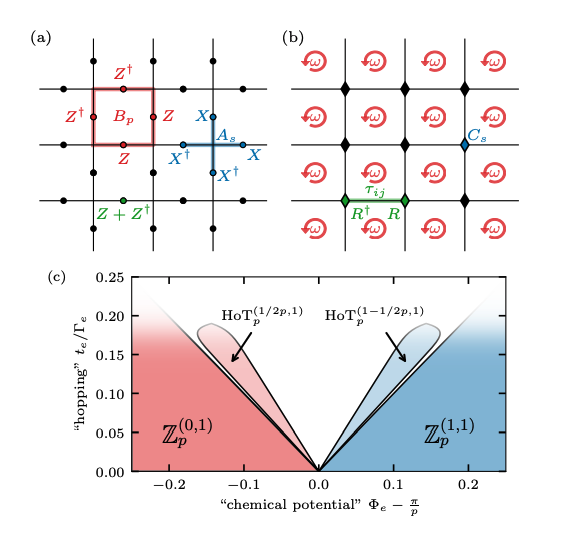
Within the chiral toric code, star and plaquette defects function as magnetic and electric excitations, representing fundamental quasi-particles. This research reinforces this understanding and extends it, demonstrating how these excitations influence the emergence of the Hall-on-Toric phases, highlighting the interplay between quasi-particle behaviour and the formation of novel topological states.
Investigations into the behaviour of charge sectors, representing different charge states within the system, during adiabatic evolution – a slow, gradual change in the system’s parameters – reveal distinct behaviours depending on the underlying charge model. The continuous charge model, described by U(1) symmetry, exhibits a uniform shift of charge sectors by one unit under a magnetic flux of 4π. Conversely, the discrete charge model, characterised by Zp symmetry, displays a cyclic change of charge sectors modulo ‘p’, effectively wrapping around the range of possible charge states. Numerical verification, through the calculation of differences in weight distribution (ΔZp and ΔU(1)) for p values of 4, 5, and 6, confirms these theoretical predictions, demonstrating a strong correspondence between theoretical modelling and computational simulation. The concentration of weights within a small number of consecutive charge sectors further characterises the behaviour of the U(1) model, providing additional insight into its properties.
Future research will focus on exploring the implications
Future research will focus on exploring the implications of these findings for the development of novel quantum materials and devices. Researchers anticipate that this work will contribute to a deeper understanding of topological phases of matter and their potential applications in quantum technologies, potentially paving the way for more robust and efficient quantum computing and communication systems.
🗞 Hall-on-Toric: Descendant Laughlin state in the chiral toric code
🧠 DOI: https://doi.org/10.48550/arXiv.2507.02035