
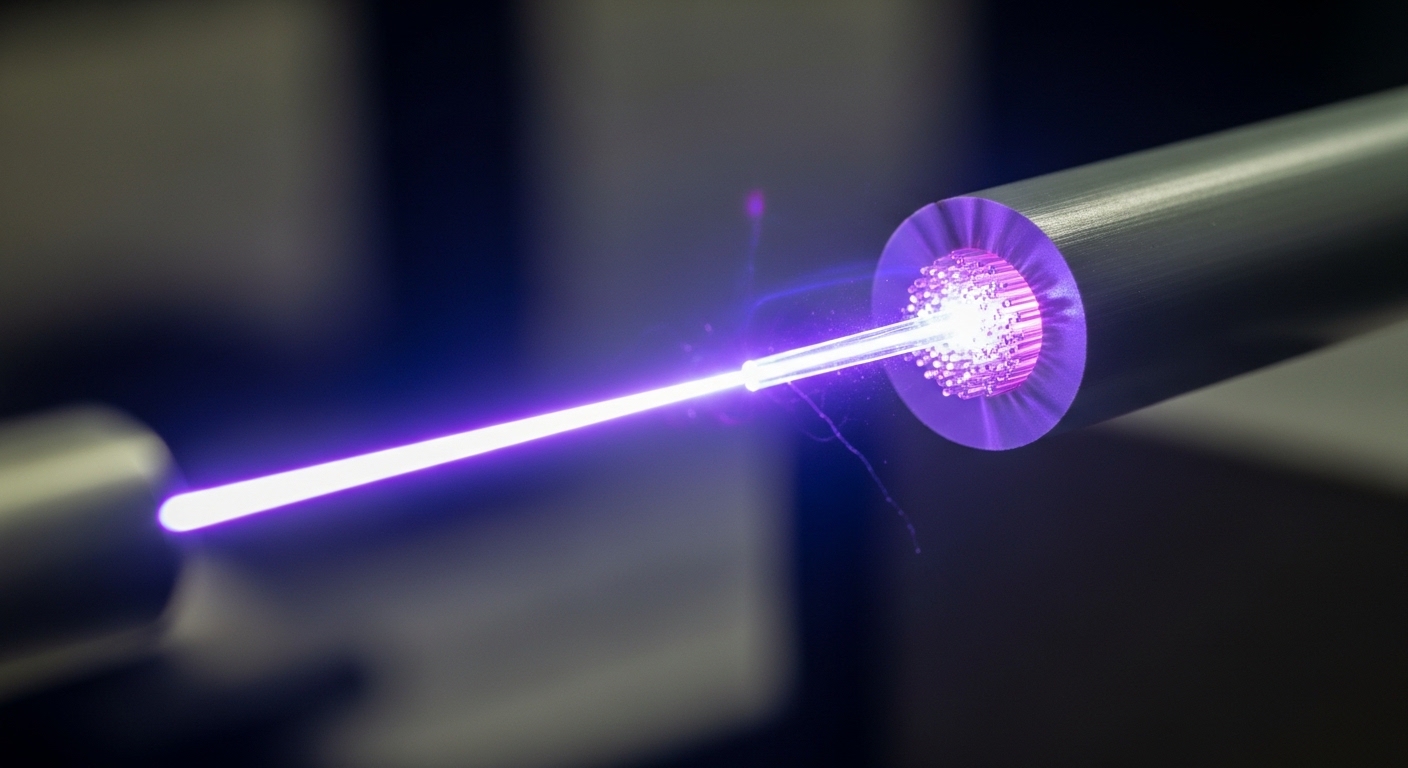
Researchers are developing increasingly compact and efficient laser technologies for integrated photonics. Like Shui, Ruixuan Yi, and Chenyang Zhao, from Northwestern Polytechnical University, alongside Jinlong Lu, Xiaotong Zhang, and Jiaqiao Zhang et al., report a novel erbium-doped tantalum oxide microring laser fabricated using a Damascene process. This work is significant because it achieves a record slope efficiency of 2.76% for Er:Ta2O5 lasers, along with stable single-mode operation and a narrow linewidth of 9.5 pm. The demonstrated device offers a scalable route towards high-performance, tunable on-chip light sources and advances monolithic active-passive integration on the tantalum oxide platform.
This breakthrough addresses a critical need for efficient, miniaturised light sources in integrated photonics, which are essential for advancements in optical communications, sensing, and microwave photonics.
The research details a novel microring laser design, monolithically integrated via a customised Damascene process, achieving a low propagation loss of 0.73 dB/cm and a high intrinsic Q-factor of 5.03x 10⁵ within the Er:Ta2O5 gain medium. A hybrid cavity, comprising a microring coupled to a U-shaped waveguide, leverages the Vernier effect to ensure robust and stable longitudinal mode selection.
Under a 1480nm pumping scheme, the fabricated laser delivers a side-mode suppression ratio of 53.3 dB and a narrow linewidth of 9.5pm, demonstrating exceptional spectral purity. Crucially, a slope efficiency of 2.76% has been attained, representing the highest value reported to date for Er:Ta2O5 lasers, with a lasing threshold of 3.3mW.
This significant improvement in energy conversion efficiency overcomes limitations inherent in previous designs, such as Fabry-Pérot cavities and microdisk resonators. Furthermore, the device exhibits stable single-mode tuning across a temperature range of 18 to 68 degrees Celsius, consistently aligning with theoretical transfer matrix models.
The laser’s compact footprint, measuring only 6.2x 2.3mm, and the use of a scalable Damascene process, pave the way for high-density, customisable on-chip photonic integration. This work establishes a viable pathway for creating high-efficiency, tunable light sources, bridging the gap towards fully integrated active-passive photonic circuits on the tantalum oxide platform.
Erbium tantalate microring laser fabrication and characterisation utilising a Vernier effect hybrid cavity demonstrates promising results
A customized Damascene process was used to monolithically integrate a high-performance, single-mode Er:Ta2O5 microring laser on a platform. The Er:Ta2O5 gain medium demonstrated a low propagation loss of 0.73 dB/cm and a high intrinsic Q-factor of 5.03x 10⁵. A hybrid cavity, consisting of a microring coupled to a U-shaped waveguide at two symmetric points, was fabricated to exploit the Vernier effect for robust longitudinal mode selection.
Non-resonant 1480nm pumping was implemented using a single-mode fiber-coupled laser (SPL-1480-800-FA-B, PatentGuru) launched into the device via lensed fiber coupling. Output signals were collected using a similar lensed fiber at the opposite facet, with estimated coupling losses of 6 dB/facet at 1550nm and 7.5 dB/facet at 1480nm.
The resulting laser yielded a side-mode suppression ratio (SMSR) of 53.3 dB and a narrow linewidth of 9.5pm. Measurements were performed at room temperature without active thermal stabilization, and emission spectra were characterized using an optical spectrum analyzer (OSA, AQ6375D, Yokogawa Inc.). A slope efficiency of 2.76% was achieved, representing the highest reported to date for Er:Ta2O5 lasers, alongside a lasing threshold of 3.3mW.
The on-chip output power was measured as a function of coupled pump power, revealing a maximum on-chip output power of 72.14 μW at a pump power of 29.24mW. Furthermore, stable single-mode tuning was demonstrated across a temperature range of 18, 68°C using a thermoelectric cooler (TEC) for precise temperature control.
Normalized emission spectra were recorded at 10°C increments, revealing a systematic redshift from approximately 1530nm to 1555nm as temperature increased. A side-mode suppression ratio exceeding 40 dB was consistently maintained throughout the temperature range, demonstrating the stability of the design.
Erbium tantalate microring laser performance characteristics and temperature-dependent wavelength tuning are reported
A low propagation loss of 0.73 dB/cm and a high intrinsic Q-factor of 5.03×10⁵ were achieved in the Er:Ta2O5 gain medium. The fabricated microring laser demonstrated a side-mode suppression ratio (SMSR) of 53.3 dB and a narrow linewidth of 9.5pm under a non-resonant 1480nm pumping scheme. A slope efficiency of 2.76% was obtained, representing the highest reported value to date for Er:Ta2O5 lasers, alongside a lasing threshold of 3.3mW.
Stable single-mode tuning was demonstrated across a temperature range of 18 to 68 degrees Celsius, consistently aligning with theoretical transfer matrix models. Measured wavelengths at various temperatures included 1528.84nm, 1528.91nm, and 1529nm for 18°C, 28°C, and 38°C, respectively, and 1556.18nm and 1556.2nm for 58°C and 68°C.
At 48°C, the spectrum exhibited multiple peaks at 1529.09nm, 1544.44nm, and 1556.03nm, indicating a transition regime with intensified mode competition. The maximum on-chip output power reached 72.14 μW, demonstrating efficient light generation within the integrated device. Simulated passive transmission characteristics of the hybrid cavity, derived via the transfer matrix method, closely matched the observed shift in experimental lasing peaks, confirming the temperature-dependent behavior of the resonant cavity.
Slight discrepancies between simulated and experimental wavelengths are attributed to localized gain-loss imbalances and nonlinear thermal gradients not fully accounted for in the static model. This work establishes a scalable pathway for high-efficiency, tunable on-chip light sources and monolithic active-passive integration on a tantalum oxide platform.
High-efficiency single-mode lasing from integrated erbium-doped tantalum oxide microresonators is demonstrated
Scientists have demonstrated a high-performance, single-mode erbium-doped tantalum oxide (Er:Ta2O5) microring laser integrated monolithically on a tantalum oxide platform using a customized Damascene process. The fabricated device exhibits a low propagation loss of 0.73 dB/cm and a high intrinsic quality factor of 5.03x 10⁵, enabling efficient light confinement within the microring cavity.
A hybrid cavity design, incorporating a microring coupled to a U-shaped waveguide, leverages the Vernier effect to ensure robust selection of a single longitudinal mode. This laser achieves a side-mode suppression ratio of 53.3 dB and a narrow linewidth of 9.5pm under non-resonant pumping at 1480nm. A slope efficiency of 2.76% represents the highest reported value for Er:Ta2O5 lasers, achieved at a lasing threshold of 3.3mW.
Stable single-mode operation was maintained over a temperature range of 18 to 68 degrees Celsius, consistent with theoretical transfer-matrix models. The authors acknowledge slight discrepancies between experimental and simulated transmission peaks, attributing these to complexities in gain-loss balance and nonlinear thermal gradients not fully accounted for in the static model.
Future work will concentrate on increasing output power through improved fiber-to-chip coupling, extending the gain region, integrating high-reflectivity components, and refining waveguide geometry to further reduce linewidth. These results establish a scalable pathway for high-efficiency, tunable on-chip light sources and facilitate monolithic active-passive integration, accelerating the development of miniaturized, high-performance erbium-based integrated lasers.
🗞 On-Chip Erbium-Doped Tantalum Oxide Microring Hybrid Cavity Single-Mode Laser
🧠 ArXiv: https://arxiv.org/abs/2602.00695