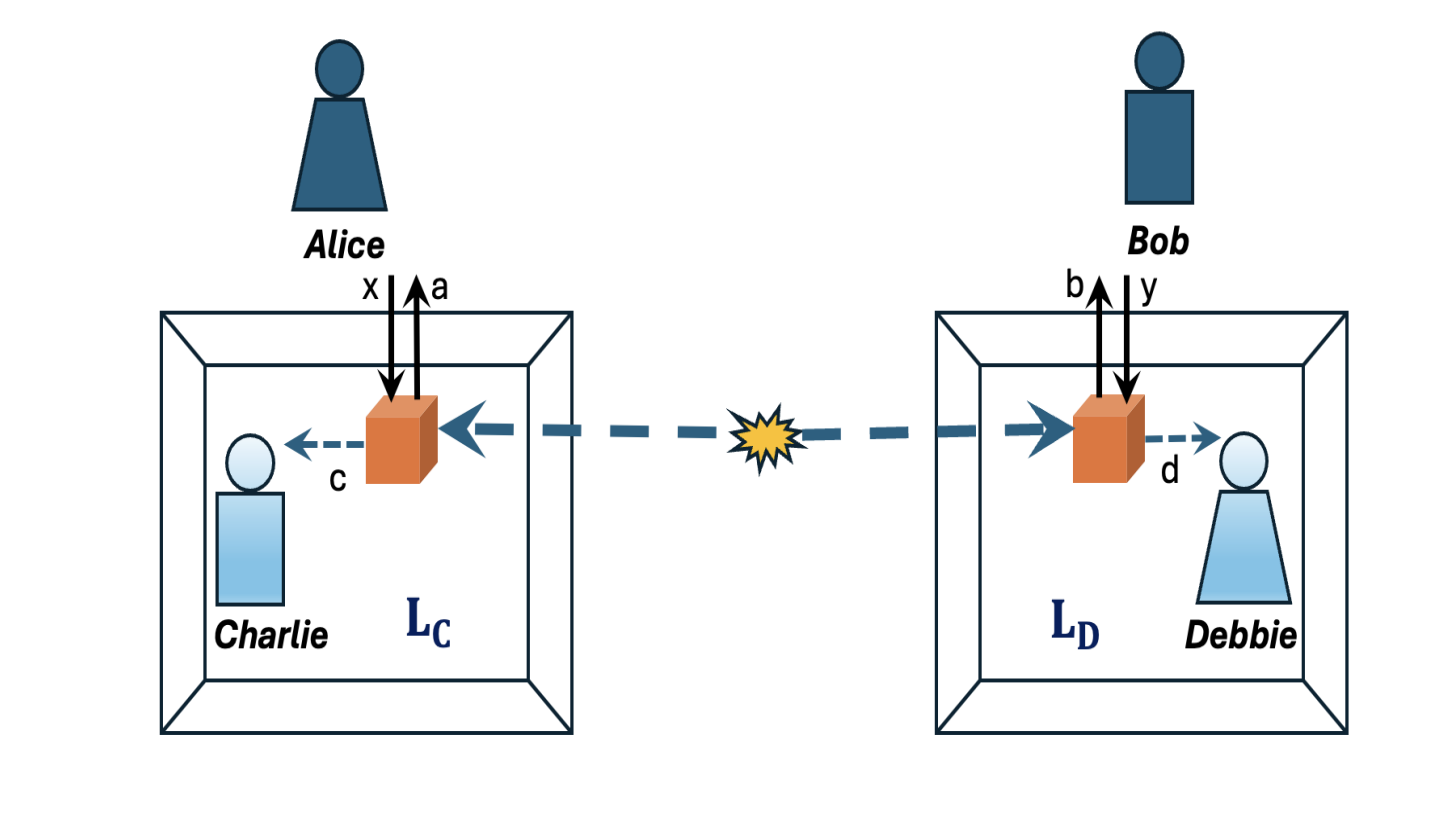
The fundamental notion that observed events possess a single, absolute truth, independent of the observer, faces increasing scrutiny from theoretical physics, and a new analysis by Sumit Mukherjee from the Indian Institute of Technology Dharwad and Jonte R. Hance from Newcastle and Bristol Universities, further challenges this assumption. Building upon recent work establishing limits to observer-independent reality, the researchers introduce the Causal Friendliness Paradox, a time-ordered extension of the well-known Wigner’s Friend paradox, to explore the boundaries of absoluteness in quantum mechanics. Their investigation demonstrates that standard quantum mechanics violates a newly derived causal inequality, revealing an incompatibility with commonly held beliefs about how observation defines reality, specifically the assumptions of absolute events, non-retrocausality, and the nature of measurement. This result not only reinforces the significance of Wigner’s Friend-type paradoxes in scenarios involving time, but also suggests that reconciling quantum mechanics with classical notions of absolute events requires a fundamental re-evaluation of our understanding of observation and reality itself.
The study establishes a theorem demonstrating that assigning absolute truth values to quantum events becomes impossible when observations are separated by time intervals allowing for signalling. This theorem extends previous work by explicitly considering relativistic scenarios and the implications of observers in relative motion. The approach involves a careful analysis of quantum measurements and the propagation of information within spacetime, utilising the framework of quantum mechanics and special relativity. Specifically, the team demonstrates that consistent assignment of absolute outcomes is fundamentally impossible without violating the principles of relativity.
These challenges question the assumption that events are absolute, suggesting that measurement outcomes are not independent of the observer. Within this framework, the standard locality assumption is replaced with Axiological Time Symmetry, and the consequences are explored when combined with the assumptions of Absoluteness of Observed Events and No Retrocausality.
Quantum Foundations, Interpretations and Early Debate
This extensive collection of papers and articles explores the foundations of quantum mechanics, covering a wide range of topics from hidden variable theories and interpretations of the wavefunction, to decoherence, contextuality, and the measurement problem. The work can be understood by examining key themes and their historical development. The collection begins with early attempts to grapple with the weirdness of quantum mechanics and propose alternative interpretations. Einstein, Podolsky, and Rosen first highlighted the apparent incompleteness of quantum mechanics in 1935, introducing the idea of local realism.
David Bohm later developed a hidden variable theory in 1952, offering a deterministic interpretation of quantum mechanics that postulates the existence of hidden variables guiding particle evolution, though this theory is non-local. Hugh Everett’s Many-Worlds Interpretation, proposed in 1957, offers a radical alternative, suggesting that every quantum measurement causes the universe to split into multiple branches, eliminating the need for wavefunction collapse. Leggett and Garg’s 1985 thought experiment tested the validity of macroscopic realism, exploring when quantum superposition breaks down. This section also covers the role of decoherence in explaining the transition from quantum to classical behavior.
Zurek’s 2003 review details decoherence, einselection, and the quantum origins of the classical world, explaining how quantum superposition is destroyed by interaction with the environment. Schlosshauer’s 2005 review further explores decoherence and interpretations of quantum mechanics. Kofler and Brukner’s 2007 work explores how the classical world can emerge from quantum physics under the restriction of coarse-grained measurements. The collection also delves into the concept of contextuality, which challenges the idea that quantum properties have definite values independent of the measurement context.
Spekkens’ 2005 work demonstrates that contextuality is a fundamental feature of quantum mechanics and cannot be explained by classical hidden variable theories. Leifer and Maroney’s 2013 work explores maximally epistemic interpretations of the quantum state and contextuality. Hardy’s 2013 work questions whether quantum states are real. Recent developments include Tezzin et al. ’s work on the counterfactual account of Lüdder’s rule and its implications for ontological models of quantum mechanics.
Hance et al. explore whether wavefunctions can simultaneously represent knowledge and reality. Adlam investigates the meaning of absoluteness of observed events. Walleghem et al. connect extended Wigner’s friend arguments and noncontextuality.
Adlam, Hance, Hossenfelder, and Palmer provide a taxonomy for physics beyond quantum mechanics. The collection also includes foundational resources like Nielsen and Chuang’s Quantum Computation and Quantum Information. The team demonstrates that standard assumptions about the nature of observation, specifically, the absoluteness of observed events, no retrocausality, and a form of time symmetry, are incompatible with the predictions of quantum mechanics. By formulating a new inequality, analogous to those found in Bell’s theorem, they show that mechanics violates this inequality, thereby challenging classical notions of objective reality. The work builds upon previous explorations of the Wigner’s Friend paradox, strengthening the argument against observer-independent facts by focusing on already observed events. Importantly, the researchers also explored a weaker form of the absoluteness of observed events, demonstrating that even with relaxed assumptions, quantum mechanics continues to resist reconciliation with classical intuitions.
🗞 Limits of Absoluteness of Observed Events in Timelike Scenarios: A No-Go Theorem
🧠 ArXiv: https://arxiv.org/abs/2510.26562