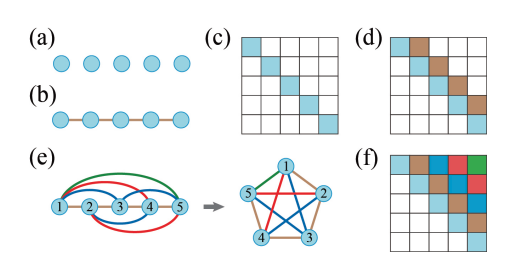
Highly entangled, multi-qubit states known as cluster states represent a crucial resource for advancing quantum communication and computation, yet creating cluster states tailored to specific applications remains a significant challenge. Jia-Jin Zou and Ze-Liang Xiang from Sun Yat-sen University, working with Jian-Wei Qin from Shanghai Jiao Tong University and Franco Nori et al., have now developed a new method for generating arbitrary cluster states using time-delayed feedback. This approach employs a novel matrix representation of the system, allowing researchers to optimise the generation process and minimise the number of feedback loops required, dramatically improving efficiency. The team demonstrates this by generating a complex tree-cluster state using only a single feedback loop, and importantly, assesses the impact of practical imperfections on the fidelity of the resulting quantum states, paving the way for more reliable quantum technologies
Photonic Cluster States and Quantum Repeaters
This research investigates the generation and control of light for applications in quantum computing and communication, areas poised to revolutionise information processing and security. A central focus lies on generating and manipulating photonic cluster states, which underpin measurement-based quantum computation, a promising paradigm for building powerful quantum processors. These states, unlike traditional quantum circuits requiring sequential gate operations, allow computation to proceed via a series of measurements on entangled photons, offering potential advantages in scalability and fault tolerance. Researchers are particularly interested in achieving deterministic generation of these states, a crucial step towards creating scalable quantum systems, as probabilistic generation severely limits the size and complexity of achievable computations. Overcoming the limitations of long-distance quantum communication also receives significant attention, with the inherent fragility of quantum states posing a major challenge to practical implementation. Photonic repeaters, devices that extend the range of quantum signals, are under development to combat photon loss in fiber optic cables, a phenomenon that exponentially degrades signal quality over distance.
These repeaters rely on the creation of near-deterministic photon emitters, sources that reliably produce single photons on demand, to enable universal quantum computation using photons. Traditional light sources emit a multitude of photons, making it difficult to isolate and control individual quantum carriers of information. Quantum dots, semiconductor nanocrystals exhibiting quantum mechanical properties, and single atoms trapped and cooled using laser techniques, are actively investigated as sources of single photons. These emitters, often integrated with nanophotonic structures, circuits with dimensions on the nanoscale, allow for precise control over photon emission characteristics, such as wavelength and polarization. Researchers are making substantial progress in achieving deterministic single-photon emission, overcoming the probabilistic behavior of many natural emitters, and improving the efficiency with which photons are collected and directed into optical fibers. This involves careful engineering of the emitter’s environment to suppress unwanted emission pathways and enhance the desired single-photon emission rate.
The manipulation of light’s properties is also a key area of investigation, extending beyond simple control of intensity and wavelength. Researchers explore chiral photonic structures, which twist light in a specific way to control polarization and direction, and to enhance the coupling between emitters and photons. Chirality, the property of being non-superimposable on its mirror image, introduces unique interactions with light, enabling the creation of novel optical devices. Furthermore, the creation of non-reciprocal devices, such as optical circulators that allow light to travel in only one direction, is crucial for building complex quantum circuits and protecting sensitive quantum information. Quantum feedback and control techniques are employed to improve the performance of quantum devices and correct errors, utilising real-time measurements to actively adjust system parameters and compensate for environmental noise. This feedback loop is essential for maintaining the coherence of quantum states, a prerequisite for successful quantum computation and communication.
Nanophotonic structures, including waveguides and cavities, are extensively used to confine and manipulate light at the nanoscale, enabling strong light-matter interactions and enhancing the efficiency of quantum processes. Waveguides act as optical channels, guiding light along a defined path, while cavities confine light, increasing the probability of interaction with embedded quantum emitters. Chiral structures are employed to control light’s polarization and direction, and to create non-reciprocal devices, while time-delayed feedback loops provide a means to control and manipulate quantum states with precision. The use of topological photonics, which utilises robust and protected quantum states arising from the topology of the photonic structure, is also explored, offering inherent resilience against imperfections and noise. Researchers are also investigating harnessing the spin and orbital angular momentum of light to control photon polarization and momentum, opening new avenues for quantum control and information encoding.
Researchers are also exploring exceptional points in non-Hermitian systems, a unique area of physics that offers potential for creating novel photonic devices with enhanced sensitivity and non-classical behaviour. Non-Hermitian systems, where energy is not conserved, exhibit unusual properties, such as unidirectional transmission and enhanced light-matter interactions. The research is grounded in fundamental principles of quantum optics, which describes the interaction of light and matter at the quantum level, providing the theoretical framework for understanding and predicting the behaviour of photonic systems. Quantum feedback theory provides the theoretical framework for designing and implementing quantum control systems, while topological physics offers insights into creating robust and protected quantum states. Understanding Landau-Zener transitions, where quantum systems jump between states under external fields, is crucial for controlling quantum processes, and spin squeezing, a technique for reducing quantum noise, enhances the precision of quantum measurements.
Overall, the research focuses on developing scalable quantum technologies by integrating deterministic sources, efficient control mechanisms, and robust architectures. Combining quantum phenomena with classical control techniques improves the performance of quantum devices, and researchers are actively exploiting novel physical phenomena, such as chirality, topology, and non-Hermitian physics, to create innovative quantum devices. A strong connection between theoretical modeling and experimental validation ensures the progress and reliability of the research, with computational simulations guiding experimental design and experimental results informing theoretical refinements. This iterative process is crucial for translating fundamental scientific discoveries into practical quantum technologies with real-world applications.
🗞 Efficiently Generation of Cluster States via Time-Delayed Feedback in Matrix Representation
🧠 DOI: https://doi.org/10.48550/arXiv.2507.15725