Ghost imaging, a technique that creates an image of an object without directly illuminating it, receives a significant boost from new research led by Shun Li, Jing-Yang Xiao Feng from Shanghai University, and Xiu-Qing Yang from Inner Mongolia University of Technology. The team, including Xiaodong Zeng and Xi-Hua Yang from Shanghai University, alongside M. Al-Amri, demonstrates a novel approach using thermal light and a ‘Zeno-like effect’ to dramatically reduce the amount of light absorbed by the sample, preventing damage commonly associated with imaging sensitive materials. This interaction-free ghost imaging scheme not only minimises harm to the object being imaged, but also enhances image quality by utilising more photons for reconstruction and actively suppressing background noise, offering a practical and cost-effective solution for non-destructive, high-resolution imaging in fields like life sciences.
This innovation utilizes classical light sources, such as thermal light, and a unique method that minimizes noise and potential damage to sensitive samples. By eliminating the need for entanglement, this method becomes more practical and accessible for a wider range of applications. This new technique offers several key advantages, including a simplified setup, increased robustness to noise, reduced risk of sample damage, and improved practicality for real-world applications.
The use of classical light sources and a streamlined setup makes the technique more accessible to researchers without specialized quantum optics equipment. The potential applications of this new ghost imaging technique are diverse, spanning medical imaging of sensitive biological samples, security screening for hidden objects, remote sensing at a distance, non-destructive testing of materials, high-resolution microscopy, and fast, efficient X-ray imaging with reduced radiation exposure. The technique’s ability to image delicate samples without causing damage makes it particularly well-suited for these applications.
Interaction-Free Ghost Imaging with Thermal Light
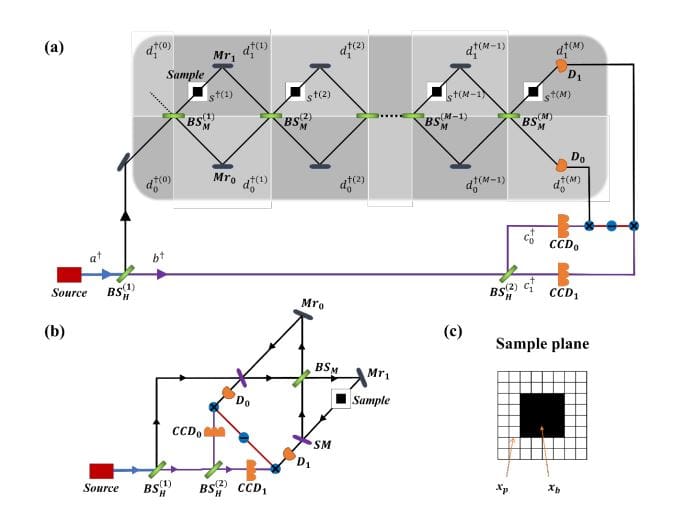
Researchers have developed a novel imaging technique that combines interaction-free measurement with thermal light ghost imaging, significantly reducing light-induced damage to sensitive samples. The team engineered a system employing a chain interferometer structure to manipulate the signal path, enabling multiple interactions while minimizing photon absorption by the sample. The team eliminated the need for entangled photon sources and single-photon detectors, simplifying the process and allowing for a substantially increased photon count per measurement, which enhances image quality and facilitates faster imaging speeds. The increased photon count enhances the signal-to-noise ratio, resulting in clearer images. Researchers demonstrated that by strategically introducing optical loss, they could actively suppress background noise, providing a new parameter for optimizing imaging performance. This active noise suppression further enhances image quality and allows for more accurate reconstruction of the imaged object.
Chain Interferometry Enables Damage-Free Ghost Imaging
Scientists have developed a novel ghost imaging scheme utilizing thermal light and a unique interaction-free measurement approach. This work significantly reduces light absorption by the sample, preventing damage typically induced by light-matter interactions, and enables markedly enhanced image quality. The system introduces a chain interferometer structure, directing light that would normally be absorbed by the sample towards a detector, while transmitting light through transparent regions to another detector. Experiments demonstrate that by employing this chain structure, the system effectively separates the signal and reference paths. The team precisely defined coefficients describing how light fields transform as they pass through these optical components, accounting for both transparent and opaque regions of the sample. Calculations reveal that as the number of interactions within the chain approaches infinity, the system achieves near-perfect photon transmission through transparent sample units.
Thermal Ghost Imaging Protects Delicate Samples
This research presents a novel ghost imaging technique utilizing a thermal light source, achieving high-quality images with significantly reduced light exposure to the sample. The team successfully eliminated the need for complex quantum light sources and single-photon detectors, overcoming challenges associated with quantum state preparation and detection efficiency. By employing a chain interferometer structure, the method reuses photons typically lost in conventional imaging, simultaneously inducing a quantum Zeno-like effect that minimizes optical damage to the imaged object. The results demonstrate that this approach not only protects light-sensitive samples from damage but also enhances image quality through increased measurement repetitions. Furthermore, the researchers discovered that controlled optical loss within the chain structure effectively suppresses background noise, consistently achieving a higher contrast-to-noise ratio than traditional thermal ghost imaging. This work offers a practical and cost-effective pathway for non-destructive, high-quality imaging, particularly suited for applications in the life sciences and other fields where preserving delicate samples is paramount.
👉 More information
🗞 Thermal interaction-free ghost imaging
🧠 ArXiv: https://arxiv.org/abs/2512.11709