Researchers have made significant progress in developing quantum computers that can factor large numbers, a task that is crucial for breaking certain types of encryption. According to a recent study, these computers can still achieve a non-negligible success probability even with high error rates. This challenges the conventional wisdom that quantum error correction is necessary for large-scale quantum computing. The study’s findings have implications for the development of practical quantum computers.
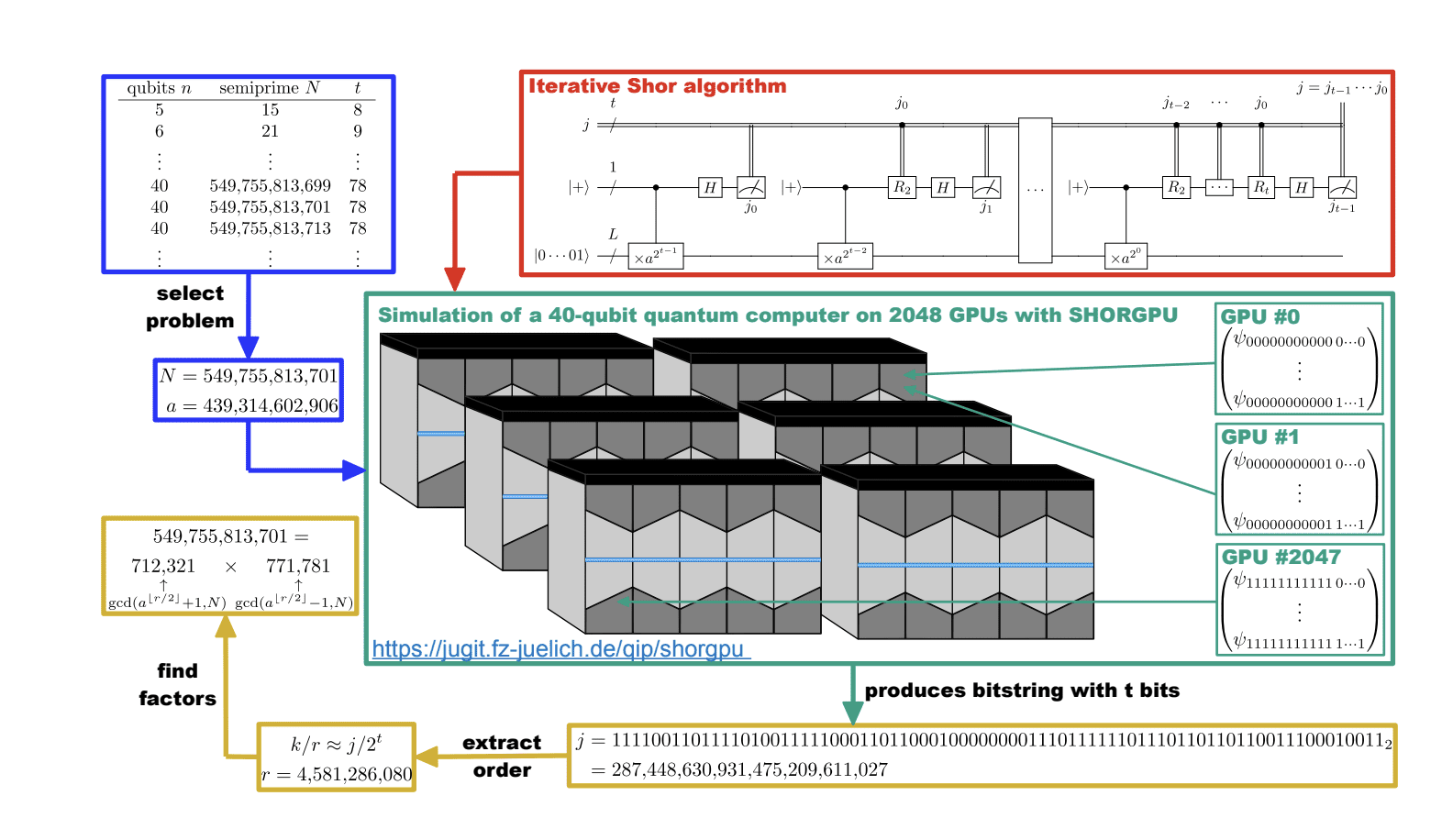
The article discusses the challenges and potential solutions for large-scale factoring on quantum computers (QCs). Factoring is a fundamental problem in number theory, and Shor’s algorithm is a famous quantum algorithm that can solve it exponentially faster than classical algorithms. However, implementing Shor’s algorithm on a real-world QC is a daunting task due to the noisy nature of quantum systems.
The authors present results showing that even with a moderate number of qubits (20-30), Shor’s algorithm’s success probability drops to zero when errors exceed a certain magnitude (δ ≥ 0.8). However, they also find that by including “lucky cases,” the success probability converges to a non-negligible value. This suggests that it might be possible to achieve a quantum speedup without relying on quantum error correction, which is a significant challenge in building large-scale QCs.
The article then explores future perspectives for overcoming these challenges. One approach is to develop more efficient algorithms and alternative ideas, such as the Ekera-Håstad scheme, which uses Shor’s discrete logarithm algorithm to reduce the required number of qubits. Another promising direction is the use of analog quantum computers (QCs), which are easier to manufacture than digital QCs due to their more relaxed requirements on individual qubit control.
Analog QCs have already led to the development of large-scale systems, such as D-Wave‘s superconducting quantum annealers with over 5,600 qubits and Pasqal‘s neutral atom-based analog QCs with up to 828 qubits. These advancements bring us closer to realizing quantum computing’s potential for solving complex problems like factoring.
In summary, this work highlights the ongoing efforts to overcome the challenges in building large-scale digital QCs for factoring. It explores alternative approaches, including analog QCs, which may offer a more feasible path forward.

External Link: Click Here For More