

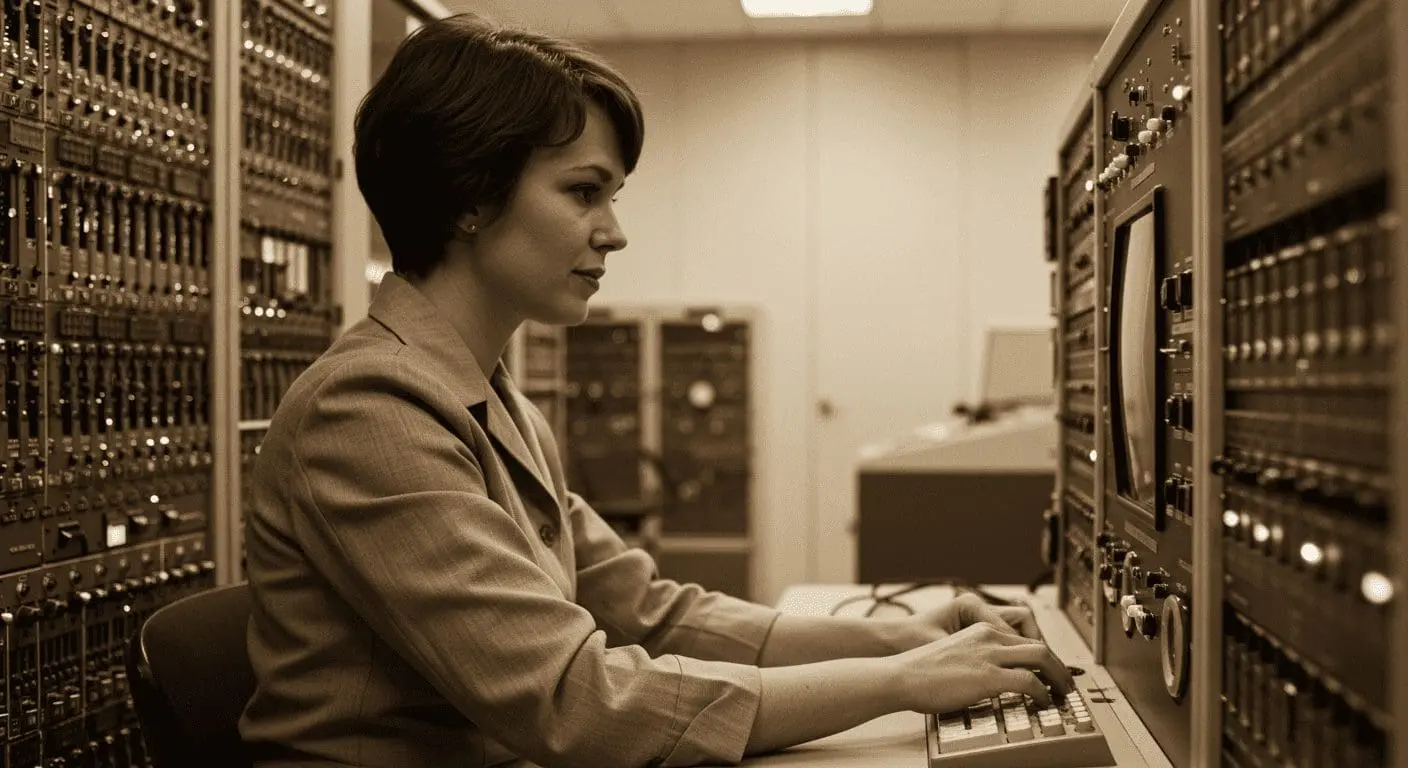
The ENIAC (Electronic Numerical Integrator and Computer), unveiled in 1945, was a landmark achievement as the world’s first programmable electronic computer. Behind this innovation were six women programmers—Betty Snyder Holberton, Jean Jennings Bartik, Marlyn Wescoff Meltzer, Ruth Lichterman Teitelbaum, Frances Bilas Spence, and Kay McNulty Mauchly Antonelli—who played a crucial role in translating complex mathematical equations into binary code. Despite their critical contributions, their work was often overshadowed by societal norms of the time, which marginalized women in technical fields.
These women faced significant challenges as they worked on the ENIAC project, including limited prior experience with programming or electronic computers. They developed innovative techniques to debug and optimize the machine’s operations, effectively pioneering the field of software development. Their efforts demonstrated the potential of programmable computers for a wide range of applications beyond simple arithmetic calculations, laying the groundwork for modern computing.
The contributions of these programmers were foundational in shaping concepts such as debugging, subroutines, and the separation of hardware from software. These innovations continue to influence contemporary programming practices, underscoring the enduring impact of their pioneering work. In recent years, there has been a growing recognition of their achievements, with organizations like the IEEE and educational initiatives highlighting their stories. This acknowledgment not only honors their past work but also serves as a testament to the enduring impact of female pioneers in computing.
The ENIAC Programmers’ Unrecognized Contributions
The ENIAC (Electronic Numerical Integrator and Computer) was a groundbreaking machine in the history of computing, marking one of the earliest examples of a general-purpose electronic computer. Completed in 1945, it was developed during World War II to calculate artillery firing tables for the U.S. Army. While the hardware engineers such as John Mauchly and J. Presper Eckert are often celebrated for their contributions, the software development work was carried out by six women: Betty Snyder Holberton, Jean Jennings Bartik, Marlyn Wescoff Meltzer, Ruth Lichterman Teitelbaum, Frances Bilas Spence, and Kathleen Antonelli.
These women were responsible for programming the ENIAC, a task that required them to develop entirely new methodologies since no software or programming languages existed at the time. They had to manually input programs by physically rewiring the machine, which involved setting switches and connecting cables according to complex mathematical algorithms. Their work was crucial in transforming the ENIAC from a theoretical concept into an operational computing tool.
Despite their pivotal role in the development of computer science, these women were largely overlooked in historical accounts of the ENIAC project. This oversight can be attributed to several factors, including societal biases of the time that often marginalized women’s contributions in STEM fields. Additionally, the focus on hardware and engineering achievements overshadowed the equally important work of software development.
The programmers’ contributions laid the foundation for modern software development practices. They developed techniques such as debugging, creating subroutines, and implementing parallel processing, which are fundamental to contemporary computing. Their innovative approaches demonstrated that programming was not merely a mechanical task but required creativity, problem-solving skills, and deep understanding of mathematics and logic.
In recent years, efforts have been made to recognize the contributions of these women. Documentaries, articles, and educational initiatives have highlighted their work, ensuring that their pioneering role in software development is no longer forgotten. Their story serves as a reminder of the importance of acknowledging diverse contributors in scientific and technological advancements.
Programming ENIAC Without Existing Manuals
The ENIAC (Electronic Numerical Integrator and Computer), developed during World War II, was one of the first electronic computers. It was designed for ballistics calculations but required skilled programmers to operate effectively. Six women—Betty Snyder Holberton, Jean Jennings Bartik, Marlyn Wescoff Meltzer, Ruth Lichterman Teitelbaum, Frances Bilas Spence, and Kay McNulty Mauchly Antonelli—were responsible for programming this groundbreaking machine.
Programming the ENIAC was a monumental task as there were no existing manuals or precedents. The women had to understand the computer’s architecture deeply, often reverse-engineering it by studying engineers’ blueprints. They physically set up the hardware using plugboards and switches, demonstrating their technical prowess and innovative thinking.
These programmers introduced foundational concepts in software development, such as subroutines and debugging. Betty Holberton notably created the first sorting program for ENIAC, highlighting her contribution to modern programming practices. Their work laid the groundwork for future advancements in computer science.
Despite their significant contributions, these women were largely overlooked historically. Post-war narratives often focused on male engineers, overshadowing the programmers’ roles. It wasn’t until recent years that their stories gained recognition, thanks to works like David Alan Grier’s “When Computers Were Human.”
The legacy of the ENIAC programmers is a testament to their pioneering spirit and technical ingenuity. Their work not only advanced computing but also paved the way for future generations of software developers, emphasizing the importance of recognizing diverse contributions in technology.
From Hardware Operators To Software Pioneers
The ENIAC project, completed in 1945, marked a pivotal moment in computing history as it was the first programmable electronic computer. Among its creators were six women: Betty Snyder Holberton, Jean Jennings Bartik, Marlyn Wescoff Meltzer, Frances Bilas Spence, Ruth Lichterman Teitelbaum, and Kay McNulty Mauchly Antonelli. These individuals played crucial roles in programming the ENIAC, a task that required understanding complex mathematical operations and developing innovative solutions to control the machine’s functions.
The women’s contributions were initially overshadowed by the focus on hardware development during the early years of computing. However, their work laid the foundation for modern software engineering. They developed detailed flowcharts and manual calculations to program the ENIAC, effectively creating the first software applications. This effort was groundbreaking as it demonstrated that computers could be more than just calculators; they could execute a variety of tasks through programmable instructions.
Despite their significant contributions, the women’s roles were often overlooked in the subsequent years. The shift towards hardware-centric development and the emergence of new programming languages like FORTRAN redirected attention away from their pioneering work. It wasn’t until later decades that their achievements began to receive recognition, highlighting their essential role in shaping the field of computer science.
The legacy of these women extends beyond their immediate contributions to the ENIAC project. Their work influenced the development of early programming tools and languages, setting precedents for future software engineers. For instance, Betty Holberton’s creation of the first sort-merge generator for the UNIVAC in 1952 was a significant advancement that improved data processing capabilities. Jean Bartik’s later involvement with early programming languages further underscored her lasting impact on the industry.
The Historical Significance Of Lost Photographs
The ENIAC (Electronic Numerical Integrator and Computer) was a groundbreaking machine in the history of computing, and its successful operation owed much to six women: Betty Snyder Holberton, Jean Jennings Bartik, Marlyn Wescoff Meltzer, Frances Bilas Spence, Kay McNulty Mauchly Antonelli, and Ruth Lichterman Teitelbaum. These programmers were instrumental in developing the software that enabled ENIAC to perform its complex calculations, marking a significant step in the evolution of computer science.
Their work was pioneering as they developed innovative programming techniques without the benefit of modern tools or documentation. The women faced numerous challenges, including deciphering the machine’s architecture and creating programs from scratch. Their contributions were crucial in establishing the foundation for software development, setting precedents that would influence future programmers.
Despite their critical role, these women’s contributions were often overlooked in historical accounts. This oversight can be attributed to several factors, including societal biases of the time and the tendency to focus on hardware rather than software. Additionally, the lack of recognition may have been exacerbated by the fact that programming was not yet widely recognized as a distinct field requiring specialized skills.
The significance of lost photographs lies in their ability to provide visual evidence of these women’s work, offering insights into their daily activities and the environment in which they operated. Such images can serve as powerful tools for preserving history, especially when combined with written records. They help humanize historical figures and make their contributions more tangible to future generations.
Overcoming Gender Barriers In Computing History
The ENIAC, unveiled in 1945 as the world’s first programmable electronic computer, marked a significant milestone in computing history. Behind this groundbreaking achievement were six women programmers: Betty Snyder Holberton, Jean Jennings Bartik, Marlyn Wescoff Meltzer, Ruth Lichterman Teitelbaum, Frances Bilas Spence, and Kay McNulty Mauchly Antonelli. These individuals were instrumental in programming the ENIAC, demonstrating their technical prowess and innovative thinking.
Betty Holberton emerged as a key figure in early computing by creating the first sort-merge generator for the UNIVAC, a crucial advancement that enhanced programming capabilities. Her work exemplified the ingenuity required to navigate the complexities of early computer systems, setting a precedent for future software development.
Despite their pivotal roles, these women’s contributions were often overshadowed during their time. The societal norms of the era frequently marginalized women in technical fields, leading to a lack of recognition for their efforts on the ENIAC project. This oversight highlights broader challenges faced by women in STEM disciplines historically.
The work of these programmers laid essential groundwork for modern software development. Concepts such as debugging and subroutines were pioneered by them, with Jean Bartik authoring a manual that became foundational for early computer users. Their innovations underscored the critical role of female programmers in shaping the digital landscape.
In later years, their contributions began to receive the acknowledgment they deserved. The IEEE recognized their achievements, and educational initiatives now include their stories, aiming to inspire future generations of women in technology. This recognition not only honors their past work but also serves as a testament to the enduring impact of female pioneers in computing.
Their Enduring Influence On Modern Programming
The ENIAC (Electronic Numerical Integrator and Computer) project, launched in 1943, aimed to create the world’s first programmable electronic computer. While the hardware development was spearheaded by engineers John Mauchly and J. Presper Eckert, the programming of this groundbreaking machine was predominantly carried out by six women: Betty Snyder Holberton, Jean Jennings Bartik, Marlyn Wescoff Meltzer, Frances Bilas Spence, Ruth Lichterman Teitelbaum, and Kay McNulty Mauchly Antonelli. These individuals were responsible for translating complex mathematical equations into the binary code that would instruct the ENIAC to perform its tasks.
The women faced significant challenges in their work, as they had no prior experience with programming or electronic computers. They developed innovative techniques to debug and optimize the machine’s operations, effectively pioneering the field of software development. Their efforts were crucial in demonstrating the potential of programmable computers for a wide range of applications beyond mere arithmetic calculations.
Despite their critical contributions, the women were often overlooked in historical accounts of the ENIAC project. This oversight was partly due to the societal norms of the time, which downplayed the roles of women in technical fields. However, recent efforts have sought to recognize and celebrate their achievements, highlighting their foundational role in shaping modern computing.
The work of these programmers laid the groundwork for future advancements in software engineering. Concepts such as subroutines, debugging techniques, and the separation of hardware from software were developed during their time with ENIAC. These innovations continue to influence contemporary programming practices, underscoring the enduring impact of their pioneering efforts.
The story of the ENIAC women serves as a reminder of the importance of recognizing diverse contributions to technological progress. Their experiences also highlight the ongoing challenges faced by women in STEM fields, emphasizing the need for continued advocacy and support to ensure equitable representation in these areas.


