Theoretical work details the behaviour of tetraquark states modelled as a four-body harmonic system. Researchers derived an analytical expression for the propagator, enabling examination of wave function evolution and probability density. This approach provides insight into quark interactions and potential complex structures like entanglement.
The strong nuclear force, one of the four fundamental forces of nature, dictates interactions between quarks – the fundamental constituents of matter. Understanding the behaviour of bound states comprising more than two quarks remains a significant challenge in particle physics. Recent theoretical work by Janjan et al. from Razi University addresses this by investigating the dynamics of tetraquark systems – particles composed of four quarks. Their study, titled ‘Propagation and Dynamics of Oscillating Tetraquark Systems’, presents an analytical model describing the time evolution of these complex arrangements, offering insights into the underlying quark interactions and potentially laying the foundation for predicting more intricate multi-quark configurations.
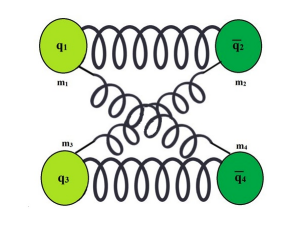
Recent theoretical work details an analytical approach to understanding the behaviour of tetraquarks – composite particles consisting of four quarks. The research presents a four-body model, employing harmonic potentials to simulate the interactions between the constituent quarks. This simplification enables the derivation of an analytical expression for the propagator – a mathematical function that describes the probability amplitude of a particle’s time evolution.
The model focuses on the internal dynamics of these exotic hadrons, specifically the oscillation and mixing of different quark configurations within the tetraquark. By treating the strong force – the fundamental interaction binding quarks together, mediated by gluons – as harmonic interactions, researchers achieve a mathematically tractable system. This contrasts with more complex numerical approaches often required to solve problems within Quantum Chromodynamics (QCD), the established theory of the strong interaction.
Analysis of the wave function reveals oscillatory patterns, indicating inherent dynamic characteristics within the tetraquark structure. The derived propagator facilitates detailed examination of the probability density and quark distribution, offering insights into the internal structure and stability of these particles. The work builds upon existing QCD research and provides a foundation for further investigation into the properties of tetraquarks and other multi-quark states.
👉 More information
🗞 Propagation and Dynamics of Oscillating Tetraquark Systems
🧠 DOI: https://doi.org/10.48550/arXiv.2506.07396