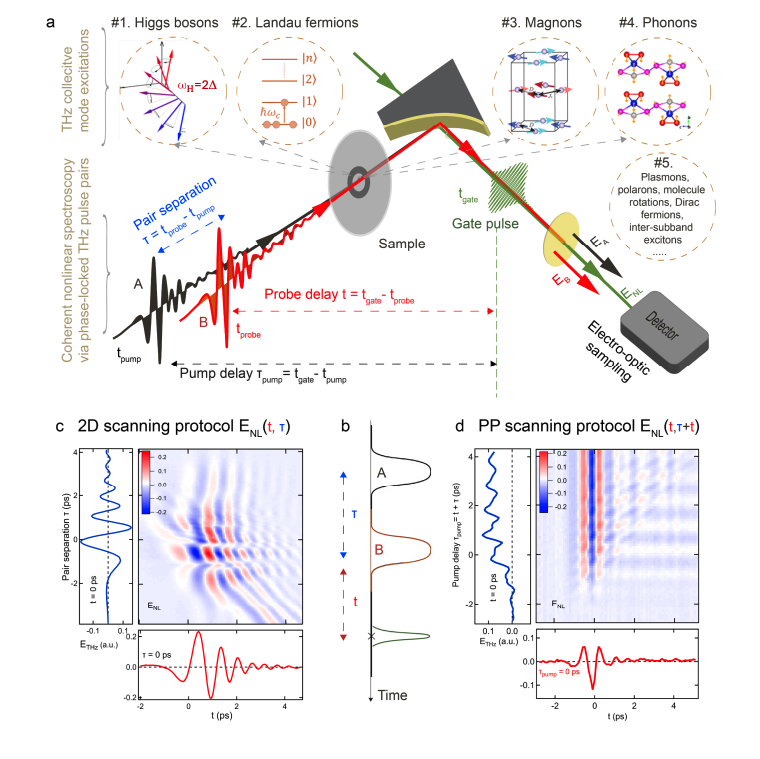
The ability to observe and control matter at the quantum level represents a significant challenge in modern physics, yet advances in spectroscopic techniques are steadily expanding our capacity to do so. Terahertz two-dimensional coherent spectroscopy (THz-2DCS), a method for probing the ultrafast dynamics of materials, is proving particularly insightful, revealing complex interactions often hidden from conventional measurement. In a comprehensive review published recently, Chuankun Huang, Martin Mootz, and colleagues from Ames National Laboratory, alongside Ilias E. Perakis from the University of Alabama at Birmingham, detail the development and application of THz-2DCS to a range of complex materials. Their article, entitled ‘Unlocking Quantum Control and Multi-Order Correlations via Terahertz Two-Dimensional Coherent Spectroscopy’, surveys the technique’s progress in areas including nonequilibrium superconductivity and dynamical topological phases, while also outlining future opportunities for its application in areas such as terahertz optoelectronics and information processing.
Terahertz two-dimensional coherent spectroscopy (THz-2DCS) represents a significant advancement in materials characterisation, offering detailed insight into complex behaviours beyond equilibrium states.
This technique expands investigative capabilities by mapping excitations across both time and frequency, effectively performing coherence tomography on driven matter and revealing excitation pathways often obscured by conventional methods. Researchers employ THz-2DCS to probe the nonlinear response functions of materials, gaining insights into behaviour under external stimuli and unlocking a deeper understanding of fundamental material properties.
THz-2DCS differentiates itself from single-particle measurements and conventional ultrafast spectroscopy through its ability to disentangle various excitation pathways and capture collective modes at terahertz frequencies. Conventional spectroscopy typically measures the average response of a material, whereas THz-2DCS allows for the precise coherent control and measurement of many-body dynamics and multi-order correlations, revealing how particles interact collectively. A quasiparticle is a collective excitation that behaves like a particle, and understanding their behaviour is central to understanding material properties.
Recent advances apply THz-2DCS to a diverse range
Recent advances apply THz-2DCS to a diverse range of materials exhibiting complex behaviours, including investigations into nonequilibrium superconductivity and nonlinear magnonics. Superconductivity, the phenomenon of zero electrical resistance, typically occurs at low temperatures, but nonequilibrium superconductivity explores conditions where this occurs outside of thermal equilibrium. Nonlinear magnonics investigates the manipulation of spin waves, or magnons, for information processing. This capability allows scientists to investigate materials operating far from equilibrium, providing a more realistic picture of their behaviour in real-world applications.
The successful application of THz-2DCS relies heavily on the study of quantum materials, including two-dimensional materials like graphene and transition metal dichalcogenides. These materials provide ideal platforms for observing complex interactions and collective behaviours due to their unique electronic properties. Alongside topological insulators and correlated electron systems, they enable scientists to investigate where electron-electron interactions significantly influence properties. The technique’s sensitivity to higher-order correlations proves particularly valuable when investigating these complex systems, where interactions between multiple electrons are crucial.
Current research focuses on optimising THz-2DCS instrumentation and refining experimental strategies, aiming to broaden the scope of applications, particularly in the fields of terahertz optoelectronics and information processing. Terahertz optoelectronics utilises electromagnetic radiation in the terahertz range for electronic and optical devices, while advancements in information processing seek to develop faster and more efficient computing technologies.
Investigations utilising THz-2DCS currently extend to dynamical topological phases and the detection of novel excitations, allowing scientists to characterise exotic collective modes within materials. Topological phases are states of matter characterised by robust surface states, while novel excitations refer to previously unobserved collective behaviours of electrons within a material.
The ongoing synergy between materials discovery and spectroscopic
The ongoing synergy between materials discovery and spectroscopic innovation ensures a vibrant future for the field, driving advancements in both fundamental materials science and applied technologies. Continued research into exotic quasiparticles, such as axions observed in materials like MnBi2Te4, will benefit significantly from the capabilities of THz-2DCS, unlocking new insights into fundamental physics and potentially leading to the development of novel quantum technologies.
Future development necessitates advancements in both THz-2DCS instrumentation and experimental strategies, improving signal sensitivity and temporal resolution to enable the study of even faster dynamics and more subtle material properties. Integrating THz-2DCS with other spectroscopic techniques, such as optical pump-probe spectroscopy, promises a more comprehensive characterisation of material behaviour.
The potential applications of THz-2DCS extend beyond fundamental materials science, holding promise for advancing THz optoelectronics and enabling the development of novel devices for communication and sensing. Moreover, the ability to control and manipulate material properties on ultrafast timescales could pave the way for new approaches to information processing and storage.
The technique’s sensitivity allows for the observation of subtle interactions and emergent phenomena that would otherwise remain hidden, providing a powerful tool for materials characterisation and discovery.
🗞 Unlocking Quantum Control and Multi-Order Correlations via Terahertz Two-Dimensional Coherent Spectroscopy
🧠 DOI: https://doi.org/10.48550/arXiv.2507.02116