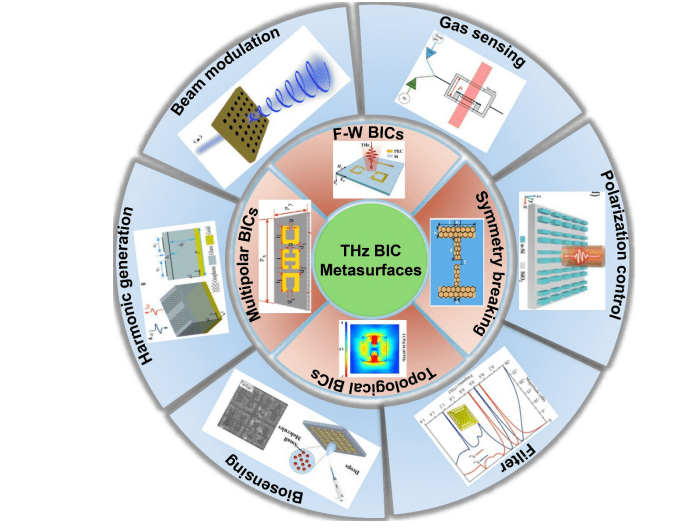
Terahertz technology stands to revolutionise fields from communications to medical diagnostics, but realising its full potential requires innovative approaches to manipulating light at these frequencies. Islam I. Abdulaal from Alexandria University, Abdelrahman W. A. Elsayed from the American University in Cairo, and Omar A. M. Abdelraouf from A*STAR, alongside their colleagues, demonstrate a significant advance in this area through the development of metasurfaces based on ‘quasi-bound states in the continuum’. These meticulously engineered structures achieve exceptionally high performance, offering both ultra-sensitive detection capabilities for biosensing and the potential for dramatically faster wireless communications, paving the way for future 6G networks and advanced medical technologies by overcoming key limitations in current terahertz systems. The team’s work represents a decade of progress in the field, moving from fundamental designs to practical applications with the promise of bridging the gap between laboratory discovery and commercial viability. This achievement establishes these metasurfaces as pivotal components for compact, efficient terahertz technologies poised to transform multiple industries.
Terahertz Metamaterials and Quasi-Bound States
Research into terahertz metamaterials and metasurfaces focuses on designing structures that manipulate terahertz waves for diverse applications, often utilizing three-dimensional printing for fabrication. Scientists are leveraging quasi-bound states in the continuum (Quasi-BICs) to achieve narrow-band resonances, high quality factors, and concentrated electromagnetic fields, proving valuable for sensing and filtering. Dynamic tunability is being pursued through materials responding to external stimuli, microfluidic channels altering refractive index, or utilizing phase-change materials. This research drives innovation in several areas, including the development of high-quality dielectric metasurfaces with unprecedented quality factors and the employment of indirect perturbation methods to maintain high-Q resonances despite fabrication imperfections.
This has led to the creation of dual-band filters and terahertz vortex beam generators based on the topological properties of BICs. Active tunability is achieved through symmetry-breaking techniques and the integration of liquid crystal elastomers, enabling controlled beam deflection. Furthermore, researchers are exploring all-dielectric active photonics, utilizing silicon supercavities for low-power switching, and developing multiplexing techniques for multichannel systems and multidimensional sensors. Recent advances include utilizing vanadium dioxide phase transitions for switching between quasi-BIC and absorption states, enhancing nonlinear optics with plasmonic-graphene metasurfaces, and achieving broadband terahertz generation with lithium niobate films.
The field demonstrates a convergence of nanophotonics, materials science, artificial intelligence, and communication technologies. Dynamically controlling terahertz devices is a major focus, driven by the demand for highly sensitive and selective sensors. Designs exhibiting quality factors reaching 1. 08×10 4 , alongside figure-of-merit values up to 4. 8×10 6 , have been demonstrated. To address fabrication tolerances, scientists developed indirect perturbation methods utilizing asymmetric silicon cuboids, successfully maintaining high-Q Fano resonances despite minor imperfections.
This enabled the creation of dual-band metal mesh filters operating at 0. 516 and 0. 734THz. The study advanced beam steering capabilities by establishing terahertz vortex beam generators based on the topological properties of BICs within photonic crystal structures. Subsequent designs merged bound states, improving quality factors and culminating in switchable optical vortex beam generators.
Active tunability was achieved through symmetry-breaking methods employing double-E structures to control Fano resonances, and through the integration of liquid crystal elastomers, enabling tunable azimuthal deflection while maintaining high quality factors. Researchers developed all-dielectric active THz photonics, demonstrating high-Q silicon supercavities that enabled low-power switching at nanosecond timescales. Polarization-based multiplexing was achieved using dual split ring resonator arrays, creating multichannel systems based on accidental BICs. Multidimensional capabilities were further expanded with dual-degree-of-freedom multiplexed metasensors, delivering performance across 0.
9-1. 6THz bands with signal enhancement factors exceeding 19 dB. Recent advances utilized vanadium dioxide phase transitions in LiTaO 3 /SiO 2 /VO 2 metamaterials, achieving switching between quasi-BIC states and perfect absorption states. Nonlinear processing capabilities were explored through theoretical frameworks and experimentally demonstrated with third-harmonic generation enhancement in plasmonic-graphene metasurfaces. Broadband terahertz generation was achieved with lithium niobate films. Contemporary research focuses on broadband bimodal multiplexing detection and intelligent metasurfaces for dynamic manipulation of electromagnetic waves.
Symmetry Breaking Enables High-Q Terahertz Resonances
Bound states in the continuum (BICs) are revolutionizing terahertz (THz) photonics, enabling metasurfaces with theoretically infinite quality (Q)-factors and unprecedented control of light. Research demonstrates that symmetry-breaking strategies are key to achieving high-Q resonances and polarization-insensitive behavior in these devices. Scientists devised C 4 -symmetric metasurfaces exhibiting quasi-BIC behavior, achieved through orthogonal positioning of meta-molecules. Polarization-independent quasi-BIC metasurfaces utilizing a two-dimensional array of silicon nanodisks with C 4v symmetry were also demonstrated, achieved by varying nanodisk radii to excite high-Q resonances while maintaining rotational symmetry.
Graphene-based metasurfaces achieving polarization independence were developed, utilizing coaxial aperture patterns and systematically altering aperture distances. Researchers are now focusing on designs that move beyond rotational symmetry to address limitations in practical applications. Metasurfaces using non-rotational symmetric dimmers were developed, leveraging the relationship between magnetic and electric quadrupoles. This work utilizes far-field multipole decomposition and near-field electromagnetic distribution analysis, marking an important step towards gaseous sensing with high-quality resonances.
These advances are driving significant improvements in biosensing capabilities. High refractive index sensitivity was achieved by introducing structural asymmetry into a metasurface, dramatically concentrating electromagnetic energy. To address challenges with THz wave absorption in aqueous environments, researchers are integrating microfluidics and functionalized nanoparticles. Scientists have successfully transitioned from early designs relying on symmetry protection to application-optimized quasi-BICs, consistently improving quality factors and light-matter control. Key milestones include the development of flexible, polyimide-based biosensors capable of detecting substances at remarkably low concentrations, and the creation of highly sensitive gas sensors leveraging unique terahertz molecular absorption properties. These advances stem from innovative approaches to manipulating multipolar resonances and breaking symmetry within metasurface designs. While substantial progress has been made, the authors acknowledge limitations related to scalability for integration into 6G communication systems, including nano-fabrication tolerances, material loss, and dynamic control. Future work will likely focus on overcoming these hurdles to fully realize the potential of BIC metasurfaces.
👉 More information
🗞 Terahertz Quasi-BIC Metasurfaces for Ultra-Sensitive Biosensing and High-Speed Wireless Communications
🧠 ArXiv: https://arxiv.org/abs/2510.00357