

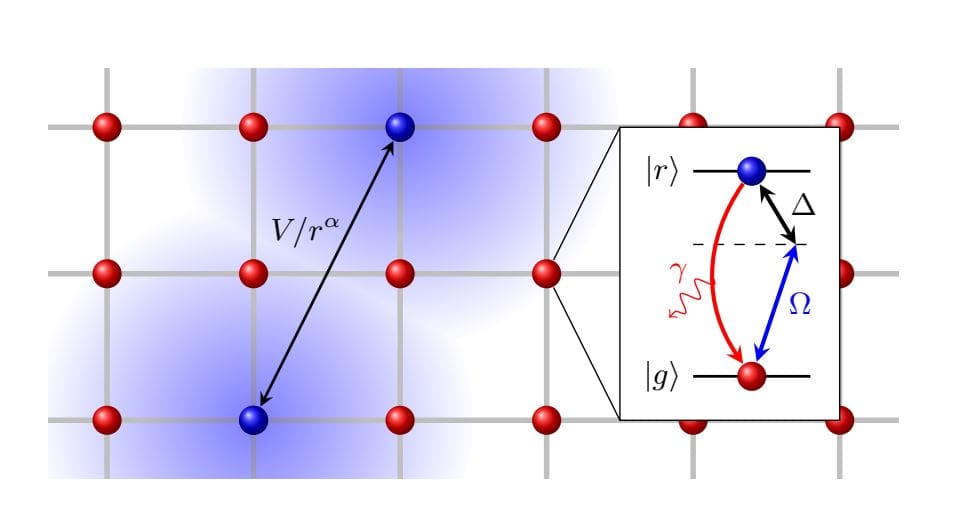
Simulating the behaviour of complex quantum systems presents a significant challenge for scientists, often requiring compromises between accuracy and computational cost. Jack Dunham and Marzena H. Szymańska, both from University College London, address this problem by developing a new method for efficiently modelling two-dimensional quantum systems with long-range interactions and dissipation. Their work introduces a technique, termed tePEPO, that accurately evolves these systems through time using tensor networks, a powerful approach to representing quantum states. This advancement overcomes limitations of existing methods, which typically restrict interactions to nearest neighbours or rely on approximations, and opens new avenues for simulating realistic physical systems, such as Rydberg atom arrays, with unprecedented precision and detail. The team’s results demonstrate the potential of tensor networks to tackle complex quantum phenomena previously inaccessible to non-approximate computational techniques.
Accurately modelling two-dimensional systems with realistic long-range interactions, alongside the effects of dissipation, is crucial for advancing modern quantum computing and simulation platforms. Scientists have now constructed a time-evolution operator, a projected entangled pair operator termed tePEPO, that efficiently evolves tensor network ansatze through time. This construction effectively represents interactions extending beyond nearest neighbors, including those between sites not directly adjacent within the lattice.
Long-Range Interactions in Two-Dimensional Quantum Systems
Scientists have developed a new method for simulating complex quantum systems, overcoming limitations that previously restricted simulations to simplified models or approximations. This work introduces a time-evolving projected entangled pair operator, denoted tePEPO, which efficiently evolves tensor network ansatze through time, enabling the study of two-dimensional systems with realistic interactions. The tePEPO construction allows for the representation of interactions extending beyond nearest neighbors, including those between non-collinear sites within the lattice. Researchers obtained accurate results using small tePEPO bond dimensions by approximating realistic radial long-range interactions that decay with distance.
This approach demonstrates the ability to model systems where interactions diminish with distance, crucial for representing physical phenomena accurately. The team then applied this method to a Rydberg atom Hamiltonian, a system exhibiting long-range dipolar interactions, and observed evidence of a dipole-dipole blockading effect even in the presence of dissipation. This observation confirms the method’s capability to model complex interactions and dynamic processes within open quantum systems. This breakthrough delivers a powerful tool for simulating two-dimensional open quantum systems, previously inaccessible to non-semi-classical methods. The ability to model dissipation alongside coherent evolution is particularly significant, as it allows for the study of realistic quantum systems subject to environmental influences.
Long-Range Quantum Dynamics via Tensor Networks
This work presents a new method for simulating the behaviour of complex quantum systems, specifically two-dimensional models with long-range interactions and dissipation. Researchers developed a time-evolving projected pair operator, termed tePEPO, which efficiently represents the system’s evolution over time as a tensor network. This approach overcomes limitations of previous methods that were restricted to nearest-neighbor interactions or relied on semi-classical approximations, offering a more accurate and versatile simulation technique. The tePEPO construction allows for the representation of interactions extending beyond immediate neighbours, including those between non-collinear sites, with a manageable computational cost.
The team demonstrated the effectiveness of their method by applying it to a Rydberg atom Hamiltonian, a system exhibiting long-range dipolar interactions. Results indicate the presence of a dipole-dipole blockade effect, even in the presence of dissipation, validating the tePEPO’s ability to model realistic physical phenomena. Importantly, the method achieves accuracy with relatively small tensor network bond dimensions, improving computational efficiency. The authors acknowledge that extending the method to even more complex interactions or larger system sizes may present challenges, and future research could focus on optimising the tePEPO construction and exploring its application to a wider range of physical systems.
👉 More information
🗞 Efficient Time Evolution of 2D Open-Quantum Lattice Models with Long-Range Interactions using Tensor Networks
🧠 ArXiv: https://arxiv.org/abs/2512.01781


