

Understanding the limits of classical computation is crucial as quantum computers develop, and researchers are now exploring how processor geometry impacts this boundary. Manuel S. Rudolph from the Ecole Polytechnique Fédérale de Lausanne (EPFL) and Joseph Tindall from the Flatiron Institute lead a team that investigates this question by simulating quantum circuits using a novel approach based on two-dimensional tensor networks. This method allows them to generate samples that closely match the behaviour of a quantum computer, and importantly, to systematically improve the accuracy of these simulations. By applying this technique to circuits mirroring those used in recent experiments and designs from leading quantum hardware platforms, the team demonstrates that the physical layout of a quantum processor significantly influences how easily its behaviour can be replicated classically, highlighting a key factor in assessing the potential advantages of quantum computation.
Tensor Networks Simplify Quantum Circuit Simulation
Quantum computers promise to revolutionize computation, but verifying their operation and developing algorithms requires extensive simulation using classical computers. However, simulating quantum systems becomes exponentially more difficult as the number of quantum bits, or qubits, increases. Researchers are continually seeking ways to overcome this limitation, and a promising approach involves using sophisticated mathematical tools to represent the quantum state of the system in a more compact form. This work focuses on simulating quantum circuits using tensor networks, which offer a way to represent complex quantum states efficiently.
Current simulation methods often struggle with the two-dimensional arrangement of qubits found in many modern quantum processors. Instead, researchers have turned to two-dimensional tensor networks, which mirror the physical layout of the quantum processor and offer a more natural and efficient representation of the quantum state. This allows for simulations that require significantly less memory and computational power, potentially unlocking the ability to simulate larger and more complex quantum circuits. This research demonstrates a controllable and verifiable method for simulating quantum circuits using these two-dimensional tensor networks.
By applying this technique to circuits designed for both IBM and Google quantum processors, the team has shown that the geometry of the processor itself plays a crucial role in the ease and accuracy of the simulation. The findings indicate that heavy-hex processors facilitate highly accurate sampling and expectation value calculations even at large circuit depths, requiring minimal computational resources. Conversely, denser grid structures can lead to a rapid buildup of complex correlations, even with relatively shallow circuits, making simulation more challenging. These results highlight the crucial role of processor geometry in determining the classical simulability of quantum circuits and pave the way for more efficient quantum algorithm development and hardware design.
Two-Dimensional Tensor Networks for Quantum Circuit Simulation
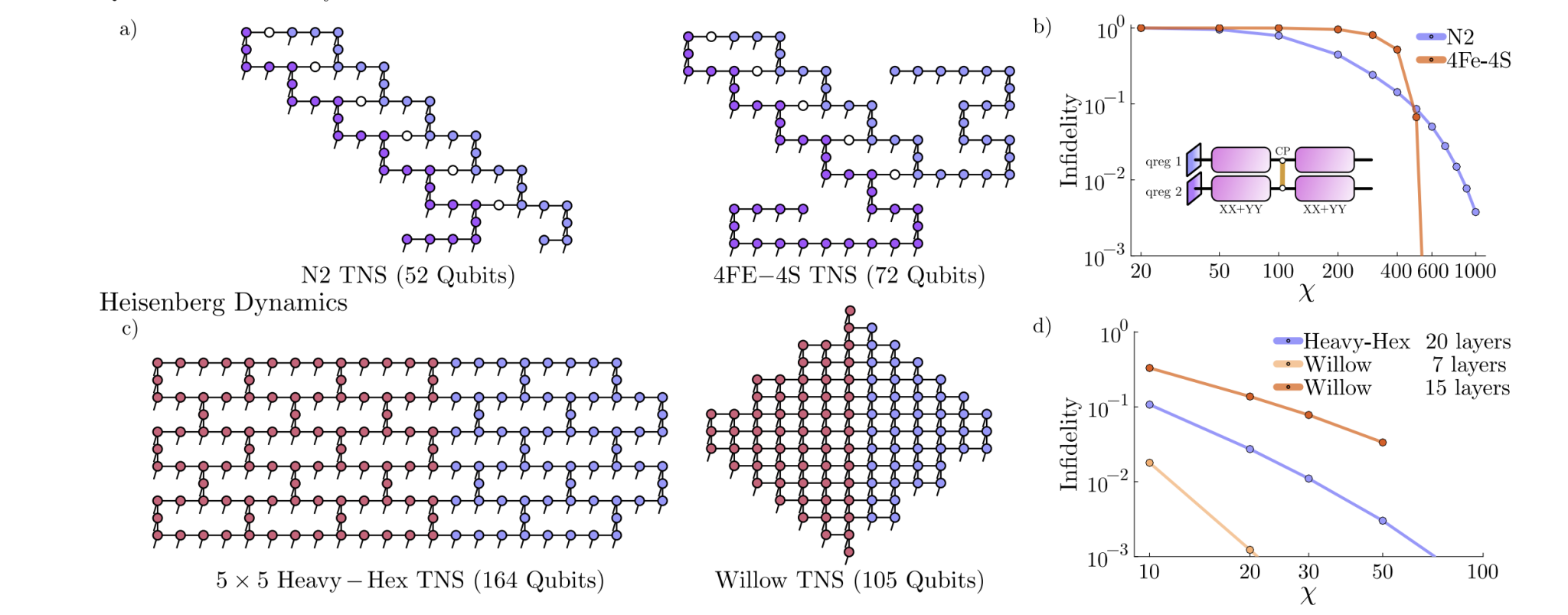
Researchers developed a novel methodology for simulating quantum circuits by employing two-dimensional tensor networks, mirroring the physical layout of modern quantum processors. This approach addresses limitations of traditional one-dimensional methods, which struggle to efficiently represent the complex entanglement present in two-dimensional qubit arrangements. By matching the tensor network geometry to the processor’s architecture, the team created a more natural and compact representation of the quantum state, significantly reducing the computational resources needed for simulation. The core of the method involves constructing a tensor network where each vertex represents a quantum sub-register and edges define the entanglement between qubits.
This network accurately captures the state of the quantum circuit at any given depth, allowing researchers to systematically increase computational effort to improve the quality of the simulation. A key innovation lies in a generalized boundary Matrix Product State contraction algorithm, which enables the controlled generation of samples from the resulting tensor network states, verifying the accuracy of the simulation and allowing for detailed analysis of the quantum system’s behavior. To demonstrate the effectiveness of this approach, the team simulated circuits on virtual representations of both IBM’s heavy-hex and Google’s Willow processors. They focused on circuits including a local unitary Jastrow ansatz circuit and a two-dimensional Heisenberg model undergoing a domain-wall quench.
By systematically increasing the network’s complexity, they demonstrated the ability to converge towards an accurate representation of the quantum state and generate reliable samples. The researchers also developed open-source software to facilitate the use of this methodology, enabling other scientists to perform robust tensor network simulations on any planar quantum processor. This software allows for precise control over the simulation parameters and provides tools for analyzing the resulting data, furthering the development of quantum computing and materials science.
Tensor Network Simulation Matches Quantum Architectures
Researchers have developed a powerful new method for simulating quantum circuits using classical computers, achieving unprecedented accuracy and scale. This work focuses on representing the complex quantum state of a circuit as a tensor network, a mathematical structure that mirrors the physical layout of qubits on a quantum processor. By adapting the tensor network geometry to match the processor’s architecture, the team overcomes limitations of traditional simulation methods which struggle with the increasing complexity of larger quantum systems. The researchers successfully simulated circuits inspired by recent experiments, including a complex local unitary Jastrow ansatz circuit, to a high degree of precision.
They demonstrated that the method can accurately represent the quantum state, allowing for the extraction of meaningful data and the generation of samples that closely reflect the behavior of the quantum circuit itself. Importantly, the team developed metrics to verify the quality of the simulation, ensuring the reliability of the results. A key finding concerns the impact of processor geometry on simulation efficiency. Simulations performed on a “heavy-hex” architecture showed rapid and accurate convergence, with minimal development of complex correlations within the simulated system. In contrast, simulations on Google’s “Willow” processor exhibited a rapid buildup of these complex correlations, even at relatively shallow circuit depths.
This suggests that the physical arrangement of qubits significantly influences the ease with which a quantum state can be classically simulated. The team’s approach not only advances the capabilities of classical simulation but also provides valuable insights into the physical nature of quantum states realized on different hardware platforms, paving the way for more efficient quantum algorithm development and hardware design. The open-source software developed alongside this research provides a versatile tool for simulating circuits on any planar quantum processor, furthering the field’s ability to explore and understand complex quantum systems.
🗞 Simulating and Sampling from Quantum Circuits with 2D Tensor Networks
🧠 DOI: https://doi.org/10.48550/arXiv.2507.11424


