
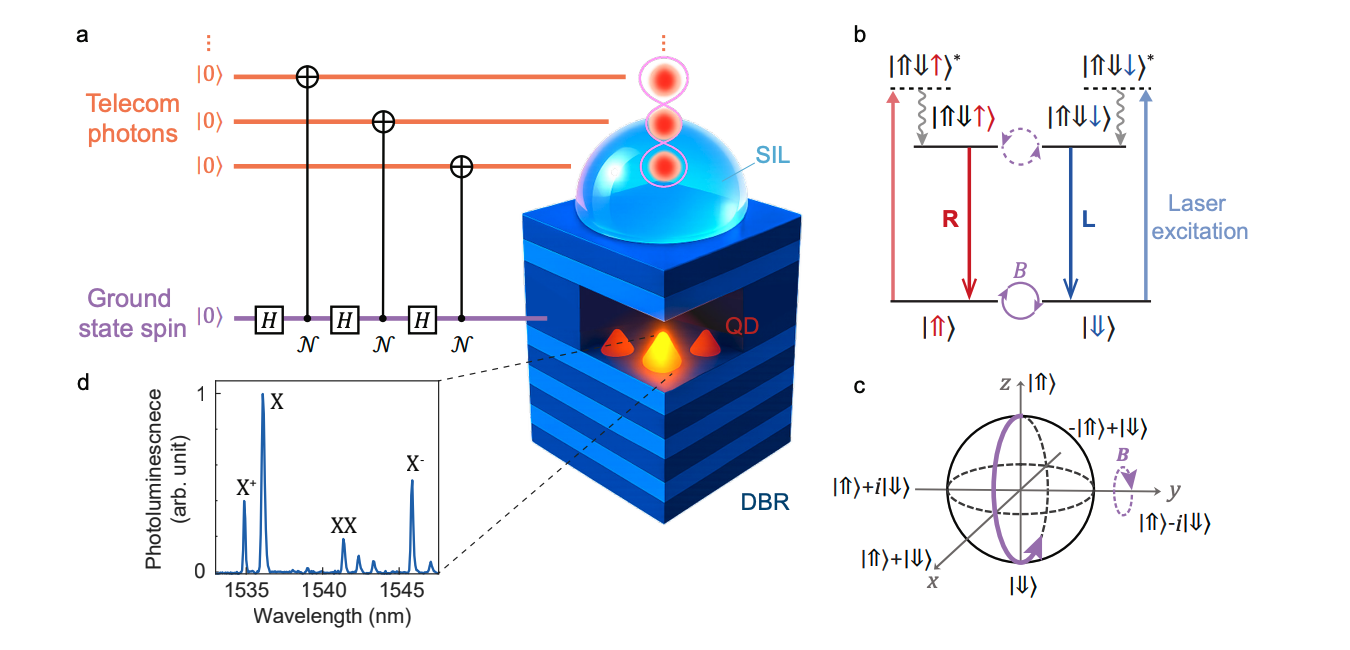
Researchers demonstrate entanglement between a quantum spin and sequentially emitted photons at telecom wavelengths, crucial for fibre optic networks. They achieve a two-qubit entanglement fidelity of 0.82 and establish a lower bound of 0.75 for three-qubit entanglement, bridging a performance gap with existing infrastructure and enabling scalable photonic cluster states.
The development of robust quantum networks necessitates efficient sources of entangled photons operating at telecommunication wavelengths, crucial for minimising signal loss during transmission through fibre optic cables. Petros Laccotripes, Junyang Huang, and colleagues from Toshiba Europe Limited, alongside David A. Ritchie from the Cavendish Laboratory at the University of Cambridge, report a significant advance in this field. Their research, detailed in the article ‘An entangled photon source for the telecom C-band based on a semiconductor-confined spin’, demonstrates a scalable method for generating entangled states using a semiconductor quantum dot, achieving two-qubit entanglement fidelity of 0.93 and establishing a lower bound of 0.83 for three-qubit entanglement, directly within the crucial telecom C-band (approximately 1530-1565 nm). This work addresses a key limitation of previous solid-state entanglement sources, which typically operate at shorter wavelengths incompatible with existing fibre infrastructure.
Robust generation of multi-qubit entangled states advances both quantum networking and measurement-based quantum computation, as researchers successfully demonstrate entanglement at telecom wavelengths within the C-band utilising an indium arsenide/indium phosphide (InAs/InP) quantum dot. This achievement circumvents a critical limitation of previous solid-state spin-photon interfaces, which traditionally operate at wavelengths incompatible with low-loss fibre optic transmission, and establishes a pathway towards practical quantum technologies. The research confirms the quantum dot possesses the necessary characteristics for generating cluster states, a specific type of entangled state particularly well-suited for quantum information processing, and implements a scalable protocol to entangle the resident spin of the quantum dot with sequentially emitted photons directly within the telecom C-band.
Researchers demonstrate high-fidelity entanglement through quantitative results, achieving a two-qubit (spin-photon) entanglement fidelity of 0.83, which indicates a strong correlation between the spin and the emitted photon. Entanglement fidelity is a measure of how closely the entangled state matches the ideal, maximally entangled state; a value of 1 represents perfect entanglement. Furthermore, they establish a lower bound of 0.73 for three-qubit (spin-photon-photon) entanglement fidelity, demonstrating the potential for scaling up the system to create more complex entangled states and paving the way for advanced quantum applications. This three-qubit entanglement is crucial as it moves beyond simple quantum key distribution towards more complex quantum algorithms and distributed quantum computation.
The study builds upon previous work in quantum dot entanglement, distinguishing itself through the use of telecom wavelengths and the demonstration of three-qubit entanglement, and acknowledges contributions from Barbiero et al. (2022, 2025), Kim et al. (2025), and Zaporski et al. (2023) who have advanced quantum light sources and spin-photon interfaces. Researchers utilised the National Epitaxy Facility as a key resource for materials growth and device fabrication, highlighting the importance of collaborative infrastructure in driving innovation.
This work addresses a critical limitation in existing quantum dot systems, which typically operate at wavelengths unsuitable for long-distance quantum communication, and generates entanglement directly in the telecom C-band, bridging the performance gap between short-wavelength systems and established fibre optic infrastructure. The C-band (approximately 1530-1565 nm) is a region of the optical spectrum with minimal attenuation in standard optical fibres, making it ideal for long-distance communication. The demonstrated fidelity levels and scalability potential suggest a viable route towards practical, large-scale photonic cluster states for fibre-based quantum network applications, and opens up possibilities for building secure quantum communication networks, distributed quantum computing platforms, and advanced quantum sensors. Future work will likely focus on increasing the number of entangled qubits and improving the efficiency of the entanglement generation process.
👉 More information
🗞 An entangled photon source for the telecom C-band based on a semiconductor-confined spin
🧠 DOI: https://doi.org/10.48550/arXiv.2507.01648