The speed at which electrons move through nanoscale devices limits their performance, and this is particularly crucial when searching for exotic particles like Majorana bound states. Michael Ridley, Eliahu Cohen, and Christian Flindt, alongside Riku Tuovinen, investigate the electron transit time within superconducting nanowire junctions that may host these elusive states. Their work establishes a direct link between measurable electrical noise and the speed of electron travel, revealing how transit time scales with the length of the nanowire. This research provides a crucial theoretical framework for experimentally distinguishing genuine Majorana bound states from other, similar phenomena, paving the way for advancements in topological quantum computing.
Time-Resolved Transport Distinguishes Majorana Zero Modes
Scientists have developed a detailed theoretical framework and computational methods to investigate the behavior of electrons in nanoscale wires that may host Majorana zero modes, exotic particles with potential applications in quantum computing. This work focuses on understanding how to distinguish genuine Majorana zero modes from similar states, utilizing nonequilibrium Green’s function theory to calculate current flow and analyze electron correlations. This investigation centers on analyzing the time-dependent current response of the nanowire to an applied voltage, examining correlations between currents at different points to identify unique signatures of Majorana zero modes, characterized by long-lived coherence and a specific frequency spectrum. Detailed numerical simulations demonstrate the robustness of these signatures, suggesting a practical pathway for experimental verification.
Transient Correlations Reveal Majorana Zero Mode Traversal Times
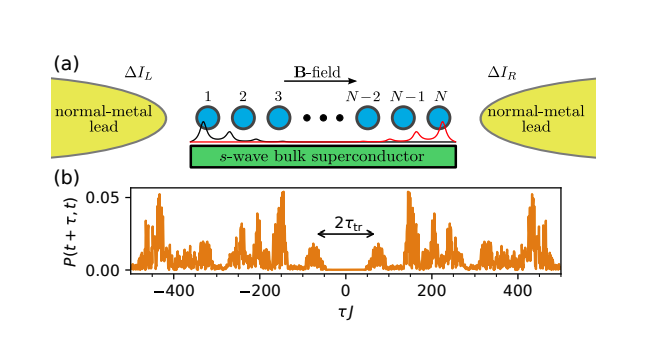
Researchers have developed a new theoretical approach to determine how long it takes for electrons to traverse nanoscale devices supporting Majorana zero modes. This method, based on time-dependent Landauer-Büttiker transport theory, analyzes current correlations, allowing scientists to extract precise measurements of electron traversal times and distinguish genuine Majorana zero modes from spurious signals. The research demonstrates that Majorana zero modes exhibit a unique length-linear relationship between traversal time and nanowire length, indicating a nonlocal delay in electron transport, contrasting with conventional electron transport. The team established a precise measurement protocol, defining how to experimentally measure current correlations and extract the traversal time, isolating the effects of crossed-Andreev conversion and revealing a finite traversal time.
Electron Speed Limits in Majorana Nanowires
Scientists have determined the maximum speed at which electrons can travel within nanoscale devices supporting Majorana zero modes, a critical step towards building practical quantum computers. By employing time-dependent transport theory and analyzing current correlations in superconducting nanowire junctions, the team accurately measured electron traversal times, demonstrating a clear linear relationship between these times and the length of the nanowire. The research investigated four distinct transport regimes, each defined by the nanowire’s properties, including the presence or absence of Majorana zero modes and the influence of magnetic impurities. By analyzing time-dependent current correlations, scientists were able to distinguish between genuine topological superconductors and those exhibiting spurious Majorana-like behavior. The team developed a heuristic formula for the traversal time, based on summing the electron dwell times at each site, which accurately captures the observed behavior. Measurements confirm a linear dependence of the traversal time on nanowire length, paving the way for developing robust quantum technologies based on Majorana zero modes.
Electron Transit Times Reveal Majorana Signatures
Researchers have established a method for characterizing the speed of electrons within nanoscale devices designed to host Majorana zero modes. By applying time-dependent transport theory to superconducting nanowire junctions, scientists successfully extracted electron traversal times, demonstrating a clear linear relationship between these times and the length of the nanowire. The research identifies distinct temporal signatures that differentiate genuine Majorana zero modes from spurious states, offering a pathway for experimental verification. The predicted timescales for observing these effects, on the order of picoseconds, are achievable with existing experimental technology. While acknowledging current limitations, the authors propose extending this framework to investigate more complex systems, potentially revealing new insights into non-Abelian orders beyond Majorana particles.
🗞 Current Cross-Correlation Spectroscopy of Majorana Bound States
🧠 ArXiv: https://arxiv.org/abs/2511.02085