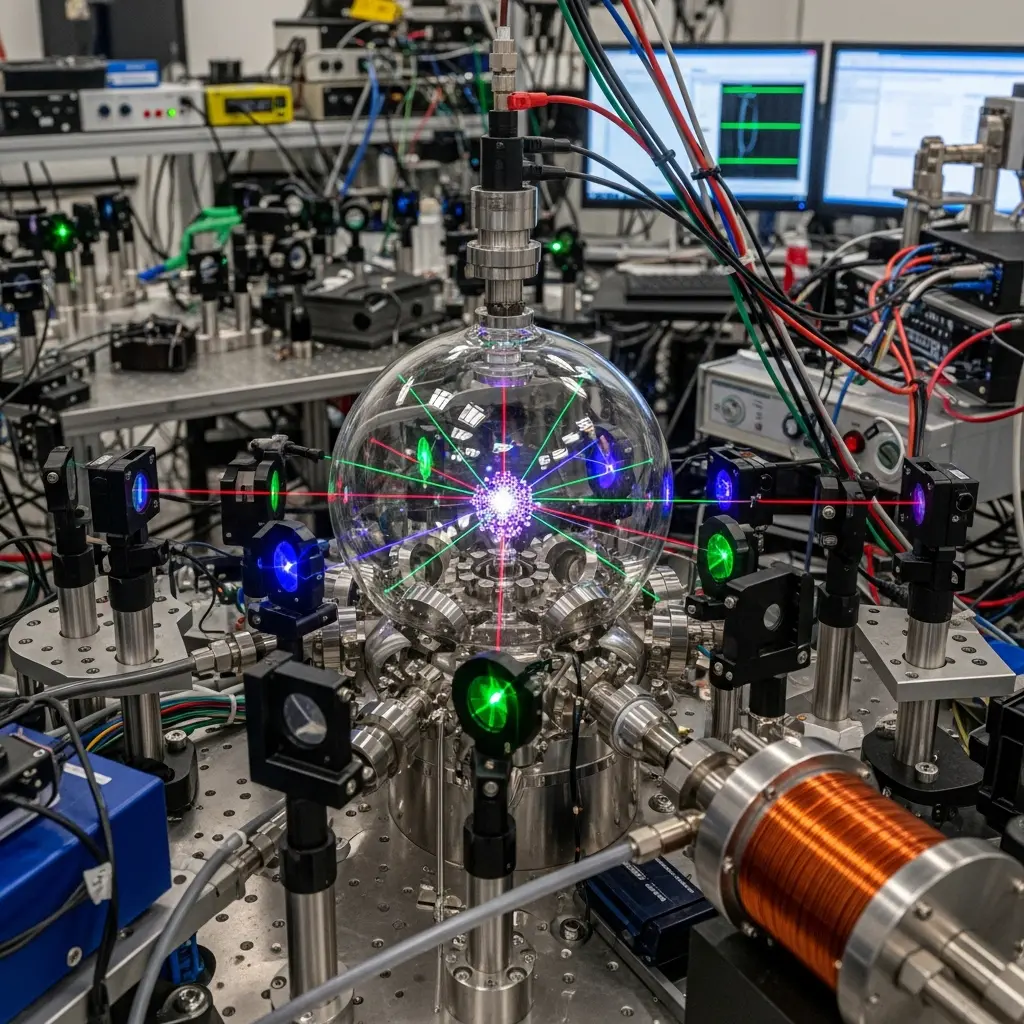
The behaviour of interacting Bose systems in two dimensions presents a significant challenge for physicists, and recent research from Michał Suchorowski of the University of Warsaw, Fabian Brauneis and Hans-Werner Hammer of Technische Universität Darmstadt, along with Michał Tomza and Artem G Volosniev, offers a new theoretical framework to address this. The team developed a generalized Gross-Pitaevskii equation that accurately models the properties of these systems, specifically focusing on attractive interactions between bosons. This advancement allows scientists to predict the existence of unique quantum states, including vortex configurations and excited states, which are potentially more readily observable in experiments than the ground state. By accurately simulating both static and dynamic behaviours in trapped geometries, the research provides a robust foundation for understanding finite 2D Bose systems and guides the development of future experimental investigations.
The team demonstrates that this equation accurately captures key properties of universal bound states in free space, commonly referred to as quantum droplets. They then apply this framework to predict the existence of universal excited states, including vortex configurations, which may be more accessible to experimental investigation than the ground state. Additionally, the researchers investigate breathing modes and quench dynamics in trapped geometries.
Bose-Einstein Condensate Dynamics via Numerical Methods
This research utilizes a variational method, employing the Townes-soliton wavefunction to approximate the ground state of the Bose-Einstein condensate (BEC). By minimizing the energy functional with respect to the size parameter, scientists estimate the ground state energy and density profile. Further analysis involves calculating the derivative of the energy with respect to interaction strength, revealing the point at which the BEC collapses. This derivative is compared with results from both numerical and variational methods, confirming the accuracy of the techniques. The team derives the equation of motion governing the size of the BEC during breathing oscillations, originating from the continuity equation and the equation of motion for momentum.
This derivation reveals how the frequency of these oscillations depends on energy, size, and interaction strength. Numerical simulations employ imaginary time evolution to determine the ground state and real-time evolution to simulate the system’s dynamics. Careful consideration is given to grid size, time step, and dynamic grid adaptation to ensure accuracy and stability. The availability of open-source code underscores a strong commitment to reproducibility. The research relies on sophisticated numerical techniques to solve complex equations governing BEC dynamics, validating these methods by comparing them to analytical results and carefully considering computational parameters.
Attractive Bosons and Quantum Droplet Theory
Scientists have developed a theoretical framework for understanding two-dimensional Bose systems, specifically focusing on attractive bosons which form quantum droplets. The work accurately captures the key properties of these universal bound states in free space, demonstrating its ability to model systems where bosons bind together due to attractive forces. Researchers established a modified coupling constant, a crucial parameter governing the interactions between bosons, which circumvents limitations found in previous models and allows for more accurate predictions of droplet behaviour. The team’s approach incorporates a density-dependent coupling strength into the Gross-Pitaevskii equation, successfully describing the behaviour of universal droplets and preserving a structure suitable for both analytical and numerical exploration.
Measurements confirm that the size of the resulting droplet is exponentially smaller than that of a typical two-body bound state. The team investigated vortex states, breathing dynamics within a trap, and quench dynamics near transitions, demonstrating the versatility of the generalized equation. This framework provides a robust foundation for exploring both static and dynamic phenomena in finite 2D Bose systems, offering guidance for the design of future experimental protocols and potentially informing studies of analogous systems in particle physics, such as Quantum Chromodynamics.
Attractive Bose Systems and Universal Droplets
This research establishes a robust theoretical framework for understanding the behaviour of two-dimensional Bose systems, particularly focusing on attractive interactions between particles. Scientists have demonstrated that a generalized Gross-Pitaevskii equation accurately predicts the properties of these systems, including the formation of universal bound states known as droplets. Importantly, this generalized equation avoids the collapse seen in standard models when interactions become strong, instead exhibiting a smooth increase in energy. The team further predicted the existence of universal excited states, such as vortex configurations, which may be more readily observed in experiments than the ground state.
Investigations into breathing modes and the dynamics of these systems under changing conditions reveal a crossover in behaviour, rather than a sharp phase transition, offering insights into the system’s stability and evolution. Future work may extend this framework to three-dimensional systems, building on the flow equations introduced in previous studies. This research provides a valuable tool for interpreting experimental results and guiding the design of future investigations into these fascinating quantum systems, offering a quantitative description even in challenging regimes of intermediate interaction strengths.
🗞 Generalized Gross-Pitaevskii Equation for 2D Bosons with Attractive Interactions
🧠 ArXiv: https://arxiv.org/abs/2511.10115