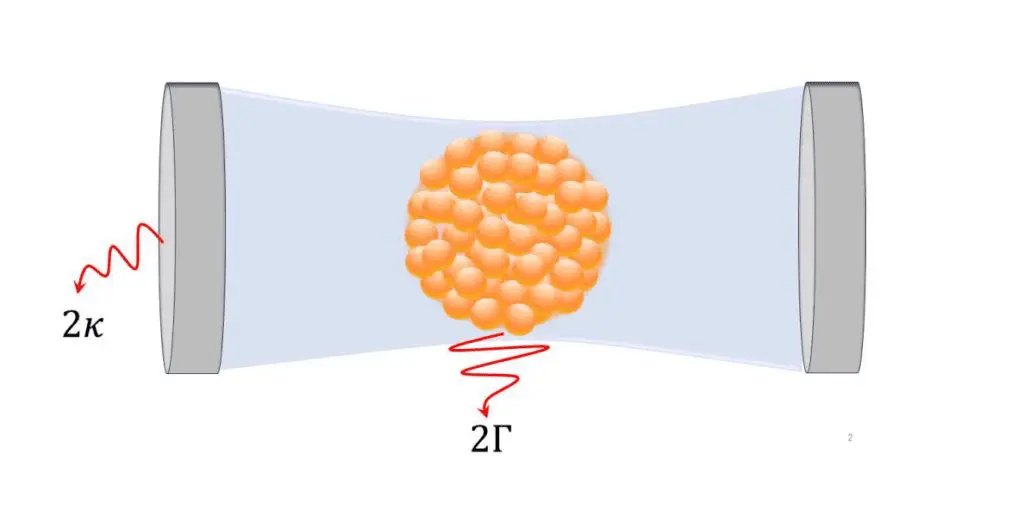
The phenomenon of superradiance, where multiple atoms emit light coherently, underpins advances in areas such as information processing and precision measurement, but controlling its strength as more atoms participate has proven challenging. Ruijin Sun, Xiang Guo, and colleagues from Northeast Normal University, alongside Andreas Ruschhaupt from University College Cork, now demonstrate a method for manipulating this scaling behaviour within a cavity-QED system. Their research reveals that carefully tuning the interaction between atoms and light significantly alters the emission process, suppressing the typical collective superradiance while simultaneously boosting emission from individual atoms. This achievement provides a crucial step towards achieving fully controllable collective emission, paving the way for improved performance in future quantum technologies and precision instruments.
Simulating Collective Quantum Emission with Rydberg Atoms
Scientists are developing increasingly sophisticated methods to simulate and understand the complex behaviour of many-body quantum systems, particularly those exhibiting collective radiative effects like superradiance. This research focuses on accurately modelling these systems, bridging the gap between theoretical predictions and experimental realisation, and ultimately enabling advancements in quantum technologies. Understanding and controlling superradiance is crucial for developing brighter, more directional light sources and harnessing collective quantum effects for practical applications. The team employs advanced simulation techniques, including the Discrete Truncated Wigner Approximation, the Positive-P Representation, and Monte Carlo Trajectories, to explore these phenomena.
These techniques are essential because directly solving the equations governing many interacting quantum particles is computationally intractable. The research also leverages the principles of Cavity Quantum Electrodynamics, which studies how atoms interact with light confined within optical cavities, enhancing light-matter interactions and providing a platform for controlling collective atomic behaviour. Neutral Atom Arrays, arrangements of individual neutral atoms trapped using optical tweezers, serve as a versatile platform for studying these collective effects and implementing quantum information processing schemes. This work is closely connected to ongoing experimental efforts using optical cavities, neutral atom arrays, and nanofiber-based systems to create and study collective quantum phenomena. Rydberg atoms, excited to high energy levels, are particularly useful due to their strong interactions, making them ideal for quantum information processing. The team’s simulations provide valuable insights for optimising these experiments and interpreting their results, contributing to a deeper understanding of superradiance and paving the way for scalable quantum computers, highly precise sensors, and advanced quantum communication networks.
Engineered Superradiance, Suppressed Collective Emission Scaling
Scientists have achieved precise control over superradiance, a phenomenon where multiple atoms collectively emit light, with significant implications for advancements in quantum information processing and precision measurement. This work demonstrates that carefully tuning the interaction between atoms and light within a cavity-quantum electrodynamics (QED) system dramatically alters the emission behaviour. The team successfully suppressed the typical superradiant scaling, where emission intensity increases with the square of the number of atoms, and instead enhanced the characteristics associated with individual atomic emissions, offering unprecedented control over light-matter interactions. The team investigated a system of atoms strongly coupled to a leaky cavity mode, discovering that the characteristic N 2 superradiant scaling is suppressed, shifting towards N 1 , approaching a quadratic scaling similar to that observed in Dicke superradiance.
Experiments involved simulating the dynamics of the atom-cavity system using the time-dependent Wigner approximation (TWA), a method that accurately captures quantum fluctuations beyond simple mean-field calculations. By mapping collective atomic properties to bosonic modes, the team was able to model the system’s evolution in phase space, enabling simulations with large numbers of atoms. The TWA approach allowed for the calculation of expectation values of observables by averaging over numerous stochastic trajectories, providing statistically robust results. Comparisons with mean-field approximations reveal the importance of including quantum fluctuations for accurate modelling, confirming the ability to engineer superradiant emission by manipulating atom-photon coupling, opening possibilities for novel quantum technologies.
Suppressed Superradiance via Strong Atom-Photon Coupling
Scientists have demonstrated significant control over superradiance, a phenomenon crucial for advancements in quantum information processing and precision measurement. This research investigates how atom-photon coupling alters the emission behaviour of multiple atoms within a cavity-quantum electrodynamics (QED) system. The findings reveal that strong atom-photon coupling suppresses the typical quadratic scaling of superradiance, instead enhancing the scaling associated with individual atomic emissions, offering greater control over light-matter interactions. The team achieved these results by employing the time-dependent Wigner approximation to model the complex dynamics of the system, overcoming computational challenges associated with traditional methods.
By carefully manipulating the atom-photon coupling, they successfully demonstrated a shift in the emission scaling, moving away from collective superradiant behaviour towards a more individual atomic response, highlighting the importance of accurately modelling quantum fluctuations to understand and control collective phenomena. Future research directions include exploring the impact of direct atom-atom interactions and extending the model to more complex systems. Nevertheless, this work provides a valuable framework for understanding and controlling superradiance, paving the way for innovative applications in quantum technologies and beyond.
🗞 Engineering atomic superradiance scaling in cavity QED system with collective and individual emission channels
🧠 ArXiv: https://arxiv.org/abs/2510.12086