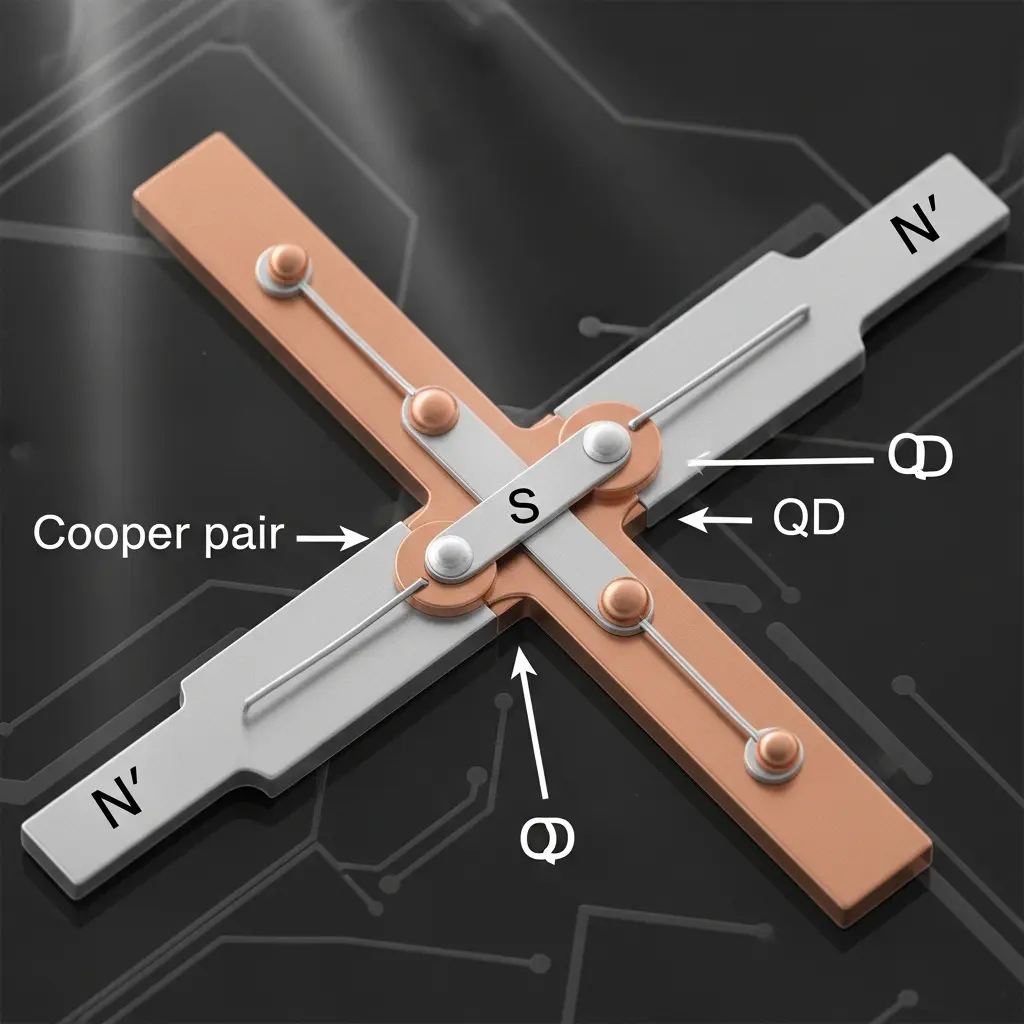
The fundamental nature of electron behaviour continues to fascinate physicists, and new research explores how to manipulate these particles using a phenomenon called crossed Andreev reflection. Austin Marga and Venkat Chandrasekhar, both from Northwestern University, investigate how electrons split within superconducting materials, creating spatially separated currents with unique statistical properties. This work demonstrates that superconductors can act as effective beam splitters for electrons, enabling the creation of microscopic circuits that mimic optical interferometers. By controlling these electron currents, scientists gain new insights into the fundamental statistics of particles and open possibilities for novel quantum devices that exploit electron interference effects.
Scientists investigate the characteristics of conducting quasiparticles and quantum entanglement through experiments designed to reveal how particles behave when measured together. Particle statistics determine outcomes in two-particle quantum interference experiments, influencing whether particles tend to bunch together or avoid each other. In superconducting proximity junctions, electrons striking a superconductor can generate holes, the absence of an electron, in spatially separated normal metal leads via a process called crossed Andreev reflection. This creates non-locally generated currents exhibiting unique properties due to the device’s four-terminal configuration.
Andreev Reflection Creates Electronic Beam Splitter
This research details a novel approach to creating an electronic beam splitter based on Andreev reflection in a superconductor. Traditional beam splitters, used in quantum optics, divide a single photon into two paths, enabling interference experiments and quantum information processing. This work aims to create an analogous device for electrons, potentially opening doors to new types of mesoscopic quantum circuits and experiments. The core principle relies on Andreev reflection, where an electron encountering a superconductor is reflected as a hole, conserving energy and momentum and effectively splitting the electron’s charge.
This splitting is essential for creating interference effects within mesoscopic systems, systems larger than atoms but small enough to exhibit quantum behavior. The team characterizes the beam splitter’s performance through shot noise measurements, which reveal fundamental noise characteristics and provide information about the quantum properties of the system. The team proposes a specific device architecture based on a normal metal-superconductor interface, where Andreev reflection acts as the beam splitting mechanism. Theoretical analysis calculates the probabilities of transmission and reflection, as well as the correlations between the outgoing particles.
A key finding is the prediction of a negative cross-correlation between the outgoing electron and hole, a signature of the quantum nature of the beam splitter that distinguishes it from classical counterparts. Analysis of two-electron incidence reveals interference effects. The proposed device offers advantages over existing electronic beam splitters, including eliminating the need for large magnetic fields and simplifying fabrication. Potential applications include quantum information processing, tests of entanglement, mesoscopic interferometry, and the study of non-equilibrium phenomena.
Negative Cross-Correlation Reveals Electron Anti-Bunching
This research demonstrates the creation of a novel beam splitter utilizing superconducting proximity junctions to manipulate electron currents and explore fundamental particle statistics. Experiments successfully generate non-local currents through crossed Andreev reflection, where electrons entering a superconductor induce holes in spatially separated normal metal leads. Measurements of current correlations quantify the degree of particle bunching or anti-bunching, providing insights into the underlying quantum behavior. The team measured autocorrelation coefficients, finding positive values for certain combinations, and a negative cross-correlation coefficient, indicating a distinct anti-correlative feature in the measurements and confirming the device’s ability to generate non-classical correlations.
Further analysis of hole creation probabilities revealed that when one electron is incident from each of two leads, holes are ejected into other leads with weighted probabilities. This device offers advantages over existing electronic beam splitters, eliminating the need for large magnetic fields and simplifying fabrication through the use of metallic films. The research establishes a foundation for constructing mesoscopic interferometric devices with potential applications in entanglement testing and quantum information processing.
Andreev Beam Splitter Demonstrates Electron Anti-Correlation
This research demonstrates the successful fabrication and analysis of a novel mesoscopic device functioning as a beam splitter for electrons, utilizing the crossed Andreev reflection process in superconducting proximity junctions. The team shows that this device generates non-local currents exhibiting a distinct, though not perfect, anti-correlation. This achievement builds upon established principles of particle statistics and two-particle interference, extending them to mesoscopic systems. The resulting Andreev beam splitter offers several advantages over existing electronic counterparts, notably eliminating the need for large magnetic fields and simplifying fabrication through the use of metallic films rather than complex crystalline materials.
While acknowledging the small magnitude of the non-local signals, the researchers highlight the clear negative cross-correlation coefficient as a promising indicator for future experimental work. Further development of this device could lead to the creation of compact, solid-state interferometers suitable for testing entanglement and advancing the field of quantum information science. The team suggests that this device can serve as a fundamental building block for more complex mesoscopic interferometric circuits.
🗞 Using Crossed Andreev Reflection to Split Electrons
🧠 ArXiv: https://arxiv.org/abs/2510.25641