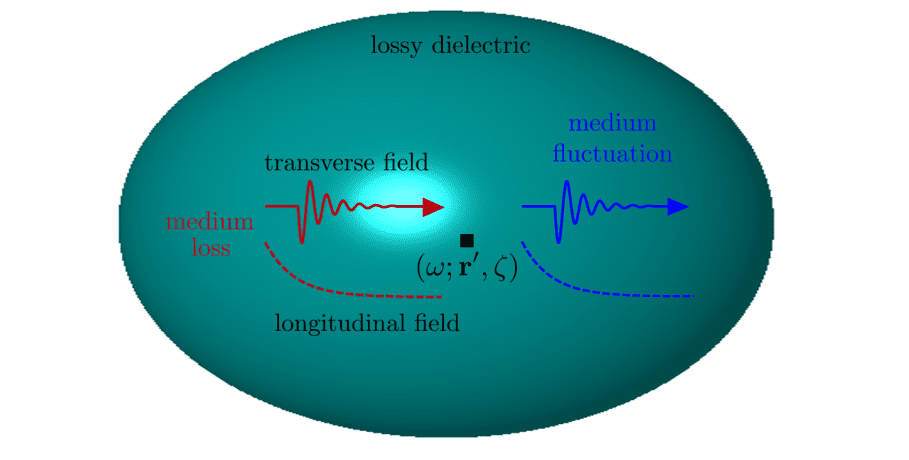
Understanding how light and matter interact requires accurately modelling the complex dynamics of atoms in realistic environments, a challenge that often exceeds the limitations of traditional computational methods. Hyunwoo Choi, Jisang Seo, and Weng C. Chew, alongside Dong-Yeop Na, now present a new numerical framework that overcomes these limitations, enabling a more complete and accurate description of atom-field interactions in open and dissipative systems. Their approach links a memory-kernel method to the dyadic Greens function, allowing for first-principles modelling of atomic behaviour directly within standard computational electromagnetic solvers. This achievement significantly advances the field by providing a rigorous way to incorporate emitter dynamics into existing simulations, paving the way for detailed investigations of light-matter interactions in complex scenarios such as near metallic mirrors or within optical cavities.
Quantum Optics Beyond Semi-Classical Approximations
This research develops a fully quantum treatment of light-matter interactions, surpassing the limitations of commonly used semi-classical approximations. Scientists accurately model systems where the electromagnetic environment significantly influences quantum behavior, accounting for memory effects and energy dissipation. This approach moves beyond treating light as a classical entity, incorporating its inherent quantum nature for a more complete understanding of these interactions. The fluctuation-dissipation theorem, Green’s functions, and spectral functions provide essential tools for calculating electromagnetic fields and their responses to external stimuli. Quasinormal modes describe resonances in open systems and determine their decay rates. Researchers develop methods for modeling dissipative and complex environments, including dispersive and absorbing dielectrics, and employ modified Langevin noise formalism to incorporate environmental effects into quantum calculations.
Open system theory addresses systems exchanging energy with their surroundings, while investigations into surface effects reveal how surfaces alter interactions between quantum emitters. These methods are applied to phenomena including cavity QED, waveguide QED, spontaneous emission, superradiance, non-Markovian dynamics, and polariton physics. This research aims to develop more accurate and realistic models of light-matter interactions in complex environments, understanding the role of non-Markovian effects in quantum phenomena, and developing new computational tools for simulating quantum optical systems. By applying these models to systems like quantum dots in cavities and plasmonic nanostructures, scientists hope to advance the field of quantum optics and pave the way for new technologies.
Modal Expansion for Open System Simulations
Scientists have developed a novel numerical framework for modeling single photon emission from two-level systems in complex electromagnetic environments, moving beyond traditional approximations. This framework integrates seamlessly with standard computational electromagnetic solvers, such as finite-difference time-domain and finite element methods. Researchers verified the completeness of boundary and medium-assisted modes using a modified Langevin noise formalism, reconstructing the imaginary part of the dyadic Green’s function through three-dimensional modal expansion, a crucial step for accurately representing electromagnetic fields in complex media. This reconstruction enables a first-principles description of atom-field interaction via the multi-mode Jaynes-Cummings model, accurately capturing the dynamics of quantum systems interacting with their environment.
Within the single excitation manifold, the team demonstrated that the memory kernel of a two-level system is directly determined by the imaginary part of the Green’s function, simplifying the computational burden. The proposed framework delivers a Green’s function-based approach for describing both atomic population and single-photon dynamics, directly compatible with Maxwell solvers, and represents a significant advancement in computational electromagnetics. To demonstrate practical applicability, scientists presented strategies for implementing their method within both finite-difference time-domain and finite element method frameworks. Numerical results were verified using a lossy Lorentz-Drude type mirror, examining scenarios including a two-level system near a finite-sized metallic mirror and a system centered within a Fabry-Perot cavity. This work establishes a rigorous foundation for incorporating quantum emitter dynamics into computational electromagnetics, extending the capabilities of classical solvers to address quantum light-matter interactions and opening new avenues for simulating complex quantum systems.
Modal Expansion Reconstructs Atom-Field Interactions Precisely
Scientists have developed a numerical framework for modeling single photon emission from two-level systems in complex electromagnetic environments, moving beyond traditional approximations. The team numerically verified the completeness of boundary and medium-assisted modes using the modified Langevin noise formalism, reconstructing the imaginary part of the dyadic Green’s function through modal expansion in three dimensions. This reconstruction allows for a first-principles description of atom-field interaction via the multi-mode Jaynes-Cummings model in open and dissipative environments. Experiments reveal that the memory kernel governing a two-level system is directly determined by the imaginary part of the Green’s function, demonstrating that radiative modes alone govern the relevant dynamics.
The research delivers a Green’s function-based approach for describing atomic population and single-photon dynamics, directly compatible with Maxwell solvers, and concrete strategies for implementing this method within both finite-difference time-domain and finite element method frameworks. Further validation involved numerical results for a lossy Lorentz-Drude type mirror, encompassing scenarios with a two-level system near a finite-sized metallic mirror and one centered within a Fabry-Perot cavity. Measurements confirm that the atomic population is governed by the imaginary part of the Green’s function, while the single-photon amplitude is characterized through equivalent current densities. This breakthrough establishes a foundation for accurately modeling quantum light-matter interactions in complex systems, paving the way for advancements in nanophotonics and integrated quantum devices.
Completeness of Quantum Emission Modelling Demonstrated
This work presents a new computational framework for modeling the emission of single photons from two-level quantum systems in complex electromagnetic environments, moving beyond the limitations of traditional Markovian approximations. Researchers successfully demonstrated a method for accurately representing the interaction between light and matter, even when the surrounding environment significantly influences the quantum system’s behavior. The core of this achievement lies in a modified Langevin noise formalism, which incorporates boundary and medium-assisted field modes to provide a complete basis for describing the system’s dynamics. Crucially, the team verified the completeness of this approach by reconstructing the imaginary part of the dyadic Green’s function in three dimensions, establishing a fundamental link between electromagnetic fields and quantum emitter behavior.
This allows for a first-principles description of light-matter interactions, enabling accurate modeling of atomic population and single-photon dynamics directly within standard computational electromagnetic solvers, such as finite difference time domain and finite element methods. The method was successfully implemented and validated using examples including a lossy mirror and a Fabry-Perot cavity, demonstrating its practical applicability and consistency with analytical predictions. The authors acknowledge that the current framework focuses on single emitters and does not yet address the complexities of multi-emitter systems or strong-coupling regimes. Future research will focus on extending the method to explore these more complex scenarios, including analyzing interactions and quantum correlations among multiple atoms. This advancement promises to be a valuable tool for.
👉 More information
🗞 Atom-Field Non-Markovian Dynamics in Open and Dissipative Systems: An Efficient Memory-Kernel Approach Linked to Dyadic Greens Function and CEM Treatments
🧠 ArXiv: https://arxiv.org/abs/2511.03561