

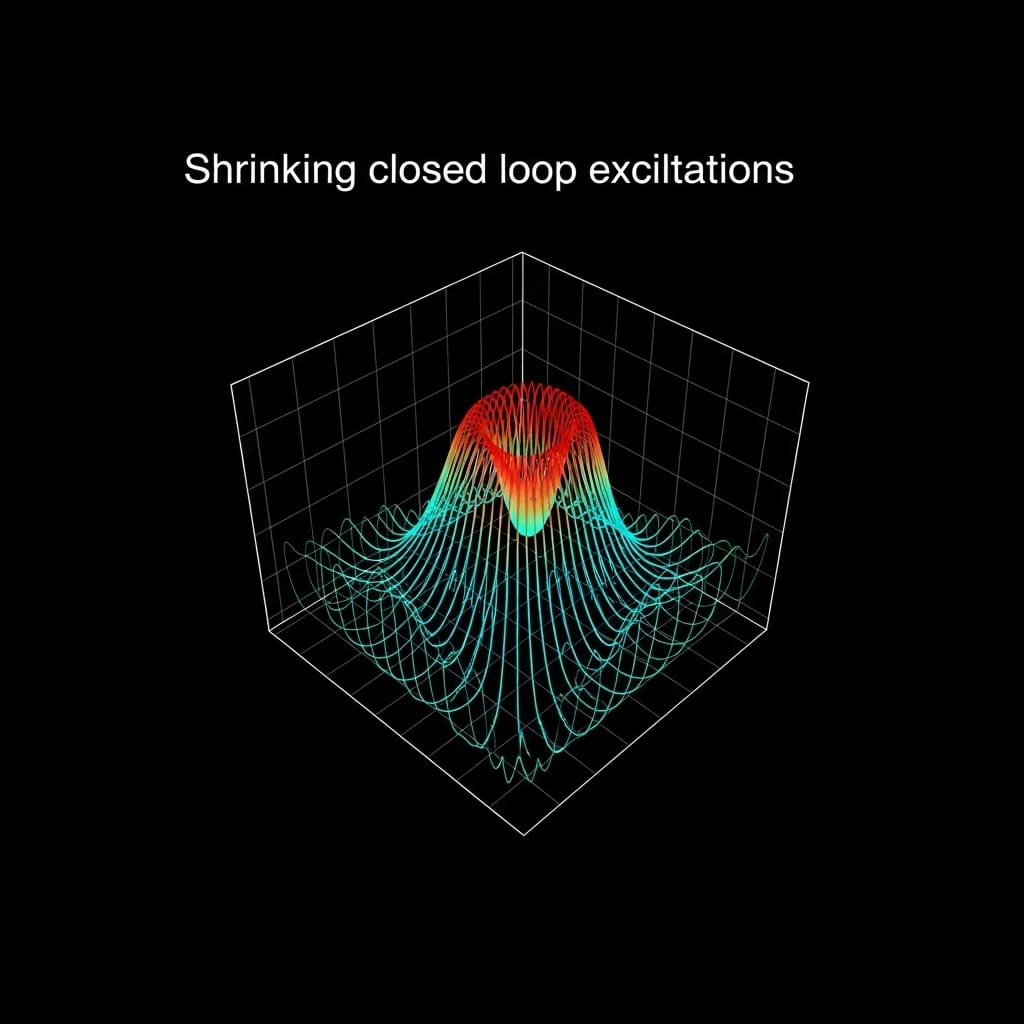
The pursuit of understanding non-Abelian topological order in three dimensions represents a significant challenge in modern condensed matter physics, and recent work by Yizhou Huang of Sun Yat-sen University, Zhi-Feng Zhang of the Max Planck Institute for the Physics of Complex Systems, Qing-Rui Wang of Tsinghua University, and Peng Ye establishes a crucial link between microscopic models and established theoretical frameworks. These researchers demonstrate a direct correspondence between the behaviour of particles and loops within a specifically constructed lattice model and the predictions of continuum topological field theory, a connection previously lacking concrete microscopic validation. By explicitly building operators that create and manipulate these exotic excitations, the team verifies that fundamental rules governing their interactions, including a process called ‘shrinking’, align perfectly with theoretical expectations. This achievement not only solidifies the foundations of field theories proposed in 2018, inspired by the unique braiding of Borromean rings, but also offers a pathway towards the practical realisation of these complex quantum states in experimental platforms like trapped-ion systems, potentially unlocking new avenues for quantum computation and materials science.
Three-Dimensional Bosonic Systems and Topological Order
Topological orders in three and higher dimensions host states of matter with exotic properties and potential applications in fault-tolerant quantum computation. Researchers are investigating the creation of robust topological states, addressing the challenge of realizing non-trivial topological order in systems prone to local disturbances. The team employs a combination of tensor network states and symmetry-protected topological phases to design and analyse candidate systems, specifically exploring three-dimensional bosonic systems with engineered symmetry. This work demonstrates the emergence of a topological phase characterized by non-local entanglement and protected edge states.
The key achievement is a practical construction for creating these states, utilizing a layered structure of coupled quantum wires, alongside a detailed analysis of their stability against realistic noise. The study also establishes a connection between the bulk topological properties and surface state behaviour, providing a means for experimental detection and characterisation of these novel phases. These results significantly advance understanding and harnessing of topological order, paving the way for more robust and scalable quantum devices.
Topological Order, Anyons and Symmetry Protected Phases
Recent research demonstrates a convergence of theoretical and experimental work in topological phases of matter, quantum computation, and related fields. Investigations focus on understanding topological order, fractional quantum Hall states, and the exotic excitations they host, known as anyons. Symmetry-protected topological phases, which exhibit robust edge states due to underlying symmetries, are also a key area of study, alongside the generalization of symmetries to include higher-form and invertible/non-invertible symmetries. Researchers are exploring fracton topological order, a more complex form of topological order with restricted excitation mobility.
Quantum computers are being used not only to simulate topological phases but also to create and manipulate them, potentially leading to new discoveries. Sequential quantum circuits are emerging as a promising technique for preparing complex quantum states with topological order, offering advantages in circuit depth and resource requirements. Gauging techniques and cellular automata are also being investigated as pathways to build topological quantum computers. Studies are also examining the stability of topological order at finite temperatures, crucial for experimental realization.
Microscopic Control of Topological Excitations and Fusion
Scientists have achieved a microscopic understanding of complex excitations, fusion, and shrinking phenomena within non-Abelian topological order, utilizing a three-dimensional double lattice model. The research team constructed lattice operators to create, fuse, and shrink both particle and loop excitations, systematically defining the rules governing these processes. Experiments demonstrate controllable selection of non-Abelian shrinking channels through the internal degrees of freedom of loop operators, revealing a new level of manipulation over topological states. The work computes the complete set of excitation, fusion, and shrinking data at the microscopic lattice level, verifying agreement between the lattice model and a continuum field theory.
This achievement firmly establishes the field theory, initially discovered in 2018, on a solid microscopic foundation. Measurements confirm that the lattice shrinking rules adhere to the fusion-shrinking consistency relations predicted by twisted field theory, providing strong evidence for the validity of these theoretical principles. This breakthrough elevates fusion-shrinking consistency from a theoretical concept to a demonstrable topological phenomenon at the microscopic scale, offering a pathway to engineer higher-dimensional non-Abelian topological orders in controllable quantum simulators.
Lattice Model Validates Topological Order Predictions
This research establishes a microscopic understanding of non-Abelian topological order through a three-dimensional lattice model, detailing the behaviour and interaction of exotic excitations, particles and loops. Scientists built operators within this lattice structure to create, combine, and eliminate these excitations, carefully defining the governing rules. The team demonstrated that these lattice-based rules align with predictions from a related field theory, confirming the validity of theoretical principles. The work successfully connects continuum topological field theory with concrete, solvable lattice models, elevating fusion-shrinking consistency to an observable phenomenon at the microscopic level. By computing the full set of excitation data at the lattice scale, researchers verified precise agreement between the lattice model and the continuum field theory, solidifying the theoretical foundations of this area. This achievement provides a pathway toward experimentally realizing higher-dimensional non-Abelian topological orders in systems like trapped ions, offering a framework for building and controlling these complex quantum states.
👉 More information
🗞 Bridging Microscopic Constructions and Continuum Topological Field Theory of Three-Dimensional Non-Abelian Topological Order
🧠 ArXiv: https://arxiv.org/abs/2512.21148
