Understanding how molecules break apart when exposed to light is fundamental to many areas of science, from atmospheric chemistry to astrophysics, and now researchers are shedding new light on these processes at the molecular level. Jean-Paul Mosnier, Eugene T. Kennedy, and Denis Cubaynes, along with their colleagues, have meticulously measured how strongly light interacts with specific molecular ions, those containing sulphur and chlorine, causing them to fragment. This research details the precise energy at which these molecules absorb light and break apart, revealing crucial details about the underlying physics and chemistry, and providing data that will refine theoretical models of molecular behaviour. By combining experimental measurements with advanced computational modelling, the team provides a comprehensive understanding of these fundamental molecular processes, which has implications for diverse fields including the study of planetary atmospheres and the development of new spectroscopic techniques.
The experimental results are interpreted with the help of extensive theoretical calculations, employing density functional theory and post-Hartree-Fock methods, to compute the absorption oscillator strengths of core excitations to valence and Rydberg states. To fully account for the experimental observations, the calculations incorporate vibrational dynamics and spin-orbit coupling. Similar experimental data are also presented for the sulfaniumyl H2S+ molecular ion.
Photoionization, Spectroscopy and Collision Dynamics
This collection of references details a comprehensive research program in atomic, molecular, and chemical physics, focusing on photoionisation, spectroscopy, and related computational techniques. The list reveals a strong emphasis on understanding the interaction of light with matter and the ionization of atoms and molecules. Research areas include photoionisation and photoabsorption spectroscopy, molecular collisions and dynamics, and computational chemistry, with a focus on calculating molecular properties and ionisation processes. The references highlight key methods, including photoelectron spectroscopy for studying ionization energies and electronic structure, core-level spectroscopy for probing composition and bonding, and density functional theory and coupled cluster theory for calculating electronic structure.
Molecular dynamics simulations model the time evolution of molecular systems, while time-dependent density functional theory investigates excited states and time-dependent phenomena. Mass spectrometry identifies and quantifies ions. Several software packages, including Gaussian, GAMESS, and ORCA, are frequently cited, indicating a reliance on computational modeling to complement experimental results. The research emphasizes theoretical calculations, particularly in understanding core-level ionization and molecular dynamics, with potential applications in chemical reactions, radiation effects, materials development, astrochemistry, and atmospheric chemistry. In summary, this bibliography represents a thorough collection of references for a research project that combines experimental and theoretical studies of photoionization, molecular dynamics, and electronic structure. It is a highly specialized area of chemical physics with broad implications for understanding fundamental chemical processes.
Interstellar Hydride Absorption Cross Sections Measured
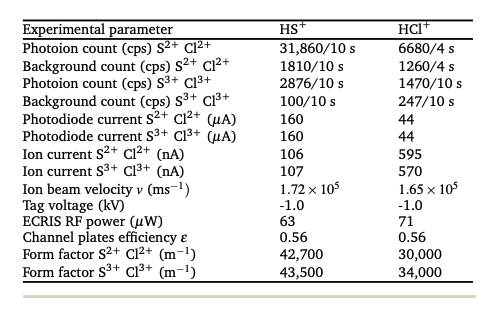
Researchers have, for the first time, measured the absorption of light by sulfanylium (HS+) and chloroniumyl (HCl+) molecular hydrides, and also investigated sulfaniumyl (H2S+) ions. These molecules are important because HS+ and HCl+ were recently discovered in interstellar gas in 2011 and 2012, respectively, and play a role in understanding chemical processes in molecular clouds. The study combines experimental measurements with advanced theoretical calculations to provide a comprehensive understanding of how these molecules absorb light. The experiments involved directing beams of HS+, H2S+, and HCl+ ions and exposing them to precisely controlled light from a synchrotron source.-
By measuring the amount of light absorbed at various energies, researchers determined the absorption cross sections, which indicate the likelihood of light absorption. These measurements were performed near the 2p ionization thresholds, approximately 180 electron volts for sulphur and 220 electron volts for chlorine, allowing detailed analysis of the molecules’ electronic structure. To interpret the experimental results, the team employed both density functional theory (DFT) and post-Hartree-Fock configuration interaction calculations. These calculations accurately model the behavior of electrons within the molecules, including the effects of spin-orbit coupling and vibrational dynamics.
The theoretical models were essential for understanding the observed absorption spectra and confirming the accuracy of the experimental measurements. The combination of experiment and theory provides a detailed picture of the electronic structure and behaviour of these interstellar molecules. A key aspect of the research is the investigation of the molecules’ fragmentation after absorbing light. When a molecule absorbs a photon, it can undergo Auger decay, resulting in the emission of an electron and potentially leading to fragmentation. The energy released during this fragmentation provides insights into the interplay between electronic and nuclear decay processes. Understanding these processes is crucial for interpreting the observed photofragmentation patterns and gaining a deeper understanding of molecular photochemistry. This work builds upon decades of research and contributes to a more complete understanding of how molecules interact with light.
Ionisation Pathways of Sulphur and Chlorine Hydrides
This research details measurements of how X2+ and X3+ ions (where X is sulphur or chlorine) are created when hydride molecules are exposed to intense synchrotron radiation. The study precisely maps the energy at which these ions form, revealing details about the electronic structure of the molecules involved. By combining experimental data with complex theoretical calculations, researchers have identified the specific electronic transitions occurring during ionisation and the roles of vibrational dynamics and spin-orbit coupling in these processes. The results demonstrate a clear correspondence between the spectra of single and double ionisation, with the onset of direct Auger processes contributing to the observed spectral features.
The investigation extends to a comparison between different molecular species, including variations in the number of hydrogen atoms attached to sulphur. These comparisons reveal how the molecular environment influences the ionisation process and the distribution of oscillator strength among different electronic states. Notably, the study highlights the prominence of transitions into the 3d resonances compared to valence and Rydberg states. While the research provides valuable insights into the electronic structure and ionisation dynamics of these molecules, the authors acknowledge that further experiments, particularly those employing multi-coincidence techniques and electron spectrometry, are needed to fully disentangle the complex decay pathways and determine whether dissociation or molecular Auger decay dominates. Future work could also explore the behaviour of different Rydberg states and their contributions to the observed spectra.
🗞 Ionic photofragmentation cross sections of the HS+ H2S+ and HCl+ molecular ions near the 2p threshold
🧠 DOI: https://doi.org/10.48550/arXiv.2507.16993