

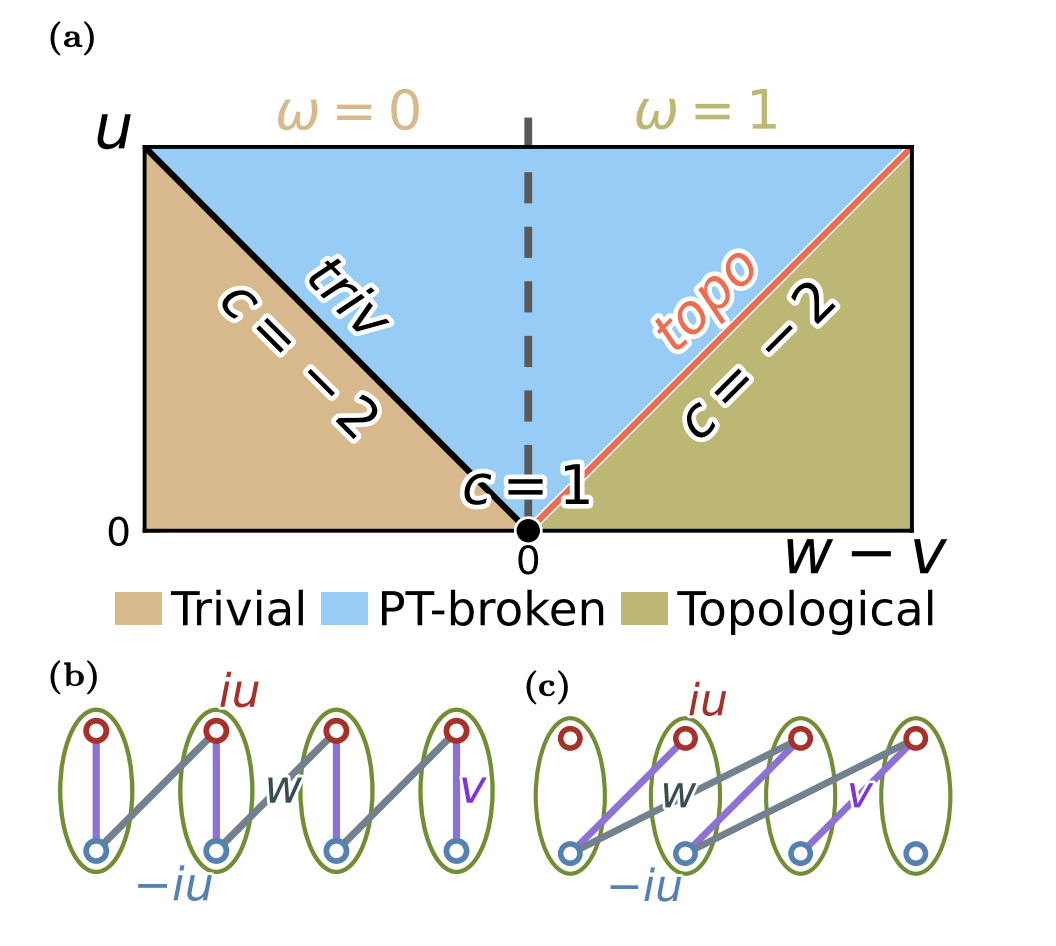
The fascinating connection between a system’s topology and its behaviour at critical points has recently spurred interest in symmetry-enriched criticality, but the role of non-Hermitian physics in these phenomena remains largely unknown. Kuang-Hung Chou, Xue-Jia Yu, and Po-Yao Chang from National Tsing Hua University, and the Yukawa Institute for Theoretical Physics, now demonstrate how parity-time (PT) symmetry fundamentally alters non-Hermitian critical points, establishing a new and distinct universality class. Their analytical investigation of non-Hermitian free fermion models reveals a novel type of conformally invariant critical point that supports robust topological edge modes, offering a pathway to potentially control and manipulate these states. Remarkably, the team finds that the topological properties of these systems are encoded within the imaginary component of the entropy scaling, a feature that does not occur in conventional Hermitian systems, and points to a fundamentally different mechanism driving the emergence of edge states at criticality.
This work investigates symmetry-enriched criticality in non-Hermitian systems, focusing on those possessing parity-time (PT) symmetry, and demonstrates that PT-symmetric criticality exhibits unique characteristics, including an infinite number of critical points and a modified critical exponent. Specifically, the team considers a one-dimensional model with complex interactions engineered to preserve PT symmetry. Detailed analysis reveals that the system undergoes a transition from a PT-symmetric phase to a broken PT-symmetric phase, accompanied by a topological phase transition characterised by a non-zero winding number. The results show that the critical behaviour at this transition is governed by a novel universality class, differing from both conventional and other non-Hermitian systems, and establishes a connection between the system’s topological properties and the emergence of critical phenomena, demonstrating that the winding number acts as an order parameter for the transition. This provides new insights into the interplay between topology, symmetry, and criticality in non-Hermitian systems, and opens up avenues for exploring novel quantum phases of matter.
Topological Phases and Non-Hermitian Physics
This is a comprehensive overview of research primarily focused on condensed matter physics and quantum information, highlighting prominent and emerging areas within topological phases of matter. Research focuses on Symmetry-Protected Topological (SPT) phases, topological order, and related concepts, with many papers identifying new SPT phases, understanding their properties, and exploring their realisation in physical systems, including non-Hermitian topological phases and gapless topological phases. The interplay between symmetries and topological order is a central topic, with researchers understanding how symmetries protect topological phases and how they can be used to classify them. Several papers relate to using quantum systems, such as trapped ions and superconducting qubits, to simulate condensed matter physics problems, particularly those involving topological phases, a key area for potential applications of quantum computing.
Understanding the behaviour of systems at quantum phase transitions, including the role of topological order and critical edge states, is also a focus, with a recent and rapidly developing area exploring non-invertible symmetries, which can lead to new and exotic topological phases. Connections between topological phases and holographic principles are also being explored, potentially providing new ways to understand and classify them. Research into non-invertible symmetries, particularly papers by Li, Oshikawa, Zheng, and Bhardwaj, is a cutting-edge area, while Wen’s papers explore connections between holography and topological phases. Work by Yang, Lin, and Yu focuses on gapless topological phases and their connection to criticality, and Thorngren, Vishwanath, and Verresen explore the connection between Higgs condensates and symmetry-protected topological phases.
Research into quantum simulation and experimental realisations demonstrates the use of trapped ions and superconducting qubits to simulate condensed matter systems, including those with topological order. Tan et al. report on the experimental observation of nontrivial topology in a superconducting processor, while Zhou’s work focuses on the topological characterization of phase transitions and critical edge states. Research into non-Hermitian topological phases is a growing area, with Yu, Yang, Lin, and Jian’s work exploring gapless topological states in measurement-only circuits, and Wen’s work focusing on string condensation and topological holography.
Key researchers in this field include Xiao-Liang Qi, Ashvin Vishwanath, and Ruihua Wen, prominent theorists in topological phases. Xiao-Jing Yu is a leading researcher in topological phases, quantum criticality, and quantum simulation, while Li Li, M. Oshikawa, and Y. Zheng focus on non-invertible symmetries and topological phases. P.
Zoller, M. Greiner, and C. Kokail are involved in experimental quantum simulation. This is a comprehensive list reflecting the vibrant and rapidly evolving field of topological quantum matter, with the emphasis on non-invertible symmetries and the connections between holography and topological phases as particularly noteworthy emerging areas of research.
Non-Hermitian Criticality and Topological Edge States
This research establishes a new understanding of critical points in non-Hermitian systems, demonstrating how parity-time (PT) symmetry enriches their properties and gives rise to a distinct universality class. Scientists have shown that these systems exhibit robust topological edge states at critical points, protected by a mechanism termed generalized mass inversion, which does not require long-range interactions. The team analytically investigated non-Hermitian free fermion models, confirming the existence of these critical points and their associated topological features. Importantly, the research reveals a unique signature of these non-Hermitian critical points: topological degeneracy is encoded within the imaginary component of entanglement entropy, a characteristic absent in conventional Hermitian systems. Through careful analysis and numerical verification, the scientists confirmed that these systems possess a central charge of -2, consistent with non-unitary conformal field theory. While this work focuses on free-fermion models in one dimension, the authors suggest that extending these findings to higher dimensions and interacting many-body systems represents a promising avenue for future investigation, and note the potential for experimental realisation using quantum and classical simulators, including platforms based on ultracold atoms, superconducting circuits, and phononic systems.
🗞 PT symmetry-enriched non-unitary criticality
🧠 ArXiv: https://arxiv.org/abs/2509.09587


