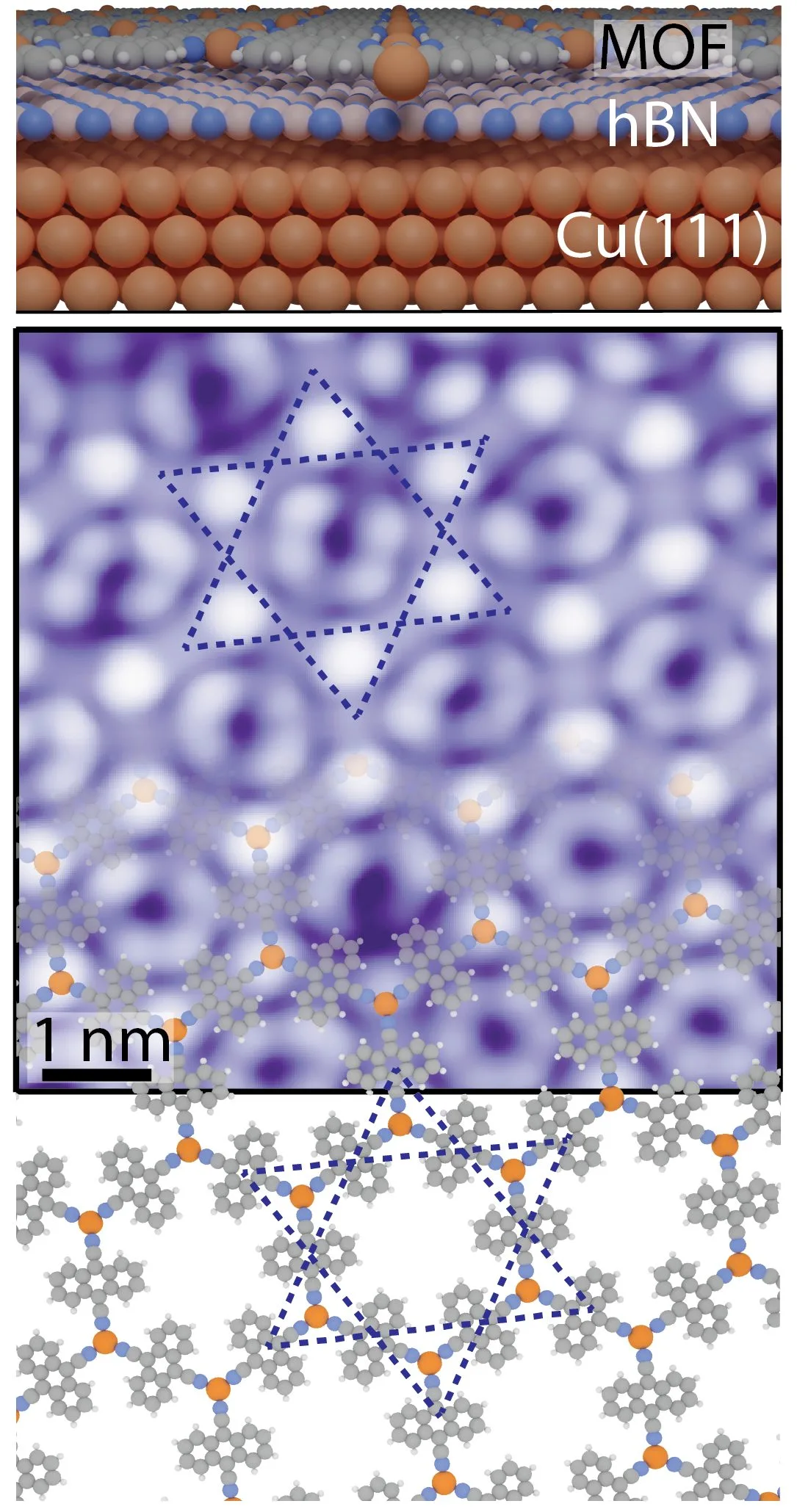
An Australian-led study by FLEET at Monash University, including lead author Dr. Benjamin Lowe and corresponding author Prof Agustin Schiffrin, has discovered a new atomically-thin material that can switch between conducting and insulating electricity. This material, a metal-organic framework (MOF), has a unique star-shaped structure that enhances electron-electron interactions, leading to a Mott insulator.
The team was able to control the switch from insulator to conductor by changing the electron population. This discovery could be used in new electronic devices like transistors. The study was published in Nature Communications and included collaboration from the University of Queensland and Okinawa Institute of Science and Technology Graduate University.
Unusual Insulating Behavior in Atomically-Thin Material
A recent study led by FLEET at Monash University has discovered an unusual insulating behavior in a new atomically-thin material. This material, a metal-organic framework (MOF), has the ability to switch between insulating and conducting states. This switchable behavior is due to strong interactions between electrons, a characteristic of Mott insulators. Mott insulators are materials that can act as insulators even when they are expected to conduct electricity. This occurs when electrons become immobilized due to strong repulsion from nearby electrons, preventing them from carrying a current.
The MOF used in this study exhibits a star-like (kagome) structure when viewed under a scanning tunnelling microscope (STM). This structure enhances the influence of electron-electron interactions, leading to the realization of a Mott insulator. The ability to switch this material from an insulator to a conductor makes it a promising candidate for application in new electronic devices such as transistors.
The Role of Electron Interactions in the MOF
The MOF at the center of this study is a class of materials composed of organic molecules and metal atoms. The versatility of supramolecular chemistry approaches allows for the construction of materials from the bottom-up, with atomic scale precision. By carefully selecting the right ingredients, the properties of MOFs can be tuned. The MOF in this study was designed with a star-shaped geometry, known as a kagome structure, which enhances the influence of electron-electron interactions.
The authors constructed the kagome MOF from a combination of copper atoms and 9,10-dicyanoanthracene (DCA) molecules. They grew the material on another atomically thin insulating material, hexagonal boron nitride (hBN), on an atomically flat copper surface, Cu(111). The structural and electronic properties of the MOF were measured at the atomic scale using scanning tunnelling microscopy and spectroscopy.
The On-Off Switch: Electron Population
The researchers were able to change the electron population in the MOF by using variations in the chemical environment of the hBN substrate and the electric field underneath the scanning tunnelling microscope tip. When some electrons are removed from the MOF, the repulsion that the remaining electrons feel is reduced and they become unfrozen, allowing the material to behave like a metal. This ability to control the electron population serves as an on-off switch for controllable Mott insulator to metal phase transitions.
Future Applications and Studies
The ability of this MOF to switch between Mott insulator and metal phases by modifying the electron population is a promising result that could be exploited in new types of electronic devices, such as transistors. A promising next step towards such applications would be to reproduce these findings within a device structure in which an electric field is applied uniformly across the whole material.
The observation of a Mott insulator in a MOF, which is easy to synthesize and contains abundant elements, also makes these materials attractive candidates for further studies of strongly correlated phenomena, potentially including superconductivity, magnetism, or spin liquids.
The Study and Its Contributors
The study, titled “Local gate control of Mott metal-insulator transition in a 2D metal-organic framework,” was published in Nature Communications in April 2024. The research was led by scientists at Monash University, with co-authors from the University of Queensland (UQ) and Okinawa Institute of Science and Technology Graduate University (OIST), Japan.
The theoretical calculations were conducted by Dr. Bernard Field, in collaboration with researchers from UQ and OIST. The experimental study was conducted in Prof. Agustin Schiffrin’s group at Monash University, which investigates the electronic properties of organic and metal-organic materials at the atomic scale. The group uses state-of-the-art nanomaterial synthesis and scanning probe microscopy techniques to synthesize novel materials that could be used in ultra-low energy electronic devices.
External Link: Click Here For More