

The emergence of complex electronic behaviour in layered materials receives significant attention from physicists, and recent work focuses on how interference between multiple moiré patterns creates what is known as a supermoiré lattice. Zekang Zhou, Cheng Shen, and colleagues at the Ecole Polytechnique Fédérale de Lausanne, alongside Kryštof Kolář from Freie Universität Berlin, and researchers including Kenji Watanabe and Takashi Taniguchi from the National Institute for Materials Science, now demonstrate the crucial role of this supermoiré lattice in twisted trilayer graphene. Their findings reveal how the lattice generates new, extremely flat bands of energy, and importantly, how these bands exhibit interaction-induced symmetry breaking and enable a transition between superconducting and insulating states. This research establishes that robust superconductivity can exist even when mirror symmetry is broken, and highlights the supermoiré lattice as a powerful tool for controlling and understanding correlated electronic phenomena in these complex materials, potentially paving the way for the design of novel electronic devices.
Twisted Graphene’s Moiré Lattice and Flat Bands
Scientists meticulously characterized twisted trilayer graphene, revealing detailed information about its electronic properties and correlated states. The study focused on alternating twisted trilayer graphene, created by stacking and twisting three graphene layers with specific angles. This configuration generates two distinct moiré patterns, each with unique wavelengths determined by the twist angles and the graphene lattice structure. Researchers specifically examined configurations where the twist angles are equal in magnitude but opposite in sign, a condition that produces a single flat band decoupled from a dispersive Dirac cone.
Detecting the Supermoiré Potential in Trilayer Graphene
To detect the supermoiré lattice, the team performed detailed electronic transport measurements on the trilayer graphene devices. They observed patterns indicative of the formation of supermoiré mini-flat bands and mini-Dirac bands, confirming the presence of the larger-scale supermoiré potential. When the two moiré lattices are close to being commensurate, their interference creates an approximate supermoiré lattice with an effective wavelength. The study further revealed phases within these supermoiré mini-flat bands and demonstrated robust superconductivity strongly modulated by the supermoiré potential. By carefully tuning the device, scientists independently controlled carrier density and displacement field, allowing them to map out the complex interplay between the moiré patterns and the resulting electronic states. The team’s work underscores the significance of the supermoiré lattice as an additional degree of freedom for tuning the electronic properties of twisted multilayer graphene systems and provides insights into correlated phenomena like superconductivity within the original moiré flat bands.
Twisted Graphene Reveals Cascade of Electronic States
Mini-Flat Bands and Supermoiré Lattice Formation
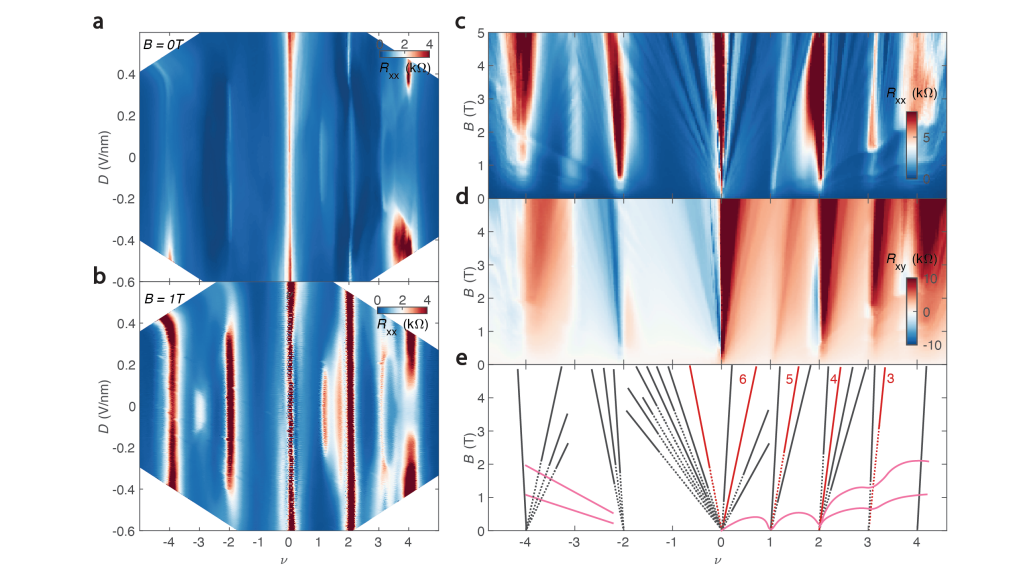
Scientists have discovered a supermoiré lattice within twisted trilayer graphene, revealing its crucial role in reshaping the material’s electronic band structure. This supermoiré lattice, formed by the interference of multiple moiré patterns, generates new mini-flat bands and mini-Dirac bands, significantly altering how electrons behave within the material. Experiments demonstrate that this lattice introduces interaction-driven symmetry breaking within the mini-flat bands, leading to a cascade of insulating and superconducting states. Measurements of electrical resistance as a function of carrier density and displacement field reveal a complex phase diagram with numerous resistive peaks and superconducting regions, spanning a broad range of charge densities.
Analysis of measurements obtained with an out-of-plane magnetic field categorizes observed states into those originating from the bottom moiré lattice, the top moiré lattice, and crucially, those arising from the supermoiré lattice itself. These measurements confirm the presence of two distinct moiré patterns and the emergence of supermoiré mini-bands. The team extracted twist angles, confirming the absence of mirror symmetry within the device. Notably, several measurements are incommensurate with those expected from the individual moiré lattices, and are identified as originating from the supermoiré lattice-induced states. These findings highlight the importance of the supermoiré lattice in tuning the electronic properties of twisted multilayer graphene and offer new insights into correlated physics within these moiré systems. The work demonstrates that robust superconductivity can exist even when mirror symmetry is broken, and underscores the potential of the supermoiré lattice as a powerful tool for designing and simulating novel electronic materials.
Supermoiré Influence on Superconductivity and Correlation
Supermoiré Lattice Drives Unexpected Superconductivity
This research demonstrates the existence of a supermoiré lattice within twisted trilayer graphene, revealing its crucial role in shaping the material’s electronic properties. Scientists discovered that the interplay of multiple moiré patterns generates unique ‘mini-bands’ and ‘mini-Dirac bands’, fundamentally altering the behavior of electrons within the material. Importantly, the team observed that this supermoiré lattice induces symmetry breaking within these mini-flat bands, leading to a cascade of electronic states, including superconductivity. The findings highlight that robust superconductivity can emerge even when mirror symmetry is absent in the twisted trilayer graphene, expanding understanding of correlated electron phenomena. By characterizing the system’s electronic structure, researchers confirmed the presence of two distinct moiré patterns and an emergent supermoiré lattice, evidenced by measurements obtained with an out-of-plane magnetic field. This work builds upon previous studies of twisted multilayer graphene, complementing existing research on both moiré quasicrystals and supermoiré lattices, and offering new insights into the relationship between twist angle, symmetry, and superconductivity.
🗞 Strong Correlations and Superconductivity in the Supermoiré Lattice
🧠 ArXiv: https://arxiv.org/abs/2509.24670


