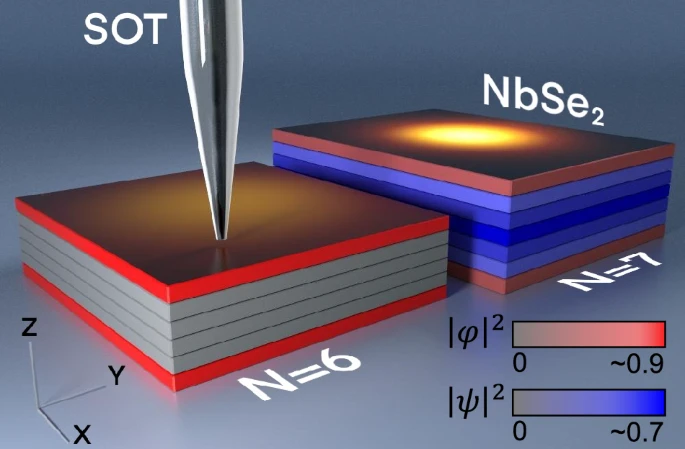
Researchers at Hebrew University of Jerusalem led by Ph.D. student Nofar Fridman and Prof. Yonathan Anahory have discovered that superconductivity in ultra-thin films of niobium diselenide (NbSe2) becomes confined to the material’s surface when the film thickness drops below six atomic layers. This finding, published in Nature Communications, challenges previous assumptions about superconductivity and was achieved using advanced magnetic imaging techniques.
The study revealed that as NbSe2 films become thinner than ten atomic layers, their ability to expel magnetic fields, measured by the Pearl length, behaves unexpectedly, increasing sharply and becoming independent of thickness. This discovery provides new insights into superconductivity in ultra-thin materials and could have implications for advancing quantum technologies.
Unexpected Superconducting Transition in Thin NbSe2 Films
Researchers at Hebrew University have uncovered a novel superconductivity phenomenon within ultra-thin niobium diselenide films (NbSe2). Their findings reveal that when these films are reduced to fewer than six atomic layers, superconductivity becomes confined to the material’s surfaces rather than permeating its entire volume. This discovery challenges conventional understanding and highlights new dimensions in studying “superconductivity in NbSe2.”
The research utilized advanced magnetic imaging techniques to observe how NbSe2 responds to magnetic fields as its thickness diminishes. Typically, the Pearl length—a measure of a superconductor’s ability to expel magnetic fields—increases with material thickness. However, this relationship breaks down for films thinner than ten atomic layers. Below six layers (approximately 2-4 nm), the Pearl length unexpectedly increases and becomes independent of thickness, indicating a shift in superconductivity behaviour.
This unexpected surface confinement suggests that ultra-thin NbSe2 films exhibit unique properties that are not observed in bulk materials. The findings underscore the importance of specialized measurement techniques in uncovering novel physical phenomena, potentially paving the way for advancements in quantum technologies.
Research Methodology and Advanced Magnetic Imaging
The researchers employed advanced magnetic imaging techniques to investigate the behaviour of NbSe2 films under varying thicknesses. Using these methods, they observed that as the film thickness decreased below six atomic layers (approximately 2-4 nm), there was an abrupt shift in superconducting properties. Specifically, the Pearl length—an indicator of how effectively a superconductor expels magnetic flux—unexpectedly increased and became independent of thickness.
This observation suggests that quantum confinement effects become significant at these reduced dimensions, altering electronic interactions and concentrating superconductivity near the films’ surfaces. These findings highlight the sensitivity of superconductivity to dimensional constraints and open new avenues for studying quantum phenomena in low-dimensional systems.
Insights into Material Behavior at Ultra-Thin Scales
Dimensional constraints play a crucial role in shaping the superconducting properties of ultra-thin NbSe2 films. As the thickness of these films is reduced, particularly below six atomic layers (approximately 2-4 nm), there is an abrupt shift in their superconducting behavior. This change is evidenced by the unexpected increase and subsequent independence of the Pearl length from thickness, indicating a fundamental alteration in how magnetic flux is expelled.
The observed surface confinement of superconductivity suggests that quantum confinement effects become significant at these reduced dimensions. In bulk NbSe2, superconductivity is distributed throughout the material, but as the film becomes thinner, the electronic interactions are altered, leading to a concentration of superconducting properties near the surfaces. This phenomenon highlights the sensitivity of superconductivity to dimensional constraints and opens new avenues for studying quantum phenomena in low-dimensional systems.
In summary, the role of dimensional constraints as a forcing function in NbSe2 films reveals new insights into the interplay between material geometry and superconductivity. These findings advance our understanding of superconductivity in two-dimensional systems and pave the way for innovative applications in quantum technologies.
More information
External Link: Click Here For More