

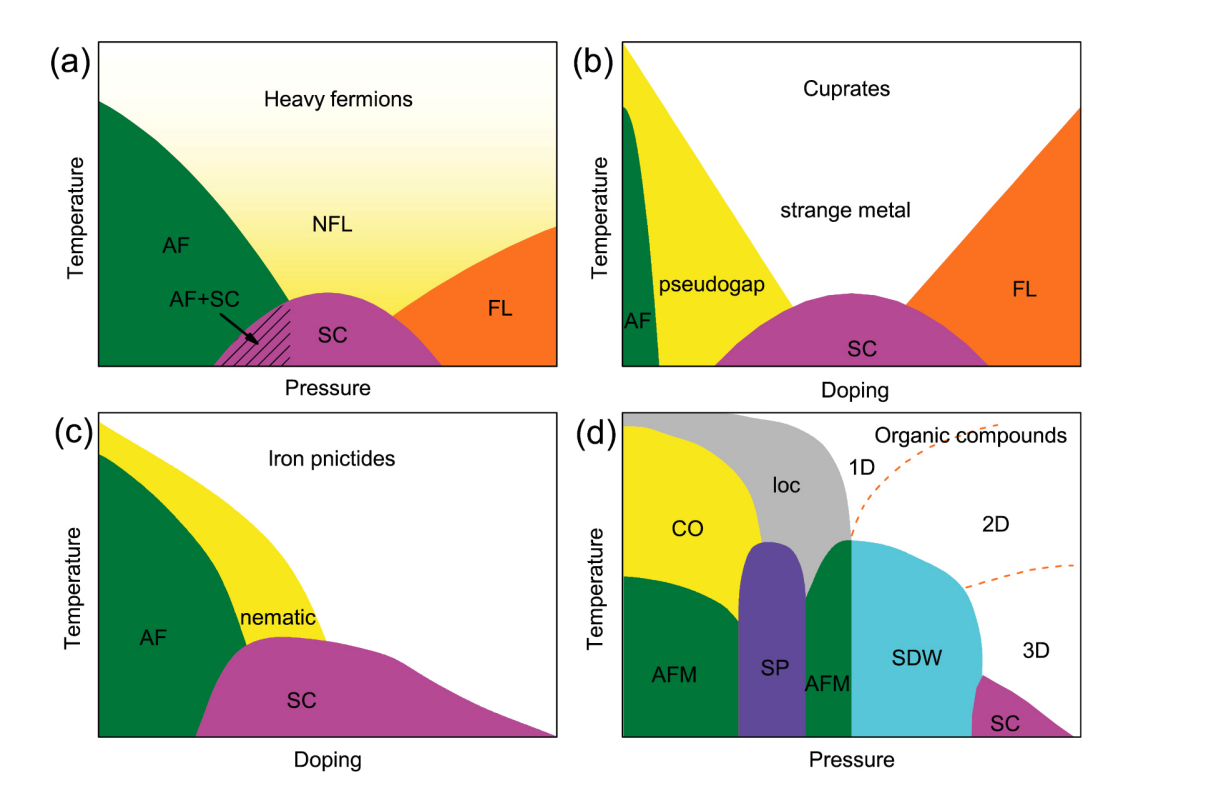
The interplay between magnetism and superconductivity represents a central challenge in condensed matter physics, with many materials exhibiting both phenomena in close proximity. Understanding how these seemingly opposing forces cooperate, rather than compete, is crucial for developing materials with enhanced superconducting properties. Researchers now investigate a scenario where superconductivity emerges not at a critical point defined by the disappearance of magnetism, but rather on the very edge of vanishing magnetic order, even in systems lacking such a critical point. Zhiqiang Wang from the Hefei National Research Center for Physical Sciences at the Microscale and the University of Science and Technology of China, alongside Ke Wang and K. Levin from the University of Chicago’s Department of Physics and James Franck Institute, explore this relationship in their paper, “Superconductivity on the edge of vanishing magnetic order”. Their work seeks to elucidate the mechanisms by which residual magnetism, even when failing to establish long-range order, constructively contributes to the stabilisation of superconductivity, potentially guiding the discovery of novel superconducting materials.
Zhiqiang Wang from the Hefei National Research Center for Physical Sciences at the Microscale and the University of Science and Technology of China, alongside Ke Wang and K. Levin from the University of Chicago’s Department of Physics and James Franck Institute, investigate the complex relationship between magnetism and superconductivity in their recent publication. Their work centres on the conditions under which magnetism promotes superconductivity, particularly in materials that do not conform to the established theory of a critical point governing this behaviour. The researchers seek to develop a more complete understanding of this interplay.
Superconductivity, the phenomenon of zero electrical resistance, frequently appears alongside magnetism, yet the precise nature of their interaction remains an area of active research. Traditional theories often posit a critical point, a specific condition where a material transitions between different magnetic states, as a crucial catalyst for superconductivity. However, many unconventional superconductors exhibit robust pairing and superconductivity without a discernible critical point, prompting scientists to investigate alternative mechanisms. These include the influence of short-range magnetic correlations – fluctuations in magnetic alignment over short distances – localized magnetic moments, and the disruption of established, long-range magnetic order.
The study demonstrates that the suppression of long-range
The study demonstrates that the suppression of long-range magnetic order does not necessarily equate to the complete absence of magnetism. Instead, it suggests a transition to a state characterised by localised magnetic moments or short-range correlations, which continue to interact with the material’s electrons. These localised moments, or their fluctuations, can then strengthen the pairing interaction, effectively binding electrons together to form Cooper pairs – the charge carriers responsible for superconductivity. Crucially, the magnetic interactions must be carefully tuned; they need to be strong enough to influence the electronic structure, but not so strong as to suppress superconductivity. This delicate balance is often achieved through subtle adjustments to material composition, applied pressure, or the introduction of impurities via doping.
Researchers emphasise that the specific mechanism by which magnetism stabilises superconductivity varies depending on the material under investigation. In some instances, magnetic interactions directly mediate the pairing interaction, while in others, they indirectly modify the electronic structure to enhance superconductivity. A comprehensive understanding requires a combination of theoretical modelling, experimental measurements, and advanced materials synthesis. By elucidating the complex relationship between these two fundamental phenomena, researchers aim to facilitate technological advancements in areas such as lossless energy transmission, improved medical imaging techniques, and the development of quantum computing technologies. Materials existing on the threshold of magnetic order represent a particularly promising area for future research, as these systems are predicted to exhibit novel and potentially useful properties.
👉 More information🗞Superconductivity on the edge of vanishing
🗞 Superconductivity on the edge of vanishing magnetic order
🧠 DOI: https://doi.org/10.48550/arXiv.2506.18996


